








ISO 22000 Certification in India
Table of Contents
What is ISO 22000 Certification?
ISO 22000 is a standard published by the International Organization for Standardization (ISO) that sets out the requirements for a food safety management system. It gives organisations a structured way to identify, prevent, and control food safety hazards across every stage of the food chain.
The standard works on a Plan-Do-Check-Act (PDCA) cycle, meaning it is not a one-time fix but an ongoing system of improvement. Any organisation, regardless of size or type, can implement and certify against ISO 22000 if it operates anywhere in the food supply chain.
ISO 22000:2018 – The Current Version
The current version, ISO 22000:2018, replaced the 2005 edition and introduced the High Level Structure (HLS) framework common to modern ISO standards like ISO 9001 and ISO 14001 for environmental management. The HLS makes it easier to integrate ISO 22000 with other management systems your organisation may already hold. It also strengthened requirements around risk-based thinking and food safety culture.
How ISO 22000 Relates to HACCP and ISO 9001
ISO 22000 combines two proven frameworks. It incorporates all seven principles of HACCP (Hazard Analysis and Critical Control Points), the globally accepted methodology for identifying and controlling food safety risks. It also draws from ISO 9001’s management system approach, adding structure around leadership, planning, performance evaluation, and continual improvement. The result is a single, integrated food safety standard that works for both small producers and large multinational food manufacturers.
Who Needs ISO 22000 Certification in India?
ISO 22000 is a voluntary certification under Indian law. However, calling it optional misses the commercial reality. In practice, it becomes a de facto requirement in several business situations.
Food Businesses That Benefit Most
ISO 22000 is applicable to a wide range of organisations:
- Food manufacturers and processors
- Packaging material manufacturers
- Agricultural farms and fisheries
- Food distributors, warehouses, and cold chain operators
- Catering companies, hotels, and restaurant chains
- Animal feed producers
- Ingredient and additive suppliers
- Pest control and equipment service providers to the food industry
The standard explicitly covers “indirect” food chain participants. A packaging supplier or a pest control company serving a food manufacturer can and should pursue ISO 22000, as major food clients routinely extend certification requirements to their entire supply chain.
When is ISO 22000 Practically Mandatory?
There are four business scenarios where ISO 22000 certification is effectively non-negotiable.
First, export markets. The EU, USA, Japan, and Gulf countries expect certified food safety systems from Indian exporters. Many international buyers will not onboard a new supplier without it. If your business relies on APEDA-regulated agricultural exports or uses an IEC code for food trading, ISO 22000 is the credibility document that opens those doors.
Second, large retail and e-commerce buyers. Major supermarket chains and online grocery platforms require ISO 22000 (or FSSC 22000) as a condition of vendor listing.
Third, institutional food contracts. Government tenders for school midday meals, hospital catering, defence canteens, and airline catering regularly specify ISO 22000 as an eligibility criterion.
Fourth, FSSAI alignment. While FSSAI registration is the mandatory legal licence for running a food business in India, ISO 22000 goes further, providing a structured, internationally recognised system that satisfies buyers and regulators beyond India’s borders.
Key Benefits of ISO 22000 Certification
Indian food businesses that achieve ISO 22000 report measurable improvements within 12 months of implementation, including fewer customer complaints, faster supplier approvals from international buyers, and reduced food safety incidents on the production floor.
The core benefits are:
- Market access: Accepted in over 160 countries, ISO 22000 removes trade barriers and satisfies buyer requirements for food safety management
- Consumer trust: The certification mark signals commitment to safe, quality food at every stage of production
- Operational efficiency: Systematic hazard controls reduce waste, recalls, and rework
- Legal protection: A documented FSMS reduces liability exposure in the event of a food safety incident
- Employee awareness: Implementation requires staff training, building a food safety culture from production workers to senior management
- Integration advantage: The HLS structure allows ISO 22000 to be integrated with other certifications like ISO 45001 for occupational health and safety, reducing audit duplication
ISO 22000 Certification Requirements
ISO 22000 has four core elements that every certified organisation must demonstrate.
The Four Key Elements of ISO 22000
The standard requires organisations to establish: (1) interactive communication across the food chain with customers, suppliers, and regulators; (2) a management system aligned with organisational strategy and leadership commitment; (3) documented prerequisite programmes (PRPs); and (4) a fully implemented HACCP plan. All four must work together. Organisations that treat them as separate boxes to tick will struggle during the certification audit.
Prerequisite Programmes (PRPs)
PRPs are the foundational hygiene and operational conditions that control contamination risks before the HACCP plan activates. They cover areas including facility layout and construction, cleaning and sanitation, pest control, personnel hygiene, waste management, allergen management, food defence, and biovigilance. Without documented and effective PRPs, a certification body cannot assess the HACCP plan fairly.
HACCP Plan Under ISO 22000
In our work with food processing clients, we find that the HACCP plan is where most businesses need the most guidance. The plan requires identifying all biological, chemical, and physical hazards at each process step, determining which steps are Critical Control Points (CCPs) or Operational Prerequisite Programmes (OPRPs), setting critical limits, and defining monitoring, corrective action, and verification procedures. This is systematic work that takes time to do properly.
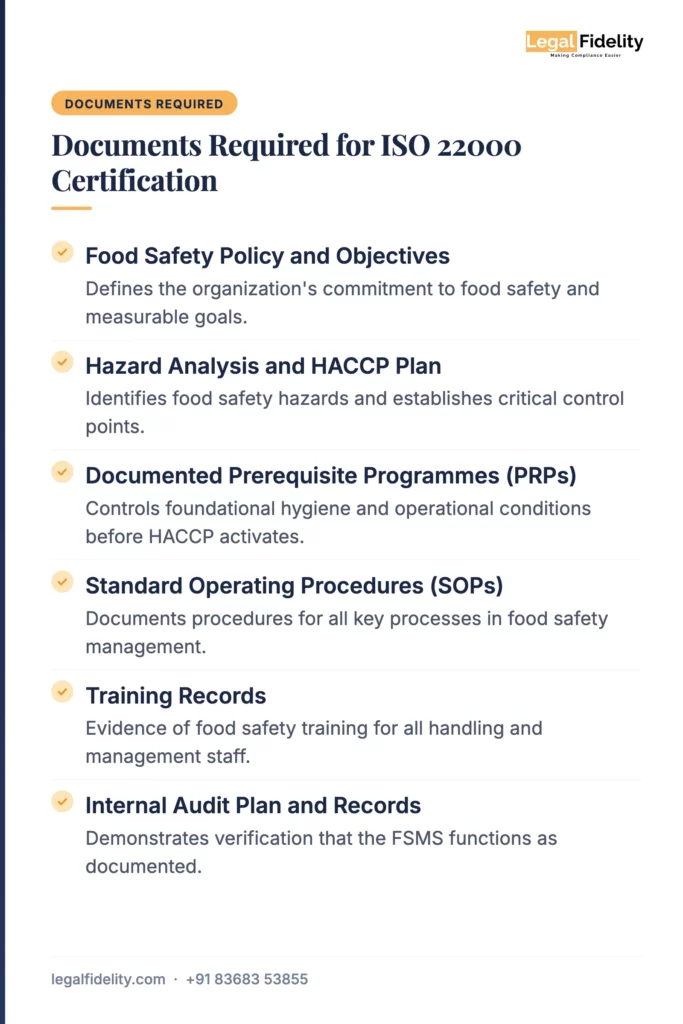
Documents Required for ISO 22000 Certification
The following documents are typically required or must be created during implementation:
- Food safety policy and objectives
- Scope of the FSMS (what products, processes, and sites are covered)
- Documented prerequisite programmes (PRPs) for each applicable area
- Hazard analysis and HACCP plan
- Standard Operating Procedures (SOPs) for all key processes
- Records of monitoring activities at CCPs and OPRPs
- Internal audit plan and records
- Management review records
- Corrective action and nonconformance records
- Calibration and equipment maintenance records
- Training records for all food handling and management staff
- Allergen management procedure
- Food defence and fraud vulnerability assessment
ISO 22000 Certification Process in India
The certification process follows six stages, from initial assessment through to certificate issuance. Total elapsed time ranges from 3 to 6 months, depending on the size of your organisation and how prepared your food safety system is at the start.
Step 1 – Gap Analysis
A qualified consultant or internal team reviews your existing food safety practices against ISO 22000:2018 requirements. This identifies what is already in place, what needs to be built from scratch, and what needs to be upgraded. The gap analysis output becomes the implementation project plan.
Step 2 – Documentation
This is the most time-intensive stage for most organisations. You develop or update all the documents listed in the requirements section: the food safety policy, HACCP plan, SOPs, PRP documentation, and records templates. Good documentation must reflect what you actually do, not what you wish you did.
Step 3 – Implementation and Training
With documents ready, you implement the new procedures on the production floor and provide training to all relevant staff. This stage typically takes 4 to 8 weeks. The system must run for at least one full cycle before the internal audit, so implementation must begin well before you schedule the certification audit.
Step 4 – Internal Audit
An internal audit checks whether the FSMS is functioning as documented. The internal auditor must be trained and independent of the processes being audited. Any nonconformities found must be corrected and evidence of correction must be recorded before the certification body audit.
Step 5 – Certification Body Audit (Stage 1 and Stage 2)
The certification audit happens in two stages, and this distinction is something many first-time applicants don’t expect. Stage 1 is a documentation review: the auditor checks whether your FSMS documentation meets the standard and whether your organisation is ready for Stage 2. Stage 2 is the on-site audit where the auditor verifies that documented procedures are actually being followed on the ground. Major nonconformities found during Stage 2 must be resolved before the certificate is issued.
Step 6 – Certificate Issuance
Once all nonconformities are closed, the certification body issues the ISO 22000 certificate. The certificate is valid for three years. Annual surveillance audits are conducted in years one and two, and a full recertification audit is required in year three.
ISO 22000 Certification Cost in India
ISO 22000 certification costs in India have two components: consultancy fees and certification body fees. The two are separate, and comparing quotes requires clarity on what each covers.
Businesses that qualify as MSMEs under the Udyam classification can access subsidies under the Ministry of Food Processing Industries (MoFPI) scheme for adopting HACCP and ISO 22000 systems. Udyam-registered businesses should check their MoFPI eligibility before paying full rates, as government reimbursements can cover 50% of certification costs for eligible units.
ISO 22000 Certification Timeline
| Stage | Typical Duration |
|---|---|
| Gap analysis | 1 – 2 weeks |
| Documentation development | 4 – 8 weeks |
| Implementation and training | 4 – 8 weeks |
| Internal audit and corrections | 1 – 2 weeks |
| Stage 1 audit (documentation review) | 1 – 3 days |
| Stage 2 audit (on-site) | 2 – 5 days |
| Nonconformity resolution | 2 – 4 weeks |
| Certificate issuance | 1 – 2 weeks |
| Total elapsed time | 3 to 6 months |
Organisations that have an existing quality management system (such as ISO 9001) or an FSSAI-compliant FSMS already in place typically complete the process in the lower end of this range.
ISO 22000 vs FSSC 22000 vs FSSAI
These three frameworks are frequently confused. They serve different purposes and are not interchangeable.
| Feature | FSSAI Licence | ISO 22000 | FSSC 22000 |
|---|---|---|---|
| Type | Mandatory Indian legal licence | Voluntary international standard | Voluntary GFSI-recognised scheme |
| Issued by | Food Safety and Standards Authority of India | Accredited certification bodies | FSSC Foundation (Netherlands) |
| Geographic recognition | India only | Global (160+ countries) | Global, preferred by major retailers |
| Required for | Any food business operating in India | Export, retail, institutional buyers | GFSI-recognised markets, top-tier retail |
| Includes HACCP | Partially | Yes, fully | Yes, with additional requirements |
| Cost | Rs. 2,000 – Rs. 7,500 (licence fee) | Rs. 80,000 – Rs. 3,00,000+ | Higher than ISO 22000 |
FSSC 22000 is built on ISO 22000 and adds sector-specific requirements recognised by the Global Food Safety Initiative (GFSI). If your target markets or retail buyers specifically require GFSI recognition, you will need FSSC 22000 rather than ISO 22000 alone. For most Indian food exporters and domestic food businesses, ISO 22000 is the right starting point.
Validity and Renewal of ISO 22000 Certification
An ISO 22000 certificate is valid for three years from the date of issue. The certification cycle includes:
- Year 1 surveillance audit: Verifies that the FSMS continues to function effectively
- Year 2 surveillance audit: Same purpose; may include a deeper review of certain clauses
- Year 3 recertification audit: A full re-audit, similar in scope to the original Stage 2
Failing to complete surveillance audits on time can lead to certificate suspension. Renewal costs are typically 50 to 70 percent of the initial certification cost, as the recertification audit is shorter than the original.
Why Choose LegalFidelity for ISO 22000 Certification?
LegalFidelity connects food businesses with experienced food safety consultants and accredited certification bodies across India. With over 100,000 satisfied clients and a 4.8-star rating, we handle the documentation, gap analysis, audit preparation, and certification body coordination so you can focus on running your business.
Our ISO 22000 service includes end-to-end support: from the initial gap analysis and HACCP plan development through to certificate issuance. There are no hidden charges. Our pricing is transparent, with consultancy and certification fees quoted separately so you know exactly what you are paying for.
Call or WhatsApp our team at +918368353855, or reach us at legalfidelity.com/contact-us. We work Monday to Saturday, 10 AM to 6 PM.
Conclusion
ISO 22000 certification gives Indian food businesses the internationally recognised food safety management system they need to access export markets, satisfy major retail buyers, and build consumer trust. The process takes 3 to 6 months, involves six structured stages from gap analysis to certificate issuance, and costs vary by business size with MSME subsidies available through MoFPI. Working with experienced consultants significantly reduces the time and effort required to reach certification-ready status.