








Patent Registration in India
Table of Contents
Patent registration in India is the formal procedure of protecting an invention — a novel product, process, or technology. After a patent is registered, the inventor gains the exclusive right to use, produce, or market the invention for a specified period, typically 20 years. This means no one else can use the invention without consent.
What is a Patent?
A patent is a legal right granted by the Indian government to secure an invention that introduces a new method, product, or technical solution to a problem. According to Section 2(1)(j) of The Patents Act, 1970, a patent covers an invention that is new, has an inventive step, and can be applied to industry. The invention must be novel, demonstrate a new improvement or feature beyond what is already known, and be useful in any industry.
Benefits of Patent Registration in India
Exclusive Ownership Rights: A patent gives its owner the legal right to make, use, sell, or distribute the invention for 20 years and to control its commercial use.
Better Brand Image and Investor Confidence: Patents increase credibility and signal that the company is innovation-focused and growth-oriented, which builds trust with investors and partners.
Licensing and Royalty Income: Patent owners can license their invention to others and collect royalties or fees, generating revenue without producing the product themselves.
Legal Protection Against Competitors: Once patented, no other company or individual can reproduce or use the invention without authorization, giving the inventor a competitive advantage in the market.
International Protection through PCT: Through the Patent Cooperation Treaty (PCT), inventors can seek protection in multiple countries by submitting a single application, expanding their market reach.
Government Support to Startups: Startups recognized by DPIIT under Startup India receive up to 80% rebate on patent registration fees, and their applications may be expedited, making the process faster and more affordable.
Eligibility Criteria for Patent Registration
- Individual Inventors: Any person who invents something new and original can apply for a patent in their name.
- Startups and Companies: Businesses that create new processes or products are eligible to apply.
- Government Bodies or Research Institutions: Government organizations involved in scientific research can register inventions.
- Foreign Applicants: Non-residents may apply through a national application or through the PCT system to secure their inventions in India.
What Qualifies as an Invention
- Novelty: The invention must be new and not previously disclosed.
- Inventive Step (Non-obviousness): It must represent a technical improvement and must not be an obvious variation.
- Industrial Applicability: It must be practically useful and capable of being made or used in industry.
What Can and Cannot Be Patented in India
Patentable Inventions
- New products or processes that introduce a technical improvement or practical solution to a problem.
- Enhanced versions of existing technologies that increase performance, efficiency, or functionality.
- A combination of software and hardware that executes a technical service or addresses a technical problem.
- New chemical compounds and innovative manufacturing methods with industrial applications.
- Biotechnology inventions, including novel microorganisms generated through human manipulation, for use in pharmaceuticals or agriculture.
Examples:
- A camera stabilization system that improves photo quality on a mobile phone.
- Energy-efficient machinery designed for industrial use.
Non-Patentable Inventions
- Discoveries and Abstract Theories: Natural discoveries, scientific principles, or mathematical models (e.g., E = mc²) cannot be patented.
- Computer Programs and Algorithms: Pure software or algorithms not combined with hardware and not serving a technical purpose.
- Traditional Knowledge and Natural Properties: Inventions based on common natural applications or traditional knowledge, such as the healing properties of turmeric.
- Agricultural and Atomic Energy Inventions: No invention based on agriculture or atomic energy can be patented under Indian law.
Types of Patent Registration Applications in India
Ordinary Patent Application
Filed when the invention is fully developed and does not claim priority over any prior application. It contains the full specification and is submitted directly for examination and grant.
Provisional Patent Application
Filed when the invention is still in development but the inventor wants to establish an early filing date. After filing, the applicant has 12 months to submit the full specification, giving time to perfect the invention without losing priority.
Complete Specification
An application that includes full technical information, claims, and a description of the invention. It is typically filed following a provisional application or directly when the invention is already developed.
Convention Application
When an inventor has filed a patent in a convention country, they can file in India within 12 months to claim priority from the earlier application, securing protection in India from the original filing date.
PCT (International) Application
Filed under the Patent Cooperation Treaty, this enables inventors to apply in multiple countries using a single international application, simplifying the path to global protection.
Divisional Application
When a single patent application covers more than one invention, it may be divided into individual applications. Each invention is then examined separately.
Patent of Addition
Filed to secure additions or enhancements to an earlier patented invention by the same applicant. It does not require a separate renewal fee and remains valid as long as the main patent is in force.
Documents Required for Patent Registration in India
- Application Form (Form 1): The primary filing form containing the applicant’s name, address, nationality, and the type of application (ordinary, convention, PCT, etc.).
- Proof of Right to Apply (if applicable): If the inventor is not the applicant (e.g., a company owns the invention), proof of assignment or a declaration demonstrating the right to file the patent.
- Drawings and Diagrams: If the invention has technical or structural aspects, illustrative drawings or diagrams must be included to clarify the invention for the examiner.
- Declaration of Inventorship (Form 5): States the real names of the inventors. Must be filed together with the full specification or within one month of its filing.
- Authorization of Patent Agent (Form 26): If filing through a registered patent agent, this form allows the agent to represent the applicant before the patent office.
- Statement and Undertaking (Form 3): Applicants must declare whether they have filed patent applications on the same invention in other countries and agree to inform the Controller of any changes.
- Fee Receipt: Proof of payment of the prescribed filing fees.
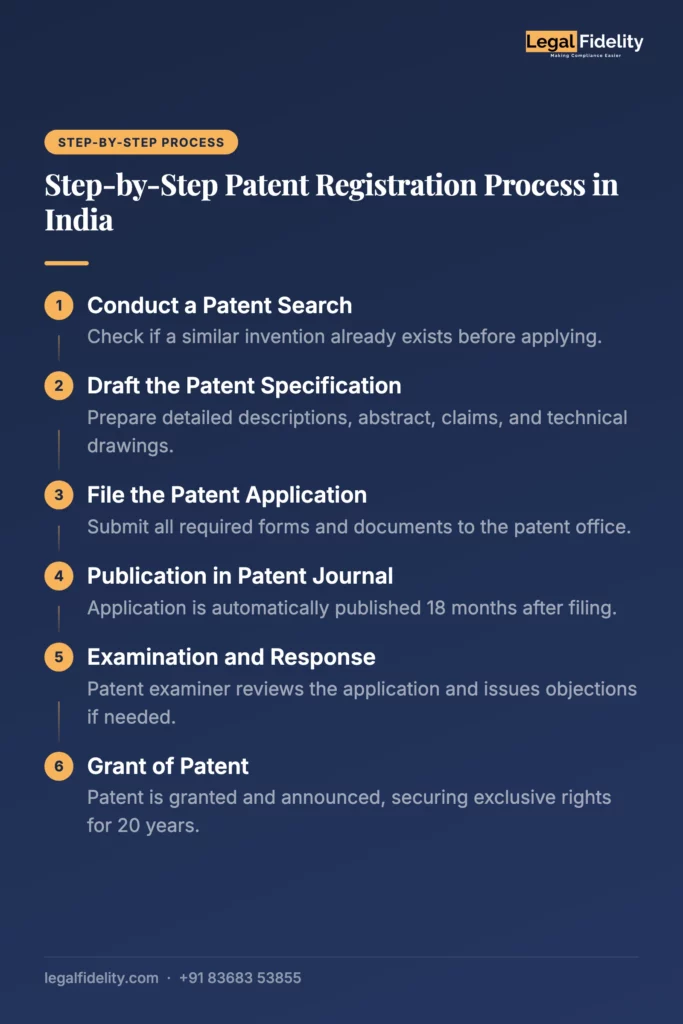
Step-by-Step Patent Registration Process in India
Step 1: Conduct a Patent Search
Carry out a patent search before applying to check whether a similar invention already exists. This prevents duplication and saves time during registration.
Step 2: Draft the Patent Specification
Prepare the patent specification, which describes the invention in detail.
- A provisional specification may be submitted for inventions still in development, securing an early priority date.
- A complete specification is required when the invention is fully developed. It includes:
- Abstract: A brief summary of the invention.
- Description: How the invention works.
- Claims: Legal statements that define the scope of protection.
- Drawings: Technical illustrations, if applicable.
Step 3: File the Patent Application
Submit the patent application with all required forms and documents to begin the official process.
Step 4: Publication of the Application
The application is automatically published in the Patent Journal 18 months after the filing date. Applicants may request early publication to accelerate the process.
Step 5: Examination of the Application
Upon filing a request for examination, the patent office reviews the application. A Patent Examiner prepares a First Examination Report (FER) listing any objections. The applicant has 6 months to respond and resolve the objections.
Step 6: Patent Opposition
Third parties can challenge the application through:
- Pre-grant opposition: Filed before the patent is granted.
- Post-grant opposition: Filed within one year after the grant.
Oppositions may be based on lack of novelty, obviousness, or wrongful ownership. The applicant must respond and may be called for a hearing.
Step 7: Grant of Patent
Once all objections and oppositions are resolved, the Controller grants the patent and announces it in the Patent Journal. The patentee then holds the sole right to use, license, or sell the invention for a 20-year period.
Patent Renewal and Restoration in India
Validity of a Patent
Under the Patents Act, 1970, a patent expires 20 years from its filing date. The owner must pay annual renewal fees to maintain protection.
Renewal Fee Schedule
Renewal fees are due from the third year of the patent and for each succeeding year. Fees may be paid annually or in advance for up to five years.
Late Payment and Restoration
If the renewal fee is not paid on time, the patent lapses and legal protection ends. The patent may be restored within 18 months of the lapse date by submitting Form 15 along with the prescribed fee and sufficient reasons for the delay. Many patent holders use reminder systems to avoid missing deadlines.
Patent Opposition and Infringement in India
The opposition and infringement framework is governed by the Patents Act, 1970, ensuring that only valid inventions are protected and that patent rights are not abused.
Patent Opposition
- Pre-grant opposition may be filed before the patent is granted.
- Post-grant opposition may be filed within one year of the grant.
Patent Infringement
Infringement occurs when someone makes, uses, sells, distributes, or imports a patented product or process without the patent owner’s consent, including importing a patented product into India without permission.
Legal Remedies for Infringement
- Civil remedies: Injunctions to stop the infringement, compensation or damages, and recovery of profits.
- Criminal remedies: Available in cases of willful infringement.
Defenses and Dispute Resolution
The accused may defend by proving that the patent is invalid or that their use falls under a legal exception, such as research or experimental use. Disputes are often resolved through licensing, negotiation, or mediation to avoid court proceedings.
Cost of Patent Registration in India
Government Filing Fees
| Applicant Type | Provisional Filing | Complete Filing |
|---|---|---|
| Individual / Startup | Rs. 1,600 – Rs. 1,750 | Rs. 4,000 – Rs. 4,400 |
| Small Entity | Rs. 4,000 – Rs. 4,400 | Rs. 10,000 – Rs. 11,000 |
| Large Company | Rs. 8,000 – Rs. 8,800 | Rs. 20,000 – Rs. 22,000 |
Professional and Drafting Charges
Professional services including specification preparation, claims drafting, and legal formalities typically cost Rs. 10,000 to Rs. 75,000 depending on the complexity of the invention and the number of drawings and claims.
PCT and Renewal Costs
- International Filings (PCT Route): Additional charges of Rs. 2 lakh or more depending on the number of countries selected.
- Annual Renewal Fee: Rs. 800 to Rs. 8,000 per year based on the year of renewal and type of applicant.
Difference Between Patent, Copyright, and Trademark in India
| Feature | Patent | Trademark | Copyright |
|---|---|---|---|
| Purpose | Protects inventions and technical innovation | Protects brand names, logos, symbols | Protects creative works such as music, books, art |
| Law Governing | Patents Act, 1970 | Trademarks Act, 1999 | Copyright Act, 1957 |
| Validity | 20 years from the date of filing | 10 years, renewable indefinitely | Lifetime of the author + 60 years |
| Territorial Scope | Country-specific (extendable via PCT) | Country-specific | Country-specific |
| Registration Required? | Yes (mandatory) | Yes (for greater protection) | Not mandatory but recommended |
| Examples | Machine, process, drug formula | Nike logo, Apple name | Song, film, software code |
How LegalFidelity Can Help You Register a Patent
- Step-by-Step Guidance: LegalFidelity guides you through every stage of the patent process, from filing to grant.
- Professional Drafting and Filing: Expert professionals draft specifications correctly to maximize protection.
- Affordable Packages: Transparent pricing packages designed for individuals, startups, and companies.
- Confidentiality Assured: Your invention information is completely secure with LegalFidelity.
- End-to-End Compliance: Support for renewals, objections, oppositions, and all post-filing legal matters.
Conclusion
Patent registration safeguards your invention and builds market credibility, fundability, and global recognition. With LegalFidelity, you get expert support to secure your patent and stay focused on innovation.