







ISO 13485 Certification in India
Table of Contents
What is ISO 13485 certification?
ISO 13485 is a standard published by the International Organization for Standardization (ISO) that sets out requirements for a Quality Management System (QMS) specific to medical devices. The current version, ISO 13485:2016, replaced the 2003 edition and introduced stronger requirements around risk management, regulatory compliance, and supply chain control.
Unlike ISO 9001, which is built around customer satisfaction and continuous improvement, ISO 13485 is built around regulatory compliance. It was deliberately designed to align with medical device regulations in the European Union, the United States, Canada, and Australia, making it the standard regulators actually reference when reviewing device submissions.
One detail that catches companies off guard: ISO 13485 does not require continuous improvement the way ISO 9001 does. Instead, it demands that your QMS stay consistently effective and that deviations get corrected. That is a subtle but important distinction. In a regulated environment, predictable and documented beats improved but inconsistent.
Who needs ISO 13485 certification in India?
ISO 13485 applies to any organisation in the medical device lifecycle, not just manufacturers. Where your business sits in that chain determines the scope and urgency of certification.
Medical device manufacturers
Manufacturers of Class A, B, C, and D medical devices under India’s Medical Devices Rules, 2017 are the primary target audience. For Class A and B devices, ISO 13485 certification is not always a statutory requirement, but holding it substantially simplifies CDSCO’s Form MD-7 and Form MD-14 applications and reduces back-and-forth with the regulator. For Class C and D devices, a valid ISO 13485 certificate from a NABL-accredited or IAF-member certification body is typically required as part of the regulatory submission.
Importers and distributors
Foreign device manufacturers registering products in India through CDSCO must submit a notarised and apostilled copy of their ISO 13485 certificate covering both the legal and actual manufacturing sites. Indian importers who facilitate this process need to understand the certification’s scope to avoid holding up their clients’ registration timelines.
Contract manufacturers and suppliers
In our work with medical device clients, contract manufacturers are the group most likely to underestimate their certification obligations. If you supply components, sterilisation services, or labelling to a device manufacturer, your customers may require you to hold ISO 13485 certification outright, or at minimum to operate under a supplier quality agreement that references the standard. Either way, the documentation burden is real.
Key requirements of ISO 13485:2016
ISO 13485:2016 mandates ten documented procedures beyond what ISO 9001 requires. These cover the processes most directly connected to device safety and performance.
The ten mandatory procedure areas are:
- Design and development controls (unless explicitly excluded)
- Purchasing and supplier evaluation
- Sterilisation process validation (for sterile devices)
- Identification and traceability throughout production
- Corrective and Preventive Action (CAPA)
- Internal audit programme
- Customer complaint handling
- Management review
- Control of nonconforming product
- Post-market surveillance data analysis
Risk management runs through all of these. ISO 13485 requires that risk be managed according to ISO 14971, the companion standard for medical device risk management. Every product design decision, manufacturing process, and supply choice must be evaluated for its potential risk to patient safety, and that evaluation must be documented.
Benefits of ISO 13485 certification
The EU (under MDR 2017/745), Canada (under MDSAP), and Australia (under TGA) all require or strongly prefer ISO 13485 as the baseline quality credential for medical device imports. Without it, Indian manufacturers cannot legally supply these markets regardless of actual product quality. That is not a compliance detail. It is a market access question.
| Benefit | What it means in practice |
|---|---|
| Global market access | Accepted by EU, US FDA, Health Canada, TGA Australia |
| CDSCO compliance support | Supports Form MD-7 and MD-14 submissions |
| Fewer product recalls | CAPA and nonconformance controls catch problems earlier |
| Customer confidence | Quality credential that B2B buyers can verify independently |
| Procurement eligibility | Required for many hospital and government tender bids |
| Reduced liability exposure | Documented QMS limits legal exposure when incidents occur |
Hospital procurement teams and large distributors across India now routinely check for ISO 13485 before signing supply agreements. That shift has happened steadily over the past five years.
ISO 13485 certification process in India
The certification process follows a defined sequence. Skipping or rushing any stage, particularly implementation, tends to produce audit findings that push the certificate date back further than the time saved.
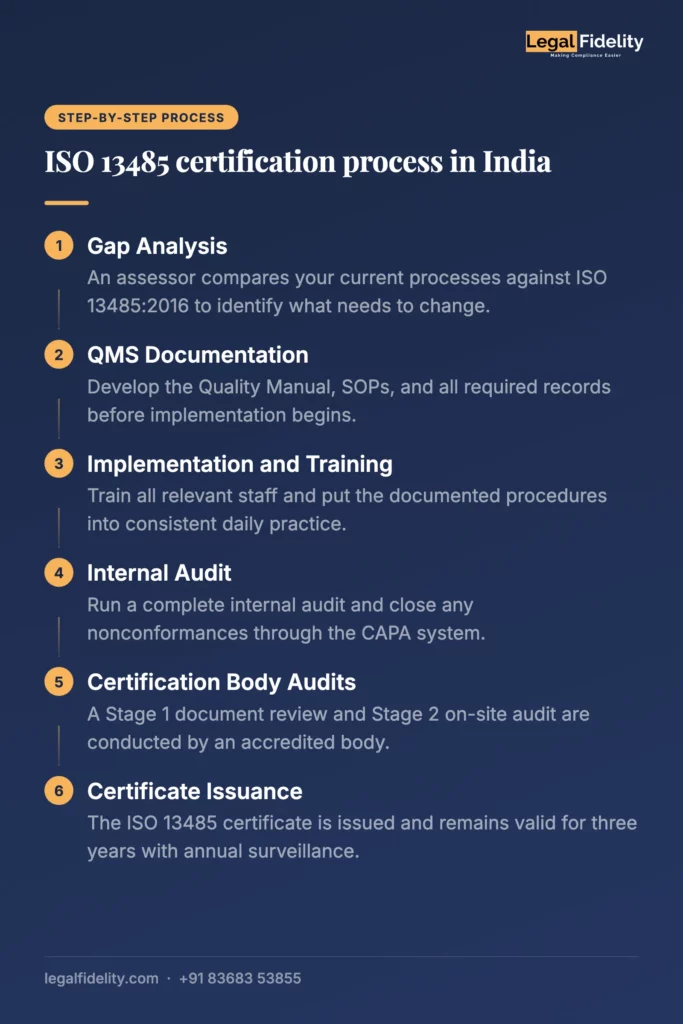
Step 1: Gap analysis
A qualified consultant or certification body assessor reviews your existing processes, documentation, and infrastructure against ISO 13485:2016 requirements. The output is a gap analysis report identifying what needs to be built, changed, or retired. Most Indian medical device companies at this stage find undocumented processes that are largely compliant in practice but have no paper trail.
Step 2: QMS documentation
Based on the gap analysis, your team develops or revises the Quality Manual, Standard Operating Procedures (SOPs), work instructions, and associated forms. This is the most time-consuming phase for first-time ISO 13485 applicants. All documentation must be version-controlled, reviewed, and formally approved before implementation starts.
Step 3: Implementation and training
We have seen it repeatedly: documentation quality gets you through Stage 1, but implementation quality is what the Stage 2 auditor is actually there to verify. Every employee whose role touches the QMS must be trained on the new procedures, and training records must be kept. Process owners need to understand not just what to do, but why each control was put in place. Auditors can tell the difference.
Step 4: Internal audit
Before bringing in the certification body, you must complete at least one full internal audit cycle. The internal audit checks whether the QMS as implemented actually conforms to ISO 13485 requirements. Any nonconformances must be addressed through the CAPA system before you proceed.
Step 5: Stage 1 audit (documentation review)
The certification body reviews your QMS documentation at a desk level. They confirm that the documented system covers all ISO 13485 requirements and that your organisation is ready for the on-site audit. Stage 1 findings are typically minor and give you time to correct gaps before Stage 2 begins.
Step 6: Stage 2 audit (certification audit)
This is the on-site audit. The certification body evaluates whether the documented QMS is actually in use across your facility. Auditors interview employees, observe processes, pull records, and test whether controls work as described. Nonconformances must be closed with supporting evidence before the certificate is issued.
Step 7: Certificate issuance
Once all audit findings are resolved, the certification body issues the ISO 13485 certificate. It is valid for three years, with annual surveillance audits in years one and two. A recertification audit at the end of year three is required to maintain the certificate.
Documents required for ISO 13485 certification
Getting documentation ready before the Stage 1 audit reduces both the audit duration and the fees charged. The table below lists the categories certification bodies typically review.
| Document category | What it covers |
|---|---|
| Quality Manual | Scope of QMS, exclusions, policy statements |
| Device Master File (DMF) | Device description, specifications, drawings |
| Plant Master File (PMF) | Facility layout, equipment list, production processes |
| SOPs and work instructions | Procedure documents for all QMS processes |
| Risk Management File | ISO 14971 risk assessment for each device |
| Design and development records | Design inputs, outputs, verification, validation |
| Supplier qualification records | Supplier evaluations, approved supplier list |
| Calibration and maintenance records | Equipment calibration schedule and historical records |
| Internal audit reports | Audit schedule, findings, CAPA records |
| Management review minutes | Annual QMS performance review |
| Training records | Employee training completion and competency evidence |
ISO 13485 certification cost in India
Certification cost depends on company size, number of employees, product complexity, number of production sites, and the certification body selected. There is no fixed government fee. Prices are set by each accredited certification body.
Timeline for ISO 13485 certification
Most Indian organisations move from gap analysis to certificate issuance in 6 to 12 months.
| Stage | Typical duration |
|---|---|
| Gap analysis | 1-2 weeks |
| QMS documentation | 4-12 weeks |
| Implementation | 4-8 weeks |
| Internal audit | 1-2 weeks |
| Stage 1 audit | 1 day to 1 week |
| Stage 2 audit | 1-3 days |
| Certificate issuance | 2-4 weeks after Stage 2 closure |
Smaller organisations with straightforward product lines can finish in 4-6 months. Larger manufacturers with multiple product lines or multi-site operations typically take 10-14 months. The most common cause of delay is not documentation. It is implementation: the procedures exist but are not yet consistently followed on the production floor when the Stage 2 auditor walks in.
ISO 13485 vs ISO 9001: key differences
Many Indian businesses already hold ISO 9001 certification and want to know whether they also need ISO 13485. For medical device companies, the answer is yes.
| Dimension | ISO 9001:2015 | ISO 13485:2016 |
|---|---|---|
| Focus | Customer satisfaction | Regulatory compliance |
| Continuous improvement | Required | Not explicitly required |
| Risk management | General risk thinking | Mandatory ISO 14971 risk management |
| Design controls | Recommended | Mandatory (with limited exclusions) |
| Sterile device requirements | Not applicable | Sterilisation validation required |
| Regulatory alignment | General | Medical device regulations specifically |
| Post-market surveillance | Not required | Required |
ISO 9001 alone is not accepted by CDSCO for Class C or D submissions, and it does not satisfy EU MDR or US FDA quality system requirements for device manufacturers. Both certifications can be held at the same time, and many manufacturers do hold both. LegalFidelity also supports businesses pursuing ISO 14001 environmental management and ISO 45001 occupational health and safety certifications alongside ISO 13485.
Consequences of non-compliance
Operating in the medical device sector without appropriate quality system compliance carries serious consequences under India’s Medical Devices Rules, 2017 and the Drugs and Cosmetics Act, 1940.
Specific risks:
- CDSCO rejection of registration applications for Class C and D devices
- Suspension or cancellation of existing manufacturing licences
- Detention of imported devices at port of entry
- Product recalls ordered by CDSCO
- Civil and criminal liability under the Drugs and Cosmetics Act for substandard or adulterated devices
- Exclusion from government procurement tenders that require ISO certification
The regulatory penalties are real, but the commercial fallout from a product recall in medical devices tends to outlast the regulatory action by years. Hospitals and distributors rarely return to suppliers after a recall, even when corrective action was prompt and thorough. Getting the QMS right before the audit is cheaper, by a wide margin, than managing a single major nonconformance after a product has reached the market.
Why LegalFidelity for ISO 13485 certification?
LegalFidelity has helped over 100,000 businesses navigate legal and compliance processes across India. Our network includes quality management professionals with direct experience in medical device QMS implementation, CDSCO submissions, and ISO certification audits.
We handle:
- Gap analysis, QMS documentation (Quality Manual, SOPs, Device Master File, risk management files)
- Internal audit support before Stage 1
- Coordination with NABL-accredited certification bodies
- Post-certification support for surveillance audits and CDSCO filings
- Transparent pricing, no hidden fees
If you are preparing for your first CDSCO Class B registration or entering EU markets for the first time, our team builds the process around your timeline. Call or WhatsApp us at +918368353855 or use the contact form at legalfidelity.com/contact-us.
Conclusion
ISO 13485 certification is the quality credential that medical device businesses in India need to operate with confidence across both domestic and international markets. It satisfies CDSCO regulatory expectations, opens access to the EU, US, Canada, and Australia, and gives hospital procurement teams and distributors a verifiable signal that your quality processes are taken seriously. Starting the process before you need the certificate, not after, is what separates companies that enter new markets on schedule from those that scramble to catch up.