








ISO 45001 Certification in India: Process, Documents, Benefits, Cost, Timeline
Table of Contents
What Is ISO 45001 Certification?
ISO 45001:2018 Certification is the international standard that defines requirements for an Occupational Health and Safety Management System. Published by the International Organization for Standardization (ISO) in March 2018, it replaced the older OHSAS 18001 Certification standard. The standard follows a Plan-Do-Check-Act (PDCA) cycle, meaning organisations don’t just set up safety systems, they continuously measure and improve them.
ISO Certification is issued by an accredited third-party certification body, not by ISO itself. In India, the National Accreditation Board for Certification Bodies (NABCB) accredits these bodies under ISO/IEC 17021. Choosing a NABCB-accredited certifier gives your certificate international recognition.
ISO 45001 vs. OHSAS 18001: What Changed?
OHSAS 18001 was the earlier occupational safety standard, widely adopted from 1999 onward. ISO 45001:2018 goes further: it requires top management to be directly accountable, brings in worker participation as a mandatory element, and uses a risk-based framework. OHSAS 18001 certificates expired globally by March 2021, so any business still referencing OHSAS 18001 is operating without a valid certification.
Who Needs ISO 45001 Certification?
Any organisation from a five-person startup to a multinational can pursue ISO 45001 certification. The standard is sector-neutral, meaning it applies equally across industries. That said, it is especially critical for businesses where the risk of physical harm to workers is high.
In our work with clients across India, we’ve found that businesses seeking government contracts, export orders, or investment from large enterprises are increasingly asked to show ISO 45001 certification as a prerequisite. It’s no longer just a “nice to have.”
Industries Where ISO 45001 Is Especially Critical
Construction, manufacturing, mining, oil and gas, chemicals, transportation, and healthcare sit at the top of the list. Factories regulated under the Factories Act, 1948, and establishments covered by the Building and Other Construction Workers Act, 1996, often find that ISO 45001 aligns directly with their existing legal obligations. Retail, IT, and financial services companies also pursue it to meet client and tender requirements.
Key Benefits of ISO 45001 Certification
ISO 45001 delivers measurable outcomes, not just paperwork. Organisations typically see a reduction in workplace injuries and lost workdays after implementation. Fewer incidents mean lower costs, because workplace accidents lead to medical expenses, legal liability, compensation claims, and lost productivity.
According to the International Labour Organization (ILO), India reports approximately 48,000 fatal workplace accidents each year. A structured OHSMS has been shown to reduce incident rates by 20–40% within the first year of implementation, based on global certification body data.
Business Benefits Beyond Workplace Safety
ISO 45001 certification improves your standing with customers, insurers, and investors. Many large-scale procurement processes especially in defence, infrastructure, and export markets require suppliers to hold ISO 45001. Insurance premiums for employee health and liability often decrease after certification, as insurers recognise the reduced risk profile. Employee morale and retention also improve when workers see that safety is taken seriously.
ISO 45001 Certification Requirements
To get certified, your organisation must establish, implement, maintain, and continually improve an OHSMS that meets the requirements laid out in ISO 45001:2018. The standard is structured around ten clauses, from context of the organisation (Clause 4) through to improvement (Clause 10).
Core Elements of an OHSMS Under ISO 45001
The OHSMS must address leadership and worker participation, hazard identification and risk assessment, legal and regulatory compliance, operational controls, emergency preparedness, monitoring and measurement, internal audit, management review, and corrective actions. Top management cannot delegate accountability, they must be personally involved in setting safety policy and reviewing performance.
Documents Required for ISO 45001 Certification
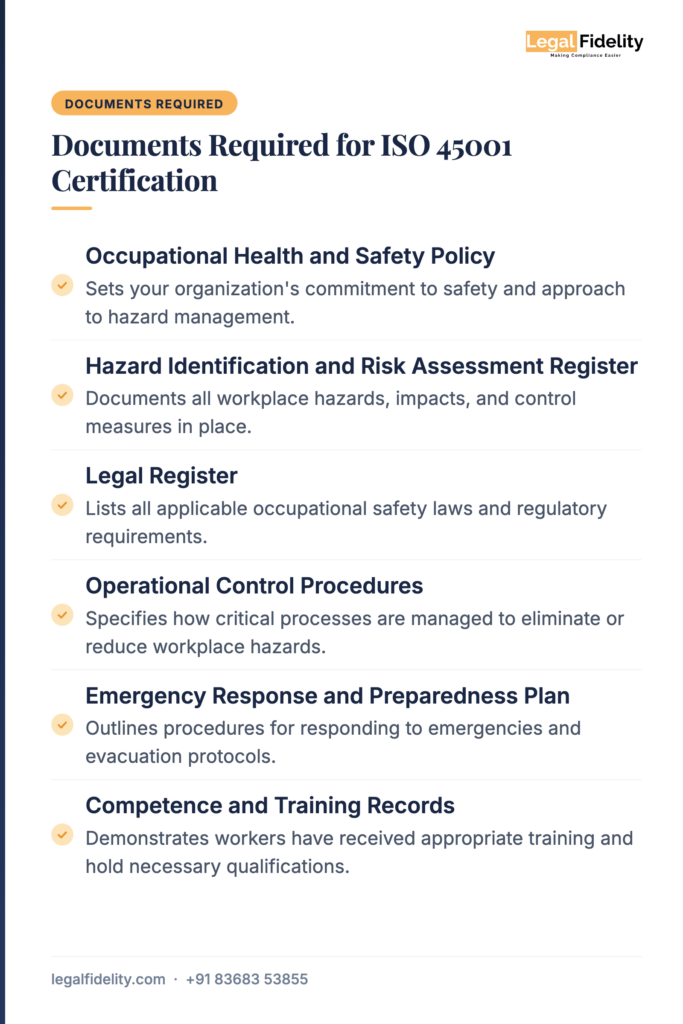
ISO 45001 requires specific documented information. Having these ready before the audit speeds up the process significantly.
Mandatory documents:
- Occupational Health and Safety (OHS) Policy
- OHS objectives and plans to achieve them
- Hazard identification and risk assessment register
- Legal register (list of applicable safety laws and regulations)
- Operational control procedures
- Emergency response and preparedness plan
- Competence and training records
- Communication and consultation records
- Internal audit programme and audit reports
- Management review minutes
- Incident investigation records
- Corrective action logs
- Monitoring and measurement records
Some certification bodies may ask for additional documents depending on your industry or the complexity of your operations.
ISO 45001 Certification Process in India
The certification process follows a structured path from gap analysis to certificate issuance. Here is how it works, step by step.
Step 1 – Gap Analysis
A consultant or internal team reviews your current safety practices against all ISO 45001 requirements. This identifies what’s already in place and what needs to be built or improved. A gap analysis saves time and prevents surprises during the formal audit.
Step 2 – Planning and System Design
Based on the gap analysis findings, your organisation designs or upgrades its OHSMS. This includes defining the scope of the system, identifying all hazards in your workplace, assessing risks, and setting measurable OHS objectives.
Step 3 – Documentation
All required policies, procedures, work instructions, and records are created or updated. Documentation must be proportionate to the complexity of your operations — a 20-person workshop doesn’t need the same volume of paperwork as a 500-person factory.
Step 4 – Implementation and Training
The documented system is put into practice across all relevant functions and levels. Workers are trained on the OHS policy, hazard controls, emergency procedures, and their individual responsibilities. Management demonstrates visible commitment.
Step 5 – Internal Audit
Before the external audit, a qualified internal auditor reviews the OHSMS to check that it’s working as designed. Nonconformities found here are corrected internally — this is far preferable to having the external auditor find them.
Step 6 – Management Review
Top management reviews the OHSMS performance using data from monitoring, incidents, audits, and legal compliance checks. This review produces decisions and actions that feed back into the system.
Step 7 – Stage 1 Audit (Documentation Review)
The accredited certification body conducts a desk review of your documented OHSMS. The auditor checks whether your documentation meets ISO 45001 requirements and whether you’re ready for the on-site audit. Any gaps identified here are addressed before Stage 2.
Step 8 – Stage 2 Audit (On-Site Assessment)
The certifier’s auditor visits your premises to verify that the OHSMS is actually implemented — not just documented. They interview workers, observe operations, inspect records, and test emergency preparedness. This is the most thorough part of the process.
Step 9 – Certification Issued
If the Stage 2 audit confirms conformity, the certification body issues your ISO 45001:2018 certificate. The certificate is valid for three years, subject to annual surveillance audits.
ISO 45001 Certification Cost in India
ISO 45001 certification costs in India vary based on organisation size, scope complexity, current security maturity, and the certification body chosen.
Costs rise with employee headcount, number of locations, shift complexity, and industry risk level. A single-location manufacturing unit with 50 employees will cost significantly less to certify than a multi-site construction company.
ISO 45001 Certification Timeline
For most Indian SMEs, the end-to-end journey from gap analysis to certificate issuance takes 45 to 90 days. Organisations that already have documented safety procedures and some form of incident tracking can often compress the timeline. Businesses starting from scratch typically need the full 90 days or more.
| Phase | Typical Duration |
|---|---|
| Gap analysis | 3 – 7 days |
| System design and documentation | 2 – 4 weeks |
| Implementation and training | 2 – 4 weeks |
| Internal audit and management review | 1 – 2 weeks |
| Stage 1 audit (documentation review) | 1 – 3 days |
| Stage 2 audit (on-site) | 1 – 5 days (depends on size) |
| Certificate issuance | 7 – 14 days after Stage 2 |
Maintaining Your ISO 45001 Certificate: Surveillance and Renewal
ISO 45001 certification is not a one-time event. The certification body conducts surveillance audits every year during the three-year validity period to confirm the OHSMS is still functioning and improving. At the end of three years, a full recertification audit is required to renew the certificate.
Organisations that fail surveillance audits due to major nonconformities or evidence of system breakdown risk suspension or withdrawal of their certificate. Maintaining records, continuing internal audits, and addressing corrective actions promptly are the keys to passing surveillance audits without difficulty.
Consequences of Not Having an Occupational Health and Safety System
India’s workplace safety laws are backed by real penalties. The Factories Act, 1948 imposes fines and imprisonment for employers whose negligence causes injury or death to workers. The Employees’ Compensation Act, 1923 requires employers to pay compensation for work-related injuries, diseases, and fatalities — costs that can run into lakhs of rupees.
Beyond statutory liability, a serious workplace accident without a documented safety system exposes businesses to civil suits, reputational damage, and the possibility of shutdowns ordered by factory inspectors. In sectors like construction and manufacturing, accidents without proper investigation and corrective action often attract regulatory scrutiny that disrupts operations for weeks.
Why Choose LegalFidelity for ISO 45001 Certification?
LegalFidelity works with a network of 500+ qualified professionals including compliance experts familiar with ISO standards and Indian regulatory requirements. We handle the end-to-end process: gap analysis, documentation, audit coordination, and follow-up so your team can keep operations running while we manage the certification path.
We’ve helped businesses across manufacturing, healthcare, and IT services achieve ISO 45001 certification without operational disruption. Our transparent pricing means no surprise invoices mid-process. With 1,00,000+ satisfied clients and a 4.8/5 star rating, LegalFidelity is the partner Indian SMEs trust for ISO certification.
Conclusion
ISO 45001 Certification gives your organisation a structured, internationally recognised framework for managing workplace health and safety. It reduces accidents, lowers liability exposure, satisfies customer and tender requirements, and signals to every stakeholder that you take your duty of care seriously.
If you’re looking to get ISO 45001 certified in India, LegalFidelity can help. Our team of experienced professionals guides you through every step, from gap analysis and documentation to audit coordination and certificate issuance so you can focus on what matters most.