








IEC (Import Export Code) Registration
Table of Contents
Why IEC Code Registration is Required for Businesses
Any business or individual dealing with international trade must have the Import Export Code (IEC) issued by the DGFT. It is important in facilitating legal and smooth cross border transactions.
- Customs Clearance: Goods cannot be transited through customs without IEC whether importing or exporting.
- Bank Transactions: Banks require IEC to make foreign currency payments regarding imports and exports.
- Government Benefits: The government provides export promotion schemes, tax benefits, and subsidies to businesses with IEC.
- Global Credibility: The presence of an IEC provides businesses with credibility in international markets, making it easier to build trust among buyers and suppliers.
Eligibility for IEC (Import Export Code) Registration
- Individuals: Anyone who owns a business as a sole proprietor is eligible to receive an IEC.
- Partnership Firms: Firms registered under the Partnership Act are qualified.
- Limited Liability Partnerships (LLPs): Registered LLPs are eligible to apply for IEC.
- Private Limited Companies: This is the most common type of exporters and importers.
- Public Limited Companies: Large companies involved in international trade.
- Societies, Trusts, and NGOs: Non-profit organisations that engage in exports or imports.
- Government Entities and PSUs: Some departments or units of the government involved in procurement or trade.
Why IEC (Import Export Code) Registration is Important and Its Benefits
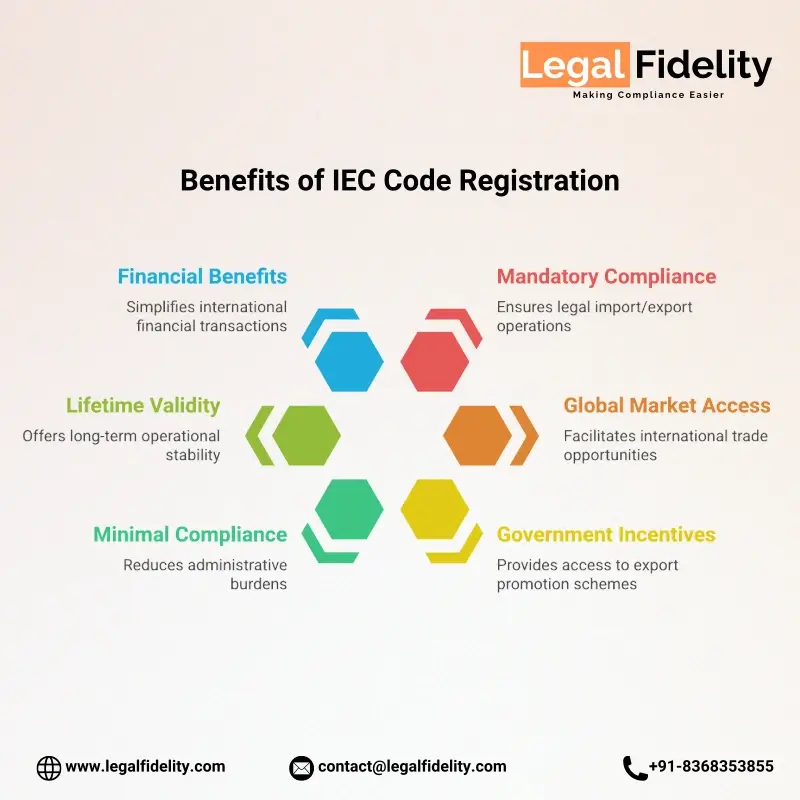
Mandatory for Import/Export
The initial compliance requirement that businesses wishing to import raw materials or export finished goods must comply with is IEC Code Registration. Without it, shipments are halted at the customs clearance point.
Global Market Expansion
IEC Code Registration serves as an access point to global trade. Through a valid IEC, businesses can reach foreign buyers and suppliers, assisting them to expand their business beyond domestic boundaries.
Availability of Government Incentives
Various export promotion schemes are provided by the Government of India including MEIS, SEIS, EPCG, and duty drawback benefits. In order to claim these incentives, an IEC Code Registration number is required.
No Regular Compliance Burden
Compared to GST or company filings, there are no monthly or annual compliance requirements with IEC. The only requirement is to verify/renew information each year on the DGFT portal.
Lifetime Validity
IEC Code Registration is valid as long as the business is running. No renewal is necessary unless business details such as Name, Address, or ownership change.
Financial and Banking Benefits
Banks require IEC Code Registration when transferring payment internationally, opening letters of credit, or during any other foreign currency transaction. This facilitates easy and safe trade.
Documents Required for IEC (Import Export Code) Registration
- PAN Card: PAN of the business entity or the proprietor is compulsory since IEC Code Registration is issued on the basis of the PAN.
- Aadhaar Card: Identity proof of the owner, partners, or directors, based on the nature of the business.
- Business Registration Proof: Partnership Deed, Incorporation Certificate, or GST Registration Certificate, where applicable, to determine the legal status of the business.
- Address Proof of Business: This may be an electricity bill, rent agreement, or property ownership of the registered business address.
- Bank Details: Cancelled cheque or bank certificate is required to confirm the bank account of the business when conducting international trades.
- Digital Signature Certificate (DSC): In the case of companies and LLPs, a DSC might be necessary to complete online authentication when applying.
Step by Step Process for IEC (Import Export Code) Registration
Step 1: Free Consultation and Eligibility Check
Our first step is a free consultation to determine whether your business can be registered for IEC. We not only explain what documents you would need in this call but also make recommendations on whether additional licences are needed when handling restricted products.
Step 2: Document Collection and Verification
Once you submit the required documents such as PAN, Aadhaar, bank information, address proof, and business registration certificate, our team carefully checks for mistakes or discrepancies and assists you in correcting them before filing.
Step 3: DSC or E-Sign Assistance
We help in obtaining or verifying a Digital Signature Certificate (DSC) or e-sign in case your entity (company or LLP) needs it. Before signing on the DGFT Portal, we ensure that the DSC functions correctly.
Step 4: Application Drafting and Filing in Form ANF 2A
We fill and process your application Form ANF 2A IEC with verified details. Each field is completed precisely according to your legal documents to prevent rejection.
Step 5: Submission and DGFT Coordination
After your application is submitted, our team monitors it within the DGFT portal. In case any questions or document rejections arise, we act immediately by re-uploading or fixing the issue. We also handle portal errors like file format errors or upload errors.
Step 6: IEC Issue and Certificates Delivery
On approval, you receive an official IEC Code Registration certificate which is downloaded immediately from the DGFT portal and mailed to you as a secure soft copy.
IEC (Import Export Code) Registration Fees and Validity
The fee for professional assistance for IEC Code Registration usually includes the preparation of documents, application submission on the DGFT portal, and complete support until your IEC is issued.
Validity (Lifetime with Annual Update)
Your IEC number is a lifetime number; no renewal is required after it has been issued. Nonetheless, according to the DGFT notification dated 2021, all IEC holders are required to verify or update their information once per year during the period between April and June. Otherwise, your IEC can be deactivated until the update is completed.
Post Registration Compliance for IEC Code Holders
1. Annual Update Requirement (Since 2021)
The DGFT requires all IEC holders to update or verify their information at least once a year, even if nothing has changed. This must be done between April and June. Failure to do so will result in the deactivation of your IEC, and it cannot be used for trade until re-updated.
2. Customs and GST Linkage
Your IEC is directly linked with Customs and GST systems, allowing the government to monitor international trade efficiently. Any mismatch in PAN or GSTIN details can cause delays in shipment clearance. Therefore, companies should maintain their GST and IEC information properly.
3. Record Keeping for Trade
IEC holders must maintain proper records of all import and export transactions, including:
- Invoices
- Shipping bills
- Customs documents
These records are necessary not only for your own business but also for audits, DGFT verification, or claiming export incentives.
Modification, Renewal and Cancellation of IEC Code
Businesses may need to update, renew, or surrender their Import Export Code (IEC) over time. These processes are simplified and completely online via the DGFT portal.
1. Updating IEC Details
In case of changes in your business, you need to revise your IEC. Common updates include:
- Change of business address
- Addition or removal of directors or partners
- Change in bank account details
- Change of ownership or company structure
2. Renewal Process
Although IEC has lifetime validity, yearly updates are mandatory from 2021. Every year, during April and June, IEC holders must verify or renew their information. Failure to update will result in deactivation of the IEC. A deactivated IEC can delay customs clearance and prevent finalizing import/export deals until reactivated.
3. Surrender or Cancellation of IEC
If you are closing your business or no longer performing import/export transactions, you can surrender your IEC:
- The surrender application can be submitted online on the DGFT portal.
- After surrender, the IEC is permanently cancelled and cannot be used in international trade.
Special Cases of IEC Code Registration
IEC is not limited to large trading firms. It is also mandatory in various other cases involving international transactions. Special cases include:
1. IEC for Service Exporters, IT and Freelancers
IT professionals, consultants, or freelancers providing services to foreign clients require an IEC to receive foreign payments. DGFT regulations also apply to service exports.
2. IEC for Manufacturers
Importers of raw materials and exporters of finished products must possess an IEC. It is essential for customs clearance and to obtain government export benefits and subsidies.
3. IEC for Non-Governmental Organizations and Charity Organizations
NGOs, societies, or charitable trusts that contribute in kind (e.g., medical supplies, equipment, or relief material) must register under IEC.
4. IEC for E-Commerce Exporters
Individuals or businesses selling goods online through platforms like Amazon Global, eBay, or Etsy require an IEC to accept payments across international borders.
In short, IEC is not limited to traditional importers and exporters. It also applies to service providers, manufacturers, NGOs, and e-commerce sellers involved in cross-border trade.
Why Choose LegalFidelity for IEC (Importer Exporter Code) Registration
- Problem-free Documentation and Filing: All of your documents are properly checked and filled in by our professional experts, minimizing the risk of rejection.
- Handling DGFT Portal Issues: The DGFT portal may contain technical faults. We handle troubleshooting, uploading, and resubmission to save your time.
- Compliance and Modifications in Future: We not only help with registration but also with annual updates, modifications, or cancellations of IEC details when needed.
- Save Time and Effort: You need not worry about paperwork and technicalities. You can focus on your business while we assist with the entire registration process.
Conclusion
IEC Code Registration is an essential requirement to legally import raw materials or export goods and services to international markets. IEC allows businesses to gain international credibility and confidently enter global markets. It offers lifetime validity, easy compliance, and access to government export incentives and subsidies.