







ISO 27001 Certification in India: Process, Documents, Benefits, Cost, Timeline
Table of Contents
ISO 27001 certification is the globally recognised standard for building an Information Security Management System (ISMS) — the framework that protects your organisation’s data from breaches, leaks, and cyber threats. Indian businesses across IT, fintech, healthcare, and e-commerce are increasingly required to hold this certification by clients, regulators, and government agencies.
What is ISO 27001 Certification?
ISO 27001 is an international standard published by the International Organisation for Standardisation (ISO) and the International Electrotechnical Commission (IEC). It specifies requirements for establishing, implementing, maintaining, and continually improving an ISMS. The current version, ISO/IEC 27001:2022, replaced the 2013 edition with updated controls and a new structure.
Certification means an accredited third-party body has audited your ISMS and confirmed it meets the standard’s requirements. The certificate is valid for three years, with annual surveillance audits in between. It signals to clients, partners, and regulators that your business takes data security seriously.
ISO 27001:2022 vs ISO 27001:2013
The 2022 revision restructured Annex A from 114 controls across 14 clauses to 93 controls across 4 themes: Organisational, People, Physical, and Technological. Eleven new controls were added, including threat intelligence, cloud security, and data masking. Organisations certified under the 2013 version had until 31 October 2025 to transition – that deadline has now passed, making ISO/IEC 27001:2022 the only valid version for new and renewed certificates.
Who Needs ISO 27001 Certification in India?
ISO 27001 certification is effectively required in many sectors. Government procurement rules, enterprise client contracts, and regulated industries increasingly list it as a mandatory vendor requirement. If your business handles customer data, financial records, health information, or intellectual property, certification signals trust.
In our work with clients, we’ve found that IT companies and SaaS startups often need ISO 27001 certification to win contracts with large corporates or international buyers. Banks and insurance companies require it from their technology vendors as part of third-party risk management.
Industries That Commonly Pursue ISO 27001
| Industry | Common Driver |
|---|---|
| IT / Software / SaaS | Client contracts, export requirements |
| Banking & Fintech | RBI guidelines, partner requirements |
| Healthcare / Hospitals | Patient data protection, NABH alignment |
| BPO / KPO | International client mandates |
| E-commerce | Payment data, customer trust |
| Government contractors | GEM portal and tender eligibility |
| Logistics & Supply chain | Partner vendor requirements |
Key Benefits of ISO 27001 Certification
ISO 27001 certification gives your business a structured, audited security posture, not just a policy document on a shelf. The benefits extend from risk reduction to competitive advantage.
- Reduced risk of data breaches – systematic controls catch vulnerabilities before they become incidents
- Regulatory alignment – demonstrates compliance with India’s DPDP Act 2023, GDPR, and RBI cybersecurity frameworks
- Tender eligibility – many government and corporate RFPs now list ISO 27001 as a prerequisite
- Client confidence – internationally recognised proof of security practices
- Lower cyber insurance premiums – insurers often discount premiums for certified businesses
- Structured incident response – documented processes for when things go wrong
Compliance with DPDP Act 2023 and GDPR
India’s Digital Personal Data Protection Act, 2023 (DPDP Act) requires organisations to implement reasonable security safeguards for personal data. While the Act does not mandate ISO 27001 specifically, having a certified ISMS is among the strongest ways to demonstrate “reasonable security” to the Data Protection Board. This matters especially for organisations handling sensitive personal data, which is subject to higher scrutiny under the DPDP Act. For businesses serving EU customers, ISO 27001 also strengthens GDPR compliance by covering many of the technical and organisational measures GDPR requires.
ISO 27001 Certification Requirements
To achieve ISO 27001 certification, your organisation must build and operate an ISMS that meets seven core clauses of the standard (Clauses 4–10). Each clause defines what you must do — not how you do it, giving you flexibility in implementation.
Key requirements include:
- Top management commitment — leadership must approve the ISMS scope, policy, and resources
- Context of the organisation — understand internal and external issues that affect information security
- Risk assessment — identify threats, vulnerabilities, and the likelihood and impact of each
- Risk treatment plan — select controls from Annex A to mitigate identified risks
- Statement of Applicability (SoA) — document which of the 93 Annex A controls apply and why
- Internal audits — verify the ISMS works as designed, before the external audit
- Management review — leadership formally reviews ISMS performance at planned intervals
- Continual improvement — address nonconformities and improve over time
The 93 Annex A Controls Explained
Annex A lists 93 security controls grouped into four categories. Every organisation must review all 93 and decide which apply. Controls cover areas such as access management, cryptography, physical security, supplier relationships, incident management, and business continuity. You don’t have to implement all 93, but you must justify any that you exclude in the Statement of Applicability.
Documents Required for ISO 27001 Certification
Documentation is a significant part of ISO 27001 implementation. The standard requires certain documents as mandatory, and auditors will check for these during both audit stages.
Mandatory documents:
- Information Security Policy
- ISMS Scope Statement
- Risk Assessment and Risk Treatment Methodology
- Risk Assessment Report and Risk Treatment Plan
- Statement of Applicability (SoA)
- Information Security Objectives
- Evidence of personnel competence (training records)
- Operational planning and control documentation
- Internal audit programme and reports
- Management review meeting minutes
- Results of corrective actions
Supporting operational records:
- Asset inventory and classification records
- Access control lists and user privilege logs
- Incident management logs
- Supplier agreements with security clauses
- Business continuity and disaster recovery plans
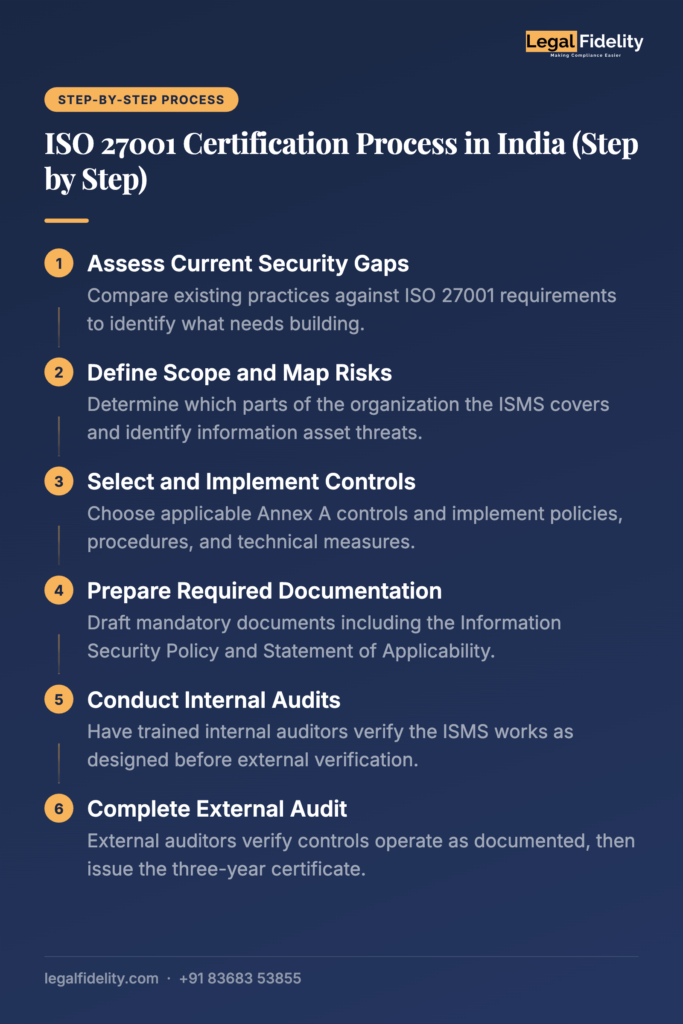
ISO 27001 Certification Process in India (Step by Step)
The ISO 27001 certification journey follows a structured sequence. Skipping steps — especially gap analysis and internal audit — typically leads to major nonconformities during the external audit.
1. Gap Analysis
Compare your current security practices against ISO 27001 requirements to identify what needs to be built or fixed. This step forms the foundation of your entire implementation project and helps create a clear project roadmap.
2. Define ISMS Scope
Decide which parts of the organisation, locations, departments, and systems the Information Security Management System (ISMS) will cover. A well-defined scope prevents unnecessary expansion and reduces audit complexity.
3. Conduct Risk Assessment
Identify all information assets, analyse potential threats and vulnerabilities, and evaluate risks based on their likelihood and potential impact. The results of the assessment must be formally documented.
4. Select and Implement Controls
Select the relevant security controls from Annex A of ISO 27001 and implement them through policies, procedures, and technical safeguards. These controls are then documented in the Statement of Applicability (SoA).
5. Create Required Documentation
Prepare and approve all mandatory ISMS documents, policies, procedures, and records required by ISO 27001. For organisations new to ISO standards, this phase usually takes the most time.
6. Conduct Internal Audit
An internal auditor trained in ISO 27001 reviews the entire ISMS to ensure it meets all requirements of the standard. Any findings are documented and corrective actions are taken before the certification audit.
7. Management Review
Top management reviews the ISMS performance, internal audit results, risk status, and security objectives. The discussion and decisions taken during this review must be properly documented.
8. Stage 1 Audit (Documentation Review)
The external certification body reviews your ISMS documentation and scope to verify readiness for certification. Any gaps identified during this stage must be addressed before the next audit.
9. Stage 2 Audit (On-Site Verification)
Auditors verify that the implemented security controls are functioning as documented. They review records, observe processes, and interview employees. Any nonconformities must be resolved before certification.
10. Certificate Issuance
After all nonconformities are closed, the certification body issues the ISO 27001 certificate. The certification is valid for three years and requires periodic surveillance audits.
ISO 27001 Certification Cost in India
ISO 27001 certification costs in India vary based on organisation size, scope complexity, current security maturity, and the certification body chosen. Here is a realistic breakdown for Indian businesses:
Large IT firms with complex environments may spend ₹10 lakh or more. Small businesses with a narrow ISMS scope can often complete the process closer to the lower end of this range. Fees depend on the accredited certification body you choose — there are no direct statutory fees payable to ISO or to any Indian government department.
ISO 27001 Certification Timeline
The time required for ISO 27001 certification depends heavily on how mature your existing security controls are. Organisations starting from scratch typically take longer than those with existing security policies. Starting with a thorough gap analysis reduces surprises and shortens the overall timeline.
Maintaining Your ISO 27001 Certificate
Achieving certification is the start, not the finish. ISO 27001 requires ongoing commitment to keep the certificate valid and the ISMS effective.
We’ve found that many organisations pass their initial certification audit but struggle with maintenance. The reason is usually that the ISMS was built just to pass the audit, rather than embedded into daily operations. Businesses that integrate ISMS processes into HR onboarding, vendor contracts, and IT change management typically maintain compliance with far less effort.
Surveillance Audits and Recertification
- Year 1 Surveillance Audit — Conducted approximately 12 months after certification. Auditors check that the ISMS is being maintained and improved.
- Year 2 Surveillance Audit — Second annual check. Focus often shifts to continual improvement evidence and corrective action records.
- Year 3 Recertification Audit — Full re-audit before the three-year certificate expires. Similar in scope to the original Stage 2 audit.
If your organisation fails a surveillance audit and cannot close major nonconformities, the certification body can suspend or withdraw the certificate.
Get ISO 27001 Certification Done with LegalFidelity
LegalFidelity makes ISO 27001 Certification fast, affordable, and hassle-free. Our team of expert consultants handles the entire process – from gap analysis and documentation to coordinating your external audit.
With 10,000+ satisfied clients, a 4.8/5 star rating, and a network of 500+ compliance professionals across India, LegalFidelity is the partner Indian businesses trust for certification services. We offer transparent pricing with no hidden fees, and our experts guide you through every stage, so you can focus on running your business.