







ISO 20000 Certification in India
Table of Contents
ISO 20000 Certification is the international standard for IT Service Management Systems (ITSMS), and it’s becoming a baseline requirement for Indian IT companies, BPOs, and managed service providers that want to win enterprise and government contracts. Built on the ISO certification overview framework developed by the International Organization for Standardization, ISO/IEC 20000-1:2018 sets out precisely what an organisation must do to plan, deliver, and improve IT services reliably. If your company manages IT services for clients, or depends on internal IT to run critical business operations, this certification signals that your processes meet a globally recognised benchmark.
What is ISO 20000 Certification?
ISO 20000 certification is formal recognition that an organisation has built and maintains a Service Management System (SMS) that meets the requirements of the ISO/IEC 20000-1 standard. An SMS is the set of policies, processes, documentation, and controls that govern how IT services are planned, delivered, monitored, and improved. Certification is granted by an accredited third-party certification body after a two-stage external audit.
ISO 20000 is often confused with ITIL (Information Technology Infrastructure Library). The key distinction is that ITIL is a framework of best practices, while ISO 20000 is a certifiable standard with auditable requirements. An organisation can implement ITIL practices to help meet ISO 20000, but holding an ITIL qualification doesn’t give you ISO 20000 certification.
ISO/IEC 20000-1:2018 – The Current Standard
The current version is ISO/IEC 20000-1:2018, published in September 2018. It replaced the 2011 edition and introduced closer alignment with the High Level Structure (HLS) used by other ISO management system standards like ISO 9001 quality management certification and ISO 27001 information security certification. This alignment makes it easier for organisations already holding one ISO certificate to add ISO 20000-1 without rebuilding their management system from scratch.
How ISO 20000 Relates to ITIL
ITIL and ISO 20000 are complementary, not competing. ITIL describes what good IT service management looks like in practice. ISO 20000 defines what an auditor will check to confirm your system is working. Most Indian IT companies that pursue ISO 20000 certification already follow ITIL-aligned processes, which shortens their gap analysis and implementation timeline considerably.
Who Needs ISO 20000 Certification in India?
ISO 20000 certification is relevant to any organisation that provides or manages IT services, whether those services are delivered to external customers or to internal business units. The standard itself states that its requirements are “generic and applicable to organisations of all sizes, sectors, and complexities.”
In our work with clients, we’ve found that ISO 20000 is most commonly pursued by IT services companies bidding on government or large enterprise projects, BPOs with SLA-based service contracts, and in-house IT teams inside banks, hospitals, and manufacturing companies that need to demonstrate service quality to regulators or auditors.
Industries and Organisation Types
The following sectors frequently hold or require ISO 20000 certification in India:
| Industry | Why ISO 20000 Matters |
|---|---|
| IT & Software Companies | Client requirement for managed services contracts |
| BPO / KPO | SLA compliance and operational quality assurance |
| Telecom | Service delivery consistency across large networks |
| Banking & Financial Services | Internal IT governance and regulatory confidence |
| Healthcare | IT systems supporting patient care and data management |
| Government / Public Sector | Mandatory for certain government IT contracts |
| Education Technology | Reliability and uptime standards for EdTech platforms |
Benefits of ISO 20000 Certification
ISO 20000 certification delivers measurable operational and commercial benefits, not just a certificate to display on a website.
Organisations certified to ISO/IEC 20000-1 report improvements across three areas: service quality, cost efficiency, and customer retention. According to multiple certification bodies operating in India, companies that implement a structured SMS before their audit typically reduce IT service incidents by 20–35% within the first year of certification, due to the discipline of documented processes and regular internal audits.
Business and Competitive Advantages
- Tender eligibility: Many central government and PSU IT contracts in India require ISO 20000 certification as a pre-qualification criterion.
- Client trust: Enterprise clients in BFSI and telecom routinely audit their IT service vendors and treat ISO 20000 as a minimum quality signal.
- Process efficiency: A certified SMS reduces duplicate efforts, clarifies ownership, and makes service transitions smoother.
- Employee clarity: Staff know exactly what processes to follow, reducing onboarding time and error rates.
- Continuous improvement: The PDCA (Plan-Do-Check-Act) cycle built into ISO 20000 means your service quality is designed to improve year on year.
Government and Public Sector Contracts
Public sector organisations in India are increasingly mandating ISO 20000 certification for IT vendors in RFPs. Just as ISO 45001 occupational health and safety is required in manufacturing, ISO 20000 is becoming a standard entry requirement for IT service contracts with ministries, state governments, and PSUs.
ISO 20000 Certification Requirements
ISO/IEC 20000-1:2018 is structured around 10 clauses. Clauses 4–10 contain the actual requirements your organisation must meet.
The standard requires your organisation to define the scope of the SMS, establish service management objectives, manage risks, document and control processes, measure performance, handle non-conformities, and drive continual improvement. It does not prescribe how to do these things – it sets what outcomes the SMS must achieve.
Service Management System (SMS) Requirements
Your SMS must cover the full service lifecycle: planning and design of services, transition (onboarding new services), delivery, improvement, and relationship management with customers and suppliers. The standard also requires you to manage any parts of the SMS that are operated by external parties or other teams within your organisation.
Mandatory Documentation
ISO/IEC 20000-1:2018 requires specific documented information as evidence of your SMS. Key mandatory documents include:
- Scope statement for the SMS
- Service management policy and objectives
- Risk assessment methodology and results
- Service catalogue
- Agreements with customers and internal/external suppliers
- Capacity and demand management plans
- Service continuity and availability plans
- Incident, problem, and change management procedures
- Internal audit programme and audit results
- Management review records
Documents Required for ISO 20000 Certification
When applying for ISO 20000 certification through a certification body, you’ll need to prepare and submit the following:
| Document | Purpose |
|---|---|
| SMS Scope Statement | Defines which services and locations are covered |
| Service Management Policy | Top-level commitment from management |
| Risk Register | Documents identified risks and controls |
| Service Catalogue | Lists all services in scope with their attributes |
| Customer Agreements / SLAs | Formal service commitments to customers |
| Supplier Agreements | Contracts with third-party service components |
| Process Documentation | Procedures for all core service management processes |
| Internal Audit Reports | Evidence of self-assessment before external audit |
| Management Review Minutes | Records of leadership review of SMS performance |
| Corrective Action Records | Evidence of addressing non-conformities |
ISO 20000 Certification Process in India
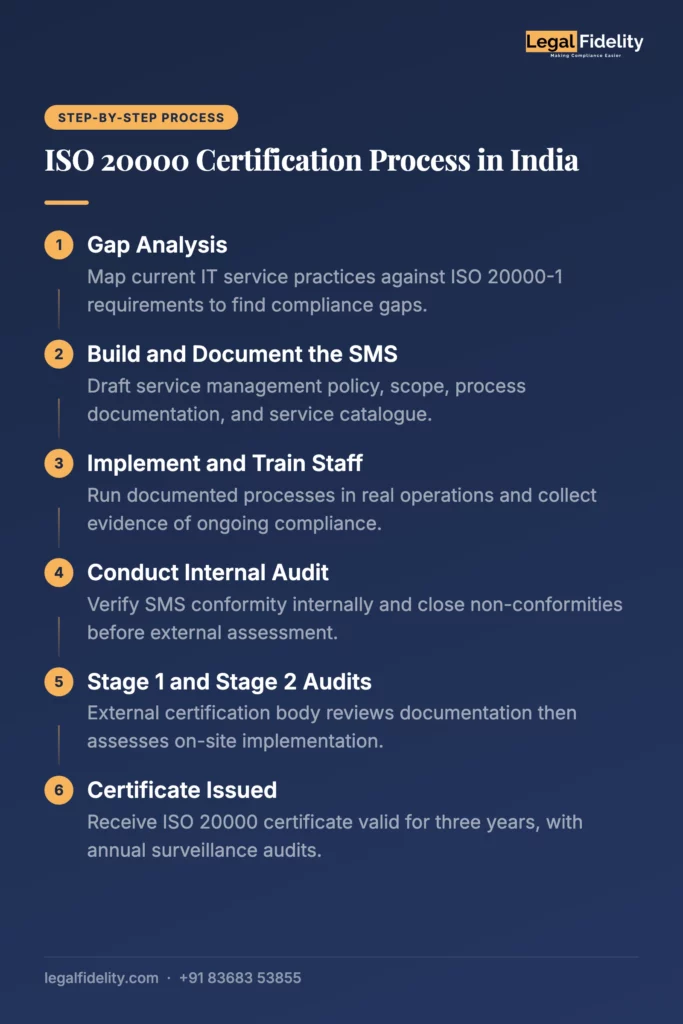
The certification process follows a structured sequence. There are no shortcuts – each step builds on the previous one, and the external audit will look for evidence that your SMS has been operational for at least three months before Stage 2.
Step 1 – Understand the Standard and Conduct a Gap Analysis
Start by reading ISO/IEC 20000-1:2018 and mapping your current IT service management practices against its requirements. A gap analysis identifies where you’re already compliant and where work is needed. Most Indian organisations find gaps in formal documentation, defined measurement metrics, and supplier management controls.
Step 2 – Establish and Document the SMS
Based on the gap analysis, develop or update your SMS documentation. This includes drafting or formalising the service management policy, defining the scope, documenting all processes, creating the service catalogue, and establishing agreements with customers and suppliers. Don’t underestimate this step – documentation quality directly affects how smoothly your audit proceeds.
Step 3 – Implement and Train
Documentation alone doesn’t satisfy ISO 20000. Your team must actually follow the defined processes. Train all relevant staff on the SMS, run the processes in real operations, and start collecting records and metrics. The standard requires evidence of the SMS being “implemented and maintained,” not just written.
Step 4 – Internal Audit
Conduct a formal internal audit of the SMS at least once before the external audit. The internal audit checks whether your processes are being followed and whether they’re producing the required outcomes. Identify any non-conformities and close them before inviting the certification body.
Step 5 – Select an Accredited Certification Body
Choose a certification body accredited by a recognised accreditation body (such as NABCB in India, or UKAS or DAkkS internationally). In India, accredited bodies offering ISO 20000 certification include Bureau Veritas, TÜV SÜD, DNV, DQS India, and ISOQAR India. The certification body conducts the external audit in two stages.
Step 6 – Stage 1 Audit (Documentation Review)
The certification body reviews your SMS documentation to confirm it meets ISO/IEC 20000-1 requirements and that you’re ready for the on-site assessment. Stage 1 is typically done remotely or at your office. The auditor provides a written report identifying any major or minor gaps. You must address all major gaps before Stage 2.
Step 7 – Stage 2 Audit (On-Site Assessment)
The Stage 2 audit is the main certification assessment. Auditors visit your site, interview staff, observe processes, and sample records to confirm the SMS is implemented and effective. If non-conformities are found, you’ll have a defined period to address them and submit evidence of correction.
Step 8 – Certification Issued and Surveillance Audits
If your Stage 2 audit is successful, the certification body issues the ISO 20000 certificate, valid for three years. During this period, the certification body conducts surveillance audits at 6, 9, or 12-month intervals to verify ongoing compliance. A full recertification audit takes place at the end of the three-year cycle.
ISO 20000 Certification Cost in India
Cost varies based on organisation size, number of services in scope, number of sites, and the certification body chosen.
Timeline for ISO 20000 Certification
| Phase | Typical Duration |
|---|---|
| Gap Analysis | 2–4 weeks |
| SMS Documentation | 4–8 weeks |
| Implementation & Training | 6–10 weeks |
| Internal Audit & Corrective Actions | 2–4 weeks |
| Stage 1 Audit (Scheduling + Execution) | 2–4 weeks |
| Stage 2 Audit (Scheduling + Execution) | 2–4 weeks |
| Certificate Issuance | 1–2 weeks after Stage 2 |
The total timeline from kickoff to certificate is typically 4–7 months for small to mid-size Indian IT companies. One factor that consistently extends timelines is underestimating the implementation phase – organisations that rush documentation without actually running processes for at least three months often face delays at Stage 2 when auditors find insufficient evidence of the SMS being “maintained.” Build in time to operate your processes before scheduling the audit.
ISO 20000 vs ISO 27001 vs ITIL – Key Differences
Indian IT companies often ask whether to pursue ISO 20000 or ISO 27001 information security certification first. Here’s how they compare:
| Aspect | ISO 20000-1:2018 | ISO 27001:2022 | ITIL 4 |
|---|---|---|---|
| Focus | IT service management | Information security | IT service best practices |
| Certifiable? | Yes (organisation) | Yes (organisation) | Yes (individual) |
| Mandatory? | No (voluntary) | No (voluntary, but often required by clients) | No |
| Audit required? | Yes (external) | Yes (external) | No |
| Best suited for | IT service providers | All organisations handling data | IT teams seeking process guidance |
If your clients are primarily concerned with data security and privacy, ISO 27001 may be the higher priority. If your contracts are SLA-driven and focus on service delivery quality, ISO 20000 is more directly relevant. Many Indian IT companies pursue both. The overlapping High Level Structure of the two standards means you can integrate both management systems and reduce audit duplication.
You might also want to consider ISO 14001 environmental management standard if your organisation has sustainability reporting obligations alongside service management goals.
Why Choose LegalFidelity for ISO 20000 Certification?
LegalFidelity has helped 100,000+ businesses across India navigate complex compliance and certification processes. Our network of 500+ qualified professionals includes consultants experienced in ISO/IEC 20000-1 implementation, gap analysis, and audit preparation for IT companies of all sizes – from bootstrapped startups to mid-size IT services firms.
We handle the end-to-end process: from your initial gap analysis and SMS documentation to connecting you with the right accredited certification body. Our team knows what Indian auditors from bodies like Bureau Veritas and TÜV SÜD look for, which means fewer surprises during Stage 2. With a 4.8/5 star rating across 1,730+ reviews, transparent pricing, and no hidden fees, we make ISO 20000 certification achievable – not just for large IT firms, but for growing SMEs and Udyam MSME registration holders looking to qualify for government IT contracts.
Call us at +918368353855 or visit legalfidelity.com/contact-us to get a custom quote based on your organisation’s size and scope.
Conclusion
ISO 20000 certification validates that your organisation’s IT service management processes meet an internationally recognised standard, making it a practical requirement for IT companies that want to win enterprise contracts, satisfy government RFPs, and build client confidence in their service delivery. The process takes 4–7 months and requires genuine implementation of a Service Management System, not just documentation. Working with an experienced compliance partner shortens the path and reduces the risk of audit delays.