








CE Certification in India
Table of Contents
What is CE Certification?
CE certification is a declaration that a product conforms to all applicable EU directives and regulations. The CE mark signals to regulators, retailers, and consumers that the product has been assessed against European standards. It does not indicate product quality in the commercial sense, but it confirms the product is safe and legally compliant for the European market.
What Does CE Stand For?
CE stands for “Conformité Européenne,” a French phrase meaning “European Conformity.” The mark was established under EU legislation to create a unified product-safety framework across member states. When you see the CE mark on a product, it means the manufacturer takes responsibility for its compliance with every applicable EU directive.
Is CE Certification Mandatory for Indian Manufacturers?
It is mandatory for any product placed on the market within the EEA or sold to EEA-based buyers. Indian exporters targeting European retailers, distributors, or end consumers must obtain CE marking before shipping. Selling without it can result in goods being seized at customs or banned from sale.
Which Products Require CE Marking?
More than 20 EU product directives specify categories that must carry the CE mark. These cover a wide range of goods, from consumer electronics to industrial machinery. If your product falls under any one of these directives, CE marking is compulsory before export.
EU Directives That Trigger CE Marking
| Directive | Product Category |
|---|---|
| Low Voltage Directive (LVD) | Electrical equipment (50V–1000V AC) |
| EMC Directive | Electronic products with electromagnetic emissions |
| Machinery Directive | Industrial and commercial machinery |
| Toy Safety Directive | Toys for children under 14 |
| Medical Device Regulation (MDR) | Medical instruments and implants |
| PPE Regulation | Personal protective equipment |
| Radio Equipment Directive (RED) | Wireless and radio devices |
| RoHS Directive | Electrical and electronic equipment (hazardous substance limits) |
| Pressure Equipment Directive | Vessels and fittings under pressure |
| Construction Products Regulation | Building materials and structures |
Several Indian product categories, including electrical switchgear, LED lighting, textile machinery, and automotive components, fall under multiple EU directives simultaneously. An Indian SME exporting LED luminaires, for example, must comply with the LVD, EMC Directive, and RoHS Directive at the same time.
Who Needs CE Certification in India?
Any Indian business that manufactures, assembles, or re-brands products falling under EU directive scope and intends to export to the EEA needs CE certification. This includes direct-to-consumer exporters, original equipment manufacturers (OEMs) supplying European brands, and Indian subsidiaries of multinational companies. Importers based in Europe who source from India also have an obligation to confirm their Indian suppliers hold valid CE compliance documentation.
Benefits of CE Certification for Indian Exporters
CE certification opens the EEA market, giving certified products access to over 500 million consumers across 30 countries. Beyond market access, the benefits are significant for Indian businesses competing globally.
- Free movement within the EEA: Once CE marked, a product can be sold in all 30 EEA member states without separate national approvals.
- Stronger buyer confidence: European retailers and distributors require CE documentation before placing orders. Having it ready speeds up commercial negotiations.
- Reduced customs clearance delays: CE-marked goods clear EU customs faster because compliance documentation is pre-established.
- Competitive edge over non-certified rivals: Many Indian exporters lack CE marking, so certified businesses win contracts others cannot pursue.
- Legal protection for the manufacturer: CE documentation provides a formal record that the manufacturer performed due diligence in case of product liability disputes.
- Gateway to other regulated markets: Several non-EU countries, including Turkey, Norway, Iceland, and Liechtenstein, accept or require CE marking for import.
CE Certification Process in India
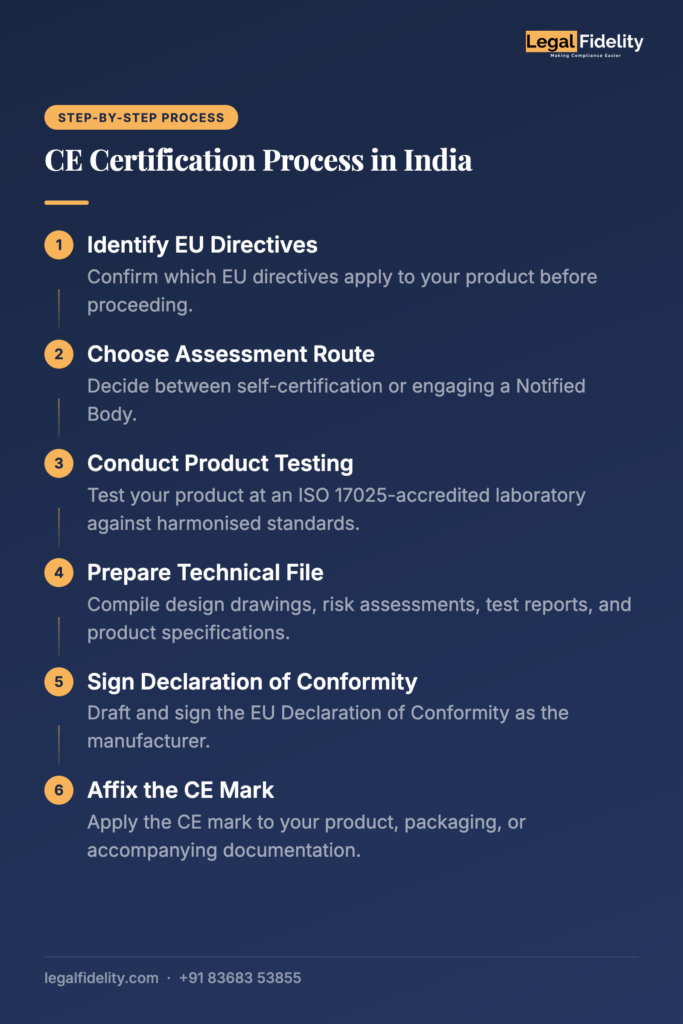
The CE certification process follows a structured path from directive identification to affixing the CE mark. The exact steps depend on the product category and its risk classification, but the core sequence is consistent across most product types.
Identify Applicable EU Directives
The first step is confirming which EU directives apply to your product. A single product may fall under more than one directive. You must meet the essential requirements of every applicable directive before you can legally affix the CE mark. The European Commission’s NANDO (New Approach Notified and Designated Organisations) database is a useful reference for this.
Determine the Conformity Assessment Route
Each directive specifies whether the manufacturer can self-certify or must involve a third-party Notified Body. Low-risk products, such as simple electrical equipment under the LVD, often allow self-certification. High-risk products, including medical devices, PPE, and certain pressure equipment, require an independent assessment by a Notified Body accredited by an EU member state.
Conduct Product Testing
Your product must be tested against the harmonised standards referenced in the applicable directives. Testing can be performed in-house if you have a capable ISO 17025-accredited lab. More commonly, Indian manufacturers send products to accredited third-party labs in India or Europe. Test reports form a critical part of your compliance evidence.
Prepare the Technical File
The Technical File (sometimes called Technical Documentation) is a comprehensive dossier proving your product meets EU requirements. It is not submitted to any authority, but must be retained for at least 10 years and made available to EU market surveillance authorities on request.
A complete Technical File includes:
- Product description and specifications
- Design drawings and schematics
- Risk assessment and analysis
- List of applicable harmonised standards
- Test reports and certificates
- Manufacturing process description
- User manuals and labelling samples
Draw Up the EU Declaration of Conformity
The EU Declaration of Conformity (DoC) is a legally binding document you sign as the manufacturer. It states which directives and harmonised standards your product complies with, and it identifies the responsible signatory. This document must accompany the product or be accessible to EU buyers and authorities.
Affix the CE Mark
Once the Technical File is complete and the DoC is signed, you may affix the CE mark to your product, its packaging, or the accompanying documentation. The mark must meet minimum size requirements (at least 5mm in height) and must not be obscured or modified.
In our work with Indian manufacturers pursuing CE certification, we’ve found that the most common cause of delays is an incomplete Technical File. Many applicants underestimate the depth of documentation required for the risk assessment section.
Documents Required for CE Certification
The documentation burden for CE certification is substantial but manageable with a clear checklist. Most of these documents are generated during the product development and testing phases.
- PAN card of the firm or applicant
- Aadhaar card of the authorized signatory
- Business registration certificate (GST certificate, MSME certificate, or company incorporation document)
- Product description and technical specifications
- Design drawings, schematics, or engineering diagrams
- Bill of materials (BOM)
- Risk assessment report
- Test reports from ISO 17025-accredited lab
- List of harmonised standards applied
- User manual and installation instructions
- Labelling samples
- Signed EU Declaration of Conformity
CE Certification Cost in India
CE certification costs vary by product type, risk classification, and whether a Notified Body is involved. There is no fixed government fee as CE marking is a market requirement, not a government registration. Costs include consultant fees, testing charges, and Notified Body fees where applicable.
Key cost factors include:
- Number of applicable directives
- Complexity and quantity of test parameters
- Whether existing lab test reports are available
- Notified Body selection and jurisdiction
- Consultant or certification body service fees
CE Certification Timeline
The timeline for CE certification depends heavily on product complexity and whether testing needs to be conducted from scratch.
| Stage | Estimated Duration |
|---|---|
| Directive identification and gap assessment | 1–2 weeks |
| Product testing at accredited lab | 4–8 weeks |
| Technical File preparation | 2–4 weeks |
| Notified Body review (if required) | 4–12 weeks |
| Declaration of Conformity sign-off | 1 week |
| Total (low-risk, self-certification) | 6–12 weeks |
| Total (high-risk, Notified Body involved) | 4–6 months |
Products that already have test reports aligned to harmonised standards can significantly compress the timeline.
Role of Notified Bodies
A Notified Body is a third-party organization accredited by an EU member state to independently assess products that carry higher safety risks. Indian manufacturers do not need to work with a Notified Body based in India. You can engage any Notified Body registered with the European Commission, regardless of their location, as long as they cover your product category.
Choosing a Notified Body early in the process can reduce turnaround time, since some bodies have local offices in India that accept physical sample submissions, avoiding costly international shipping.
CE Marking vs BIS Certification: Key Differences
Indian manufacturers sometimes ask whether CE marking and BIS (Bureau of Indian Standards) certification serve the same purpose. They do not. The two are separate conformity frameworks for separate markets.
| Parameter | CE Marking | BIS Certification |
|---|---|---|
| Scope | European Economic Area (EEA) | Indian domestic market |
| Governing body | European Commission | Bureau of Indian Standards |
| Mandatory for domestic sale? | No | Yes (for notified products) |
| Mandatory for export to Europe? | Yes | Not applicable |
| Self-certification option? | Yes (low-risk products) | No |
| Validity | Ongoing (subject to directive updates) | 1–2 years (renewable) |
A product exported to Europe must carry CE marking. The same product sold in India under BIS-notified categories must carry the ISI mark. These are parallel requirements for separate markets, not alternatives to each other.
Consequences of Non-Compliance
Exporting products to the EU without CE marking, or with fraudulent or incorrect CE marking, carries serious consequences. EU member states have national market surveillance authorities empowered to act against non-compliant products at any stage, from customs entry to retail sale.
Consequences include:
- Customs rejection: Non-compliant products may be held at EU ports and refused entry.
- Market ban: Authorities can issue a sales ban for non-compliant products already in the market.
- Product recall: Manufacturers or importers may be required to withdraw products already in circulation.
- Financial penalties: EU member states each set their own penalty levels; fines can run into tens of thousands of euros.
- Reputational damage: A market ban or recall is publicly disclosed by surveillance authorities, affecting buyer and distributor confidence.
- Loss of contracts: European buyers terminate contracts with suppliers who cannot maintain CE compliance.
Why Choose LegalFidelity for CE Certification
LegalFidelity has helped hundreds of Indian manufacturers and exporters navigate the CE certification process, from directive mapping to Technical File preparation and Notified Body coordination. Our network includes experienced technical consultants who specialize in EU product compliance for electronics, machinery, medical devices, and industrial equipment.
We handle the paperwork, laboratory coordination, and compliance documentation so you can focus on production. Our process is transparent, with fixed quotes and no hidden charges. With a 4.8-star rating across 1,730+ reviews and 100,000+ satisfied clients, LegalFidelity is a trusted partner for Indian businesses entering the European market.
Conclusion
CE certification is a non-negotiable requirement for Indian manufacturers and exporters targeting the European market. Understanding which directives apply to your product, whether self-certification or a Notified Body route is required, and what documentation you need will save you significant time and cost.