








GMP Certification in India:
Table of Contents
What is GMP Certification?
Good Manufacturing Practice (GMP) is a system of guidelines that ensures products are produced consistently and safely under controlled conditions. The certification confirms that a facility’s processes, equipment, personnel, and documentation all meet a defined quality standard. Unlike a product-level quality check, GMP evaluates the entire manufacturing environment.
GMP is not a single universal standard. In India, the framework splits depending on your industry and intended market. Pharmaceutical manufacturers follow Schedule M under the Drugs and Cosmetics Act, 1940. Food businesses may follow FSSAI’s GMP guidelines or international standards like HACCP. Cosmetic manufacturers follow BIS or WHO-GMP guidelines. Understanding which standard applies to your business is the first decision to make.
Legal Basis for GMP in India
The primary legal framework for pharmaceutical GMP in India is the Drugs and Cosmetics Act, 1940, and the Drugs and Cosmetics Rules, 1945. Schedule M of these Rules defines the minimum requirements for factory premises, plant design, hygiene, and quality management. The Central Drugs Standard Control Organisation (CDSCO), under the Ministry of Health and Family Welfare, is the national regulatory authority that oversees GMP compliance for drugs and medical devices.
State Food and Drug Administration (FDA) offices handle GMP inspections for state-licensed pharmaceutical units. The Revised Schedule M, notified in 2023, aligns India’s pharmaceutical GMP norms more closely with WHO-GMP standards and imposes stricter requirements on facility design, documentation, and validation.
Types of GMP Certification in India
| Type | Applicable to | Issuing Authority |
|---|---|---|
| Schedule M GMP | Pharmaceutical manufacturers | State FDA / CDSCO |
| WHO-GMP | Exporters supplying to WHO-listed markets | CDSCO |
| FSSAI GMP | Food business operators | FSSAI |
| BIS GMP | Cosmetics, household products | Bureau of Indian Standards (BIS) |
| ISO 22000 / HACCP | Food manufacturers seeking global recognition | Accredited certification bodies |
Who Needs GMP Certification?
GMP compliance is mandatory for pharmaceutical manufacturers under Schedule M, and failure to comply can result in license cancellation under the Drugs and Cosmetics Act. For food and cosmetics, GMP may be legally required under FSSAI regulations or mandatory for export markets. Large retail chains and hospital procurement systems increasingly demand GMP certificates from suppliers, even where no statutory obligation exists.
Businesses that need GMP Certification include:
- Pharmaceutical manufacturers (tablets, syrups, injectables, APIs)
- Medical device manufacturers
- Food processing and packaging units
- Nutraceutical and dietary supplement makers
- Cosmetic and personal care product manufacturers
- Ayurvedic and herbal product companies
- Veterinary drug manufacturers
Mandatory vs Voluntary GMP
For pharmaceutical companies, Schedule M compliance is non-negotiable. Any business holding a drug manufacturing licence under the Drugs and Cosmetics Act must demonstrate GMP compliance during licensing and periodic inspections. For food businesses, FSSAI registration is the base-level requirement, and GMP adherence is embedded within FSSAI’s compliance framework for larger operators. Cosmetic manufacturers may treat GMP as voluntary unless they export to regulated markets.
Benefits of GMP Certification
In our work with manufacturing clients, we’ve seen GMP Certification open doors that would otherwise remain closed, from government procurement contracts to export clearances. The certification signals quality consistency to buyers and regulators alike.
Key benefits include:
- Market access: WHO-GMP Certificate is required to export pharmaceutical products to over 100 countries that follow WHO procurement guidelines.
- Reduced product recalls: GMP-certified facilities produce fewer defective batches due to documented process controls, reducing the risk and cost of recalls.
- Regulatory goodwill: CDSCO and state FDAs treat GMP-certified manufacturers more favourably during surprise inspections.
- Tender eligibility: Government pharmaceutical tenders and hospital procurement policies often specify GMP certification as a mandatory bid condition.
- Consumer trust: A GMP certificate on product packaging signals safety and quality to end users.
- Lower insurance premiums: Some product liability insurers offer reduced premiums to GMP-certified manufacturers.
If your business also pursues environmental or safety management certifications, consider pairing GMP with ISO 14001 environmental management certification or ISO 45001 occupational health and safety certification for a well-rounded compliance profile.
GMP Certification Process in India
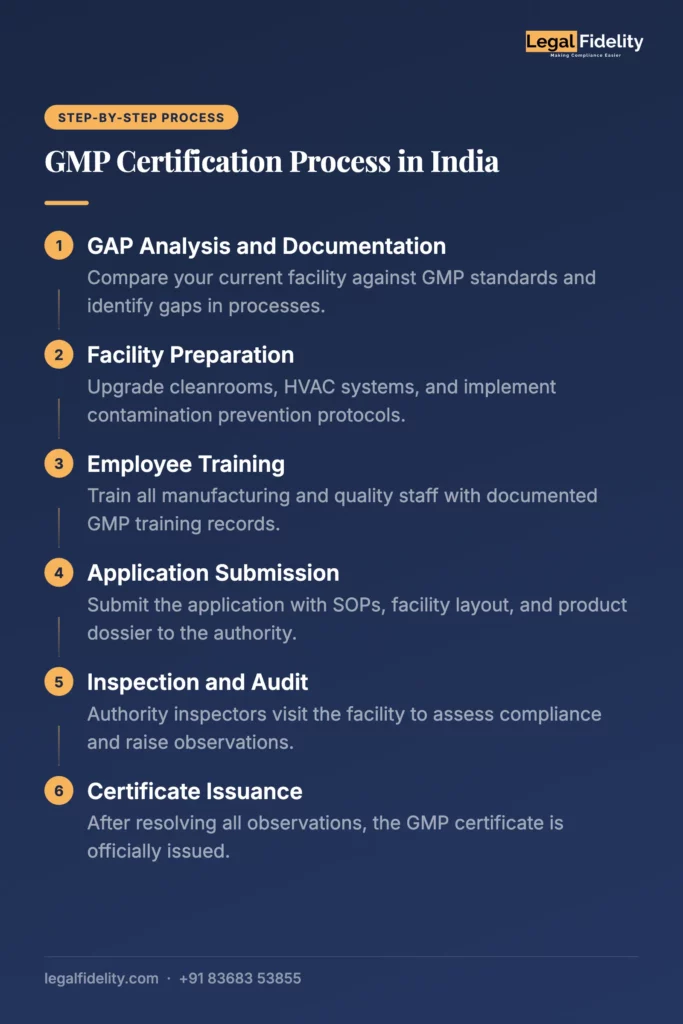
The GMP certification process typically takes 2 to 6 months, depending on the current state of your facility and the type of certification sought. The steps below apply broadly to pharmaceutical and food manufacturers pursuing certification through CDSCO, state FDA, or an accredited certification body.
Step 1 – GAP Analysis and Documentation
The process begins with a GAP analysis, which compares your current facility and practices against the applicable GMP standard. This stage identifies missing SOPs (Standard Operating Procedures), infrastructure deficiencies, and documentation gaps. A consultant or internal quality team conducts the analysis and prepares a remediation plan. GAP analysis typically takes 2 to 4 weeks.
Step 2 – Facility Preparation
Based on the GAP analysis, you bring the manufacturing facility up to standard. This includes upgrading HVAC systems, cleanrooms, laboratory equipment, and storage areas. Pest control, waste management, and cross-contamination prevention protocols are documented and implemented. For pharmaceutical facilities, cleanroom classification and validation are formal requirements under Revised Schedule M.
Step 3 – Employee Training
All personnel involved in manufacturing, quality control, and quality assurance must receive documented GMP training. Training records are a mandatory part of the GMP file and are checked during inspection. Senior technical staff must hold specified educational qualifications as defined under Schedule M.
Step 4 – Application Submission
For pharmaceutical GMP, the application is submitted to the State FDA (for state-licensed units) or CDSCO (for central-licensed units and WHO-GMP). The application package includes the completed form, facility layout, equipment list, product dossier, and SOPs. For WHO-GMP specifically, Form TRS 823 and a detailed site master file are required. For food manufacturers, the application goes to FSSAI or an accredited certification body.
Step 5 – Inspection and Audit
After application acceptance, the authority schedules an on-site inspection. Inspectors assess the physical facility, review documents, observe manufacturing processes, and interview staff. Deficiencies are recorded as observations. Major observations require corrective action before certification is granted. Minor observations may be addressed after certification with a defined timeline.
Step 6 – Certificate Issuance
Once the inspection is satisfactory and all observations are resolved, the GMP certificate is issued. CDSCO typically takes 2 to 3 months from application to certificate for WHO-GMP. State FDA timelines vary. For accredited body certifications (food/cosmetics), the timeline from audit to certificate is generally 4 to 6 weeks.
Documents Required for GMP Certification
The exact document list varies by certification type. The following are typically required for pharmaceutical GMP applications:
- Name, address, and identity proof of the applicant (PAN, Aadhaar)
- Copy of the industrial trade or manufacturing licence
- List of approved products with formulations
- Form TRS 823 for site inspection (for WHO-GMP)
- Facility layout with dimensions and area designations
- Equipment list with specifications and calibration records
- Standard Operating Procedures (SOPs) for production, cleaning, and quality control
- Batch manufacturing records for the 3 most recent batches
- Stability test reports for products (real-time and accelerated)
- Employee qualification and training records
- Product recall and adverse event reporting procedures
- Environmental monitoring reports (for sterile or controlled facilities)
GMP Certification Cost in India
GMP certification costs in India vary widely based on the type, facility size, and how much remediation work is needed before the audit. Government fees for Schedule M or state FDA inspections are relatively low, but preparation costs can be significant for older facilities.
For MSMEs, Udyam Registration as a recognised MSME can make your business eligible for government-subsidised certification assistance schemes, which can offset a part of the GMP certification cost.
GMP Certification Timeline
| Stage | Duration |
|---|---|
| GAP analysis and documentation | 2–4 weeks |
| Facility preparation | 4–12 weeks (depends on gaps) |
| Employee training | 1–2 weeks |
| Application submission to inspection scheduling | 2–4 weeks |
| Inspection and corrective action | 2–6 weeks |
| Certificate issuance | 1–3 weeks |
| Total (typical) | 3–6 months |
WHO-GMP applications through CDSCO typically run 3 to 5 months. State FDA timelines may be shorter for straightforward applications. Food manufacturer GMP certifications through accredited bodies can be completed in 2 to 3 months for well-prepared applicants.
Validity and Renewal of GMP Certificate
GMP certificates are generally valid for 1 to 3 years, depending on the issuing authority. WHO-GMP certificates from CDSCO are typically valid for 3 years. State FDA licences with embedded GMP conditions are reviewed at licence renewal. Surveillance audits are conducted every 6 to 12 months to verify ongoing compliance.
Renewal requires re-inspection of the facility and updated documentation. Any major changes to the facility, product portfolio, or manufacturing process must be reported to the authority before the renewal date. Failure to renew on time can result in suspension of the manufacturing licence.
Consequences of Non-Compliance
Non-compliance with GMP norms carries serious legal and commercial consequences in India.
Under the Drugs and Cosmetics Act, 1940:
- Section 18B empowers licensing authorities to cancel or suspend a drug manufacturing licence if GMP conditions are violated.
- Section 27 provides for imprisonment up to 3 years and fines for manufacture of sub-standard drugs.
- Section 22 allows inspectors to seize and detain products from non-compliant facilities.
The 2023 Revised Schedule M compliance deadlines mean that pharmaceutical MSMEs who haven’t upgraded their facilities face an elevated risk of licence suspension in 2025 and 2026. Our experience shows many small manufacturers underestimate the time required for documentation alone, let alone physical upgrades, making early action especially important.
Beyond legal penalties, a failed GMP inspection or product recall can permanently damage buyer relationships and market reputation. International markets, including the US FDA, EU EMA, and WHO procurement channels, will delist Indian manufacturers who lose their GMP status.
GMP vs ISO Certification – Key Differences
Many manufacturers ask whether GMP and ISO certification serve the same purpose. They don’t. GMP is a product-safety and process-control standard specific to regulated industries. ISO certification covers quality management, environmental performance, or information security more broadly.
| Criteria | GMP Certification | ISO Certification |
|---|---|---|
| Issued by | Government authority or accredited body | Accredited certification body |
| Industry scope | Pharma, food, cosmetics, medical devices | All industries |
| Legal requirement | Yes (pharma); varies (food/cosmetics) | Generally voluntary |
| Focus | Manufacturing process and product safety | Quality systems and processes |
| Validity | 1–3 years | 3 years (annual surveillance) |
| Export relevance | Mandatory for regulated markets | Preferred in B2B contracts |
For food exporters, APEDA registration combined with GMP and HACCP certification covers the core compliance requirements for agricultural and processed food exports. For broader quality management, an ISO certification alongside GMP creates a stronger market positioning.
Why LegalFidelity for GMP Certification
Getting GMP certified involves regulatory submissions, facility assessments, documentation systems, and ongoing compliance monitoring. Errors at any stage can delay certification by months and expose your business to regulatory risk.
We’ve helped manufacturing businesses across pharmaceuticals, food processing, and Ayurvedic products navigate GMP certification without the confusion of managing multiple agencies and paperwork streams on their own. LegalFidelity’s network includes qualified professionals with hands-on experience in Schedule M compliance, WHO-GMP applications, and FSSAI regulatory requirements.
What LegalFidelity provides:
- GAP analysis and pre-inspection facility assessment
- SOP drafting and documentation system setup
- Liaison with State FDA or CDSCO on your behalf
- Training support for manufacturing and quality teams
- Post-certification surveillance audit preparation
With 100,000+ clients served and a 4.8/5 star rating, LegalFidelity delivers expert support at transparent pricing, with no hidden charges. Call or WhatsApp us at +918368353855, or reach out at legalfidelity.com/contact-us.
Conclusion
GMP Certification is a foundational quality credential for any Indian manufacturing business in pharmaceuticals, food, cosmetics, or medical devices. It protects consumers, satisfies regulatory requirements, and opens access to export markets and institutional buyers. With revised Schedule M timelines tightening requirements in 2025 and 2026, manufacturers who act early will avoid licence disruptions and stay ahead of competitors in regulated supply chains.