








What is Udyam Registration?
Table of Contents
The Government offers an official recognition process known as Udyam Registration for Micro, Small, and Medium Enterprises (MSMEs) in India. It was introduced by the Ministry of Micro, Small and Medium Enterprises (MSME) on 1st July 2020 in the provisions of MSME Development Act, 2006.
In simple terms, it is an identity card of your business. Once MSMEs are registered, a unique certificate with Udyam Registration Number (URN) is generated and an online certificate is issued, which makes the company a recognized MSME.
Purpose of Udyam Registration
- To provide a legal identity to each MSME.
- To enable businesses to access easier benefits, subsidies and schemes offered by the government.
- To assist the government monitor the growth of the MSME and tailor improved government policies.
This registration replaced the earlier regime of Udyog Aadhaar Memorandum (UAM) to increase transparency, convenience as well as digitization.
Features of Udyam Registration
- Fully digital & paperless: Physical forms and in person office visits are required.
- Aadhaar based registration of MSMEs: Speedy verification with Aadhaar.
- Each enterprise was given a 12-digit permanent Udyam Registration Number (URN).
- Lifetime validity: There is no need to register it again after you are registered.
- Integration with PAN & GST: Once you file both, GST and ITR reports, the business details are updated automatically.
The importance of Udyam Registration for MSMEs in India
Without Udyam Registration, your business can miss:
- Priority Sector Lending: Avail of collateral free and low-interest loans as part of the priority sector lending. Banks can give easy loans to the MSME at a lower rate.
- Government Subsidies & Incentives: Get the benefit of a variety of MSME schemes, subsidies, and incentives which can only be availed by registered enterprises.
- Tenders Eligibility: To participate in the Government and PSU tenders, it is mandatory to have the Udyam registration.
- A legal, trusted government backed identity: This credibility assists you to establish your reputation with consumers, lending banks and business associates.
Thus, the Udyam Registration is a necessary requirement to remain compliant with the law, and to avail the financial, legal, and administrative assistance of the government.
Udyam Registration Certificate
All enterprises receive an electronic Udyam Registration Certificate after a successful registration process, as their proof of official identity as MSME.
The certificate includes:
- Unique Udyam Registration Number (URN): A 12 digit permanent number.
- The type of the enterprise: Micro, Small or Medium.
- QR code: that will be verified immediately.
- Applicant and company information.
This certificate is required when applying to collateral-free loan, government subsidies, priority sector lending and also in tenders.
What are MSMEs?
In July 2020, the government simplified the MSME eligibility and the overall categorization of MSMEs. In the past, this classification of MSME was confusing because it was solely based on investment. A combined Investment-turnover criterion now defines MSMEs and this makes it more practical and inclusive.
| Category | Investment Limit | Turnover Limit |
|---|---|---|
| Micro Enterprises | Up to ₹1 crore | Up to ₹5 crore |
| Small Enterprises | Up to ₹10 crore | Up to ₹50 crore |
| Medium Enterprises | Up to ₹50 crore | Up to ₹250 crore |
Eligibility for Udyam Registration
The following business types are eligible for Udyam:
- Proprietorships: Single owned businesses like shops, freelancers, and small traders.
- Partnership Firms: Partnership Firms businesses that have two or more partners.
- Limited Liability Partnerships (LLP): New structured business entities that provide the flexibility of the partnership with the advantage of limited liability.
- Private Limited & Public Limited Companies: Business incorporated under the Companies act.
- Hindu Undivided Families (HUFs): Businesses run by family.
- Societies, Trusts, and Co-operatives: Social, charitable and community based businesses.
Benefits or Advantages of Udyam Registration
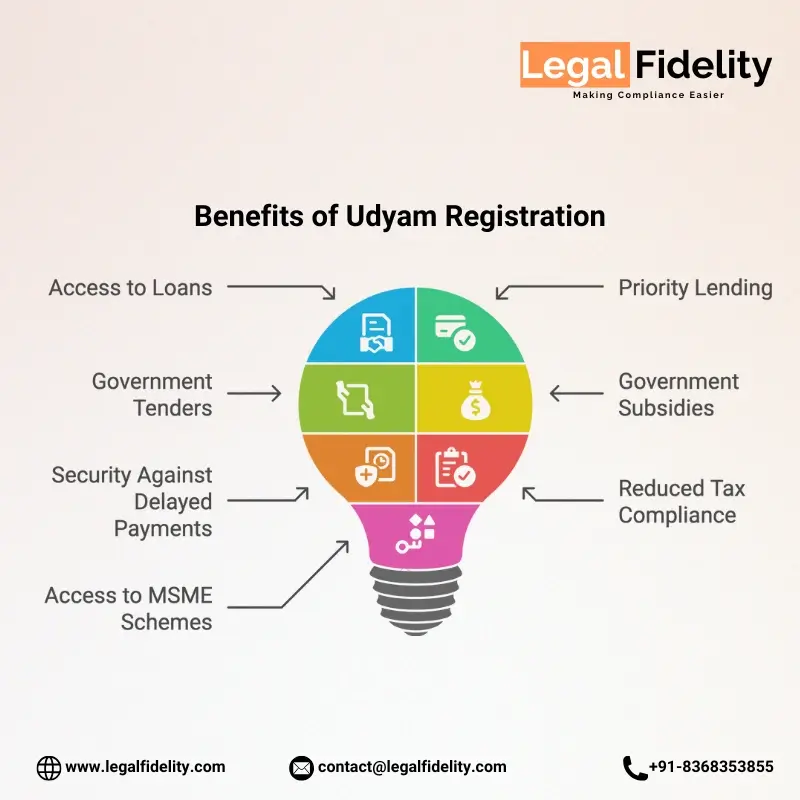
Simple access to loans of MSMEs
Accessibility of finance is one of the biggest challenges of small businesses. With Udyam Registration, you can access collateral free MSME loans under various schemes like the credit guarantee fund where taking money is easier without risking personal assets.
Priority lending by banks
Registered MSMEs are considered by the banks and NBFCs in the priority sector lending. This translates into faster approvals, lower interest rates and a greater probability of getting the funds that you require.
Simplifying Government tenders
Udyam Registration offers your company access to Government e-Marketplace (GeM tenders) and allows you to bid on the Central Public Procurement Portal (CPPP) tenders that are frequently limited only to verified MSMEs.
Exclusive government subsidies
Government subsidies are also available to registered MSMEs on such major costs as ISO certifications, patents, and trademark registrations. This minimizes expenses as it also lets you create a more powerful brand.
Security against delayed payments
Managing Cash flow is a challenge to small businesses. Udyam registered enterprises are legally entitled to be free of delayed payments and can even demand compensation of interests on delayed payments in form of Udyam Act regulations.
Reduced tax compliance and tax burden
Most of the registered MSMEs enjoy these tax concessions and rebates as well as simplified compliance requirements which enable them to concentrate more on business expansion rather than paperwork.
Access to special MSME schemes
Udyam Registration will provide you a gateway to various exclusive MSME schemes and incentives launched by the government to support you through technology upgradation, marketing support, and skill development programmes.
Documents Required for Udyam Registration
The following documents are required for Udyam Registration:
- Aadhaar Card: The Aadhaar of the business owner, promoter, or managing partner is compulsory.
- PAN (Permanent Account Number): PAN Card of the business or individual (proprietor).
- GSTIN (If Applicable): Compulsory for GST registered businesses otherwise optional.
- Business Details:
- Business name
- Date of incorporation
- Type of activity (manufacturing/service/trading)
- Bank account details
- Mobile Number Linked with Aadhaar: For OTP verification.
Step by Step Process on How to apply for Udyam Registration
The Udyam Registration process may seem confusing, time consuming and prone to mistakes. That is where LegalFidelity comes in to ensure that the whole process is hassle free, quick and stress free to the entrepreneurs in Mumbai.
Step 1: Consultation & Understanding Your Business
Our professionals will know the nature of your business, investment and your turnover first. This will assist in rightly categorizing your business Micro, Small, or Medium according to governmental regulations right from the beginning.
Step 2: Easy Document Preparation
We assist in collecting and arranging the necessary information like Aadhaar, PAN, GST if applicable and other company details. Saves your time and avoids mistakes that can lead to rejection.
Step 3: Filing Done by Experts
Rather than struggling with the online portal, our team submits the application on behalf of you appropriately and within the MSME requirements. This reduces the chances of mistakes or unwarranted delays.
Step 4: Quick Processing & Updates
We track your application and inform you on every stage, until you get your Udyam Registration Number (URN) and digital certificate.
Step 5: Support Even After Registration
Our experts provide post registration guidance related to loan at lower rates, provision of subsidies and schemes, and bidding in government contracts.
Common Challenges in Udyam Registration
Although Udyam Registration itself is easy and online, there are several challenges most entrepreneurs go through. Being aware of them can make your preparation easier and prevent any delays.
Aadhaar Linking Issues
- In some cases, the registration fails because of the Aadhaar-PAN mismatch.
- The most common arenas of concern include the difference in names, or wrong information, between Aadhaar and PAN records.
Technical Glitches
- The process can be delayed by the Udyam portal problem or not being available due to maintenance.
- Other common problems with different users include OTP not received during Aadhaar verification.
Document Verification Problems
- Data on PAN or GST databases may not always match, which is why there might be problems with the verification of the Udyam document.
- Sometimes the system might put the business in the incorrect category like Micro, Small or Medium as an error in auto-filling.
Lack of Awareness
- Most businessmen are not even aware of the process or advantages of registering their businesses.
- Small traders also fail to register because of the challenges in MSME awareness or lack of the necessary guidance.
Language Barrier
The portal is mostly in English and Hindi and may not suit the regional entrepreneurs to complete the registration conveniently.
Renewal and Update of Udyam Registration
The most significant thing about Udyam is that the MSME certificate is valid lifetime. That is, after registering, there will be no Udyam renewal procedure, the certificate will be valid indefinitely.
But they must update the contents of the certificate in case changes occur like:
- Change of business name or address.
- Change in PAN or Aadhaar information.
- Change in investment or turnover, where the change in the business category may occur such as Micro, Small and Medium.
Why Updating is Necessary
Updating your details helps you to avoid inconveniences when taking a loan, availing subsidies, or participating in government programs. It also avoids mistakes of verification of banks and authorities.
Transition from Udyog Aadhaar to Udyam
Before July 2020, MSMEs used to be registered through the Udyog Aadhaar Memorandum (UAM) system. Although it was a significant step towards the MSMEs recognition, it had several drawbacks:
- Many businesses ended up with multiple registrations, which created confusion.
- No real time verifications were performed, which lowered the reliability of the process.
- Any modification of information or correction of wrong information was usually a complex and time consuming task.
To fix these gaps, The Ministry of MSME developed the Udyam Registration portal on 1st July 2020, which is considered a total digital transformation in MSME compliance.
With Udyam, things became much easier:
- One enterprise, one registration: each company will be issued a unique Udyam Registration Number (URN).
- Aadhaar based registration: where PAN is validated offers clear and instant validation.
- Automatic updating: due to GST and Income Tax Return filings eliminate paperwork and keep both records current.
Role of MSMEs in the Indian Economy
SMEs are known to be referred to as the backbone of the Indian economy. They have an immense contribution to make:
- Provide almost 30 percent of Indian GDP.
- Contribute 45 percent to the total exports in India by the MSMEs.
- Facilitate the employment of more than 110 million people in the country.
More than numbers, MSMEs make significant contributions to the economy:
- Promote entrepreneurship and innovation at the ground level.
- Contribute to regional growth, particularly semi-urban and rural regions.
- Aid to stabilize development between urban and rural India to lower the economic imbalances.
Conclusion
Udyam Registration opens the door to government programs, financial support, tax incentives, and greater credibility, providing your business with a solid base to build on.
With the right registration guidance, your business will be in a good position to grow sustainably, enjoy legal protection, and market opportunities.