







Copyright Registration in India
Table of Contents
What is Copyright Under Indian Law?
The copyright law in India is regulated by the Copyright Act 1957, amended which provides copyright of works of creativity simultaneously promoting its more extensive usage. The Act mainly aims to:
- Secure the ownership and control of the creator.
- Encourage the access and utilization of works to educational, cultural and social progress.
It should be noted that copyright does not safeguard just ideas, methods, or concepts. It simply safeguards the manifestation of those concepts in a tangible kind of form, a book that is written, a song that is composed, or a software that is developed.
Benefits or Importance of Copyright Registration in India
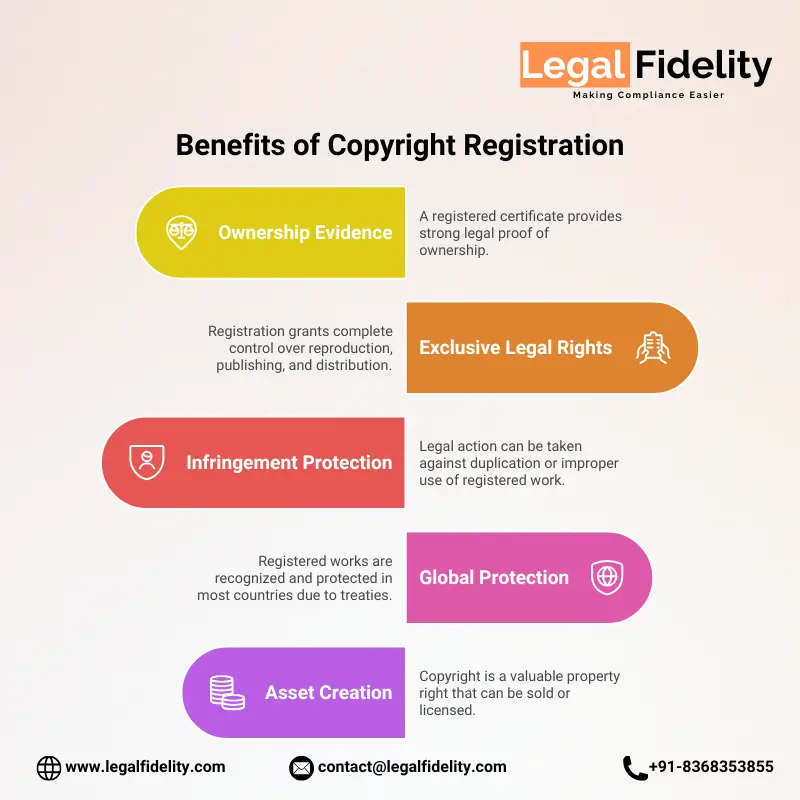
- Ownership Evidence: A registered certificate is good legal evidence in case of disputes because the creator of the works can easily prove that he is the owner of the works.
- Exclusive Legal Rights: The registration provides an owner with complete authority to control reproduction, publishing, adapting, distributing, and publicly performing his or her work.
- Protection of infringement by law: The registered person, in case of duplication or improper use of the work, may initiate a lawsuit in court and be awarded damages or compensation.
- Commercial Advantage: It eases the procedure of licensing, royalty collection, and commercialization of the usage of creative works and is legally safer.
- Global Protection: Being a member of such treaties as the Berne Convention and the TRIPS, registered works also receive recognition and protection in most other countries.
- Deterrent Effect: Registration of the work is a constant reminder to the potential offenders as they may get sued due to copying of the work.
- Asset Creation: Copyright as an asset is a property right and is a valuable property that can be sold, transferred, or licensed and is a contribution to the business and financial value of a creator or company.
Scope of Copyright Protection in India
- Literary Works: books, novels, articles, blogs, scripts, computer programs, software codes, databases.
- Artistic Works: This category comprises paintings, sketches, drawings, photographs, logos, packaging designs and other visual works.
- Musical Works: Original music composition, sheet music and score that has no written text or a recording of sound.
- Sound Recordings: It deals with the sounds like songs, podcasts, audio books and studio recording.
- Cinematographic Films: Movies, Documentaries, videos, web series, and short films.
- Dramatic Works: Stage-plays, scripts, screenplays, choreographic and pantomime.
- Architectural Works: Architectural layouts, blueprints and models.
- Computer Software and Digital Works: It protects the digital representations such as apps, websites, games, digital illustrations and other material of the web.
Works Not Protected by Copyright in India
- Ideas, concepts, or methods: Copyright does not protect ideas or concepts; it only protects the expression of an idea in a tangible form.
- Titles, names, short phrases, or slogans: These are considered too tiny to be subject to copyright protection but are normally covered by trademark laws.
- Common symbols, shapes, or designs: Things that are basic or common and lack creativity or originality simply cannot be copyrighted.
- Government and judicial texts: Judgments, laws, and reports and other government publications are not generally considered to be under copyright.
- Public domain works: There is no more restriction on the use of the work once the copyright expiry period has passed and anybody can use the work.
Who Can Apply for Copyright Registration?
The Copyright Act, 1957 allows the following persons to retain legal rights to seek copyright registration:
- Authors or Creators: It is the original authors of literary, artistic, musical, dramatic or software works.
- Owners or Publishers: Individuals or organizations that have purchased ownership or rights by contract, assignment, or as an employee.
- Legal Heirs or Representatives: Legal Heirs or representatives of the writer can be used in case the writer dies.
- Assignees or Licensees: these are individuals or organizations whereby lawful rights have been allocated or licensed.
- Organizations: An organization, company, NGO, or other legal entity that creates original works, such as software companies or publishing houses.
Eligibility Criteria for Copyright Registration in India
To have the protection under Copyright Act, 1957, the following requirements are there:
- Originality: The work must be the original of the work of the writer and it must not infringe or be in any way a copy of an existing work.
- Tangible Form: This must be a tangible form such as writing or recording or any other form that is documented.
- Published or Unpublished Works: Published and unpublished works are both registerable. The unpublished works may also require special declaration by the applicant.
- Indian and Foreign Nationals: Indian nationals and foreigners have the right to apply provided the work is published in India or the applicant is a member country to the member country to the Berne Convention.
- Joint Authors: Joint works are works, which have a minimum of two authors and the rights are shared equally or by agreement.
- Corporate or Institutional Works: Works that have been done under guidance of corporates, NGO and institutions may be registered as works.
Understanding the © Symbol and Its Use in India
Copyright ownership is an international mark of copyright ownership (©). According to the Copyright Act, 1957 (India), copyright protection is automatic upon the creation of an original work, and there is therefore no obligatory use of the symbol. but it has important benefits:
- Purpose: It reminds the people that the work is copyrighted and that it should not be reproduced, distributed, and adapted without the author’s permission.
- Application: It is commonly printed on books, software, websites, film, music albums and artworks.
- Example: © 2025 LegalFidelity. All rights reserved.
- Legal Value: This symbol does not in itself establish rights, but together with the copyright registration, it assists in strengthening the ownership evidence and aid in legal enforcement.
- Misuse: The © mark should not be added to an item that is not actually innovative or otherwise qualifies as such or to an item that is not worth copyrighting, because it may cause confusion, a wrong interpretation and even legal problems.
Legal Rights of a Copyright Owner in India
- Right of Reproduction: To reproduce the work in any format like print, electronic, audio or even video.
- Right of Publication and Distribution: To publish the work, to distribute it in the form of any sort of distribution including sale.
- Right of Communication to the Public: The right to ensure that the work is published, sold or distributed to any medium.
- Right of Translation and Adaptation: To make the work known, to perform, to broadcast or make the work known.
- Right to License or Assign: To assign or grant the right to others, most usually on a royalty basis or on a commercial basis.
- Moral Rights of the Author: Economical rights are transferable and sell-able, however, the author is entitled to be identified as the creator and to protest against misuse, mutilation or distortion of the work is the right of the author.
Duration and Validity of Copyright in India
In India copyright protection is limited and the time varies depending on the nature of work:
- Literary, Dramatic, Musical, and Artistic Works: The term of protection is the life time of the author and 60 years following the death of the author.
- Cinematograph Films, Sound Recordings, Government Works, Anonymous or Pseudonymous Works: The term of protection is 60 years starting with the year when the first publication takes place.
- Posthumous Works refers to published after the author’s death: The Protection of Posthumous Works will last 60 years starting from the first of the year on the year of publishing.
After the time of copyright has elapsed, the work joins the public domain, i.e. it can be used by anyone at all without any permission.
Renewal is not necessary – the protection of copyright is automatic during the terms prescribed by the law.
Documents Required for Copyright Registration in India
1. General Documents
- Form XIV: Form of application of copyright.
- Statement of Particulars (SoP) and Statement of Further Particulars(SoFP), where necessary.
- Power of Attorney (PoA): It is mandatory in case an application is made by an advocate or agent.
- Fee Receipt: Document of Government payment of fees as appeared in Schedule II of the Rules.
2. Work-Specific Documents
- Literary, Dramatic or Artistic Works: Two copies of the written work, piece of artwork, design or logo
- Computer Programs or Software: Source code at least 10 and at most 10 pages with explanatory notes.
- Cinematograph Films: A copy of the film and other promotional material.
- Sound Recordings: A CD/DVD or other digital copy of the recording.
- Musical Works: Notation or sheet music or a recorded version of the composition.
- Works of Art like logos, Designs, labels: NOC of Trademark Registry, provided that it is already trademarked.
3. Additional Requirements
- NOC by the Author or Publisher: In the case when the applicant is not the primary creator.
- NOC of Copyright Holder: Where there are derived or adapted works.
Step by Step Process of Copyright Registration in India
Identify and Prepare the Work
Make sure that the work is original and can be copyrighted (literary, artistic, musical, dramatic, films, sound recordings, software, etc.), and gather all the materials including manuscripts, artwork, recordings, or source code.
Filing the Application (Form XIV)
Fill Form XIV with all the pieces of work, author and applicant information, ensure that the correct type of work is entered and attach a Power of Attorney (PoA) in case the work information is entered using an agent.
Attach Required Documents
Submit the Statement of Particulars and Further Particulars in case of need and a work and other documents copy are required by NOCs, fee receipts etc.
Payment of Prescribed Fees
Pay the prescribed fee by the government on the Copyright Office portal or by demand draft and keep the fee receipt safely as an official documentation of payment of your application.
Submission and Diary Number
File the application at either the Copyright Office portal or at the office. This is succeeded by Diary Number in the form of reference number to monitor application status.
Registration by the Registrar of Copyrights.
The Registrar reviews the application so that the work has been copyrighted and the documents are fully complete.
Objection/Dispute Resolution
In case of the objection of a third party to the application under Section 45 then the applicant needs to answer in the time required. An appeal may be carried out in front of the Registrar to settle any disagreements.
Grant of Registration
With approval, the Registrar records the work in the Register of Copyrights and publishes the Copyright Registration Certificate that can be downloaded via the official portal and used as a piece of legal evidence and assert copyright.
Government Fees for Copyright Registration in India
The government fee on registration varies according to the kind of the applicant and the nature of the work:
| Type of Applicant | Fee (INR) | Notes |
|---|---|---|
| Individual / Author | 500 | Fee is charged per work |
| Small Business / Startup | 500 | Fee is charged per work |
| Company / Institution | 500–1000 | Depends on the type of work; fee is per work |
| Online Filing | May include additional portal charges | Applies when submitting through the Copyright Office portal |
Time Taken for Copyright Registration in India
- Without Objections: It generally requires 2 to 6 months when application is received.
- With Objections or Third-Party Disputes: May take 6 to months or longer, subject to hearings and responses.
- Post-Examination: Within a few weeks after all the issues are resolved, the Copyright Registration Certificate is usually given.
How to Check Copyright Application Status Online
The status of your application of the copyright can be seen online through the official e-filing system of the Copyright Office.
It is always better to retain the Diary Number, which will help to easily follow the track and respond to any notices related to the Copyright Act, 1957.
Objections and Hearings in Copyright Registration Process
In the Copyright Act of 1957 and Copyright Rules of 2013, the Registrar is given the right to object when considering a copyright application.
The typical grounds of objections are as follows:
- The work is similar to works that are already in copyright and this has created an issue of originality.
- Missing, incomplete or false documents attached with the application.
- Uncertainties in terms of authorship, ownership or right to use.
Procedure to Address Objections (as per Sections 17 & 45, Rules 69–70):
- The Registrar gives a formal notice to the applicant listing the objections.
- A formal reply must be made within the stipulated time and addressing all the aspects of the points raised.
- The applicant can be invited to a hearing, as necessary, with the Registrar to have the issues of dispute or ownership issues ascertained.
- The application may have flaws in various areas, and other documents or amendments may have to be made to correct them.
- When the Registrar is content that everything is in order, the application is accepted, and the process goes on to registration, and eventually the Copyright Registration Certificate is issued.
Copyright Infringement in India and Legal Remedies
Section 14 of the Copyright Act, 1957, states that a copyrighted work shall have been infringed when a person reproduces, distributes, performs, broadcasts, adapts or communicates the copyrighted work to another person without the consent of the copyright owner and hence violates the exclusive rights of the copyright law.
Examples of Infringement:
- The unauthorized duplication of books, software, music, films or works of art.
- Making use of logos, trademarks or other artistic designs.
- Creation or reproduction of electronic media without a license.
- Adaptation, or transcription of a piece of composition without authorization.
Civil Remedies (Sections 55–61):
- Injunctions: Orders of court to an infringement that is being executed or is going to be executed.
- Damages or Account of Profits: It is a type of award that replaces the damages or profits that the infringer made.
- Delivery up or Destruction: Infringing copies may be ordered by Court to be seized, delivered or destroyed.
Criminal Remedies (Sections 63–63B):
- Imprisonment: First time offenders, less than 3 years.
- Fines: Between INR 50,000 to 2,00,000.
- Enhanced Penalties for Repeat Offenders: Repeat offences can receive up to 6 years jail and increased penalties.
- Seizure of Infringing Material: The infringing copies may be investigated or destroyed by the law enforcement.
Assignment, Licensing and Transfer of Copyright in India
1. Copyright Assignment (Section 18):
- The owner of a copyright has the right to delegate all rights of the copyright to the second party or entity.
- The assignee acquires all the rights under the Act on Section 14.
2. Copyright Licensing (Section 19):
- The owner of a copyright has the right to license the use of a work, but not a transfer.
- License may be exclusive, the work as used by the licensee solely, or non-exclusive, the work as used by many simultaneously.
- In licensing agreements, the scope, term, area and compensation is generally defined.
3. Condition of Assignment or Licence:
- It must be written and must be signed by the author of a copyright.
- Be very specific on rights it provides, limit, scope, coverage and budget.
- May contain termination clauses
Copyright vs Trademark vs Patent in India
| Feature | Copyright | Trademark | Patent |
|---|---|---|---|
| Scope of Protection | Original creative work: literary, artistic, musical, software, original brand identifiers | Original creative work: literary, artistic, musical, software, original brand identifiers | name, logo, symbol, Novel Invention, process, or product. |
| Duration | lifetime of author and any further 60 years beyond the Author lifetime | 10 years, renewable indefinitely Author lifetime | 20 years of the date of filing |
| Registration | Optional but recommended | Mandatory due to legal protection from infringement | Mandatory due to legal protection |
| Exclusive Rights | Reproduction, adaptation, distribution, public communication | Exclusive use of the mark in relation to goods or services | Manufacture, use, sale or importation of the invention |
| Legal Framework | Copyright Act, 1957 | Trade Marks Act, 1999 | Patents Act, 1970 |
| Enforcement | Enforcement Civil and criminal remedies | Civil and criminal remedies | Civil remedies only |
International Protection of Copyright from India
- Berne Convention: India is a member. Other member countries automatically protect Indian works even without registration.
- WIPO Services: The World Intellectual Property Organization (WIPO) provides services on the registration, licensing, and enforcement of copyright worldwide.
- International Agreements: TRIPS (Trade-Related Aspects of Intellectual Property Rights) and the Marrakesh Treaty are some of the treaties that offer protection and guarantee rights of authors across borders.
Practical Tip: When the businesses or creators plan to distribute or commercialise their works abroad, they are suggested to register the work in the countries or states of interest so that they could enforce the law.
Why Choose LegalFidelity for Copyright Registration in India
LegalFidelity offers hassle-free Copyright Registration service to creators and businesses:
- Professional Expertise: Full guidance during the whole process from application submission to the issuance of certificate.
- Error Free Applications: This minimizes the possibilities of any objections or delays.
- On Time Processing: Our Expert Team offers seamless processing of submissions, queries and hearings.
- Low Prices: Affordable fees with No Hidden Charges.
Conclusion
Copyright registration is very essential to secure your original works, be it literature, artistic property, music, movies or programs.
It provides legal protection and exclusive rights and remedies in case of infringement, making your intellectual property safe under the Copyright Act, 1957.