







ISO 14001 Certification
Table of Contents
What is ISO 14001 Certification?
ISO 14001 Certification is published by the International Organisation for Standardisation (ISO). It is part of the ISO 14000 family of standards, which covers environmental management broadly.
The current version is ISO 14001:2015. A revision (ISO 14001:2026) is expected, with proposed additions around climate change adaptation, biodiversity, and lifecycle thinking.
Many government tenders, large corporations, and export buyers now require suppliers to hold this certification.
What is an Environmental Management System (EMS)?
An EMS is a set of processes, policies, and practices that an organisation uses to manage its environmental responsibilities systematically.
It is built on the Plan-Do-Check-Act (PDCA) cycle:
- Plan: Identify environmental aspects, legal requirements, and objectives
- Do: Implement processes and controls
- Check: Monitor, measure, and audit performance
- Act: Take corrective actions and drive improvement
An EMS does not guarantee zero environmental incidents. It gives your organisation a repeatable system to reduce risk, stay compliant, and improve over time.
ISO 14001:2015 Requirements: Clauses 4 to 10
ISO 14001:2015 is structured around 10 clauses. Clauses 4 to 10 are the operational requirements.
Clause 4: Context of the Organisation
You must understand your organisation’s internal and external environment. This includes identifying stakeholders (regulators, customers, communities) and understanding issues that affect your environmental goals.
Clause 5: Leadership
Top management must demonstrate commitment to the EMS. This includes setting an Environmental Policy, assigning roles, and integrating the EMS into business strategy.
Clause 6: Planning
You must identify your environmental aspects (activities that interact with the environment) and their impacts (the resulting environmental effect). You must also identify applicable legal and regulatory requirements, including Indian environmental laws.
You then set measurable environmental objectives and plan how to achieve them.
Clause 7: Support
This covers the resources, competence, awareness, communication, and documentation needed to run the EMS. You must maintain documented information to support your processes.
Clause 8: Operational Control
You must plan and control the processes linked to your significant environmental aspects. This includes managing contractors, emergency preparedness, and environmental performance in your supply chain.
Clause 9: Performance Evaluation
This requires regular monitoring, internal audits, and management reviews. You must measure whether your environmental objectives are being met.
Clause 10: Improvement
When problems arise (nonconformities), you must take corrective action. The clause also requires a commitment to continual improvement of the EMS.
Benefits of ISO 14001 Certification for Indian Businesses
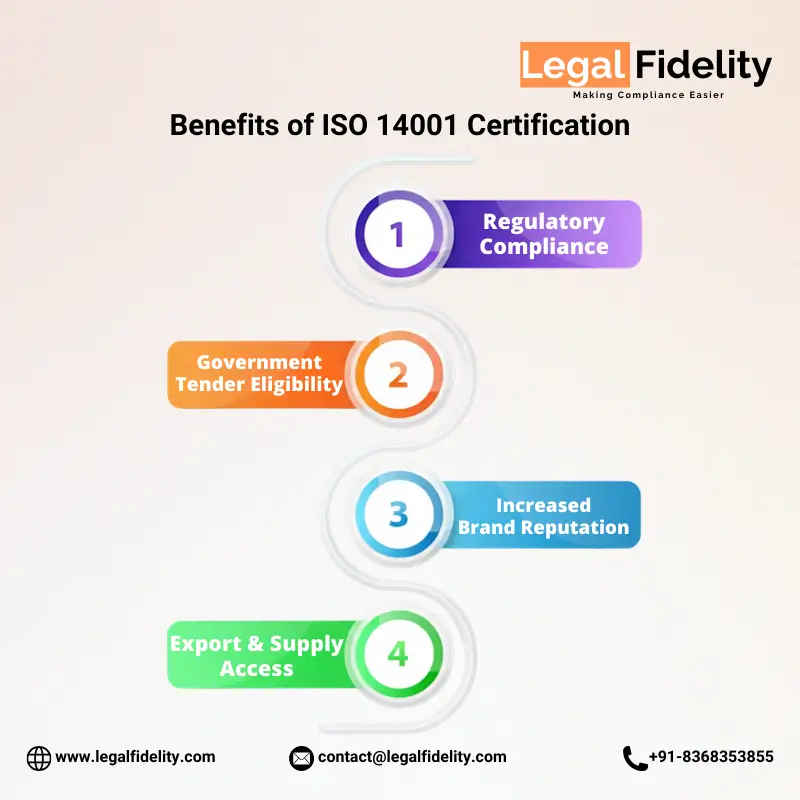
Regulatory Compliance
India has a robust set of environmental laws. Key legislation includes:
- The Environment Protection Act, 1986 (administered by MoEF&CC)
- The Water (Prevention and Control of Pollution) Act, 1974
- The Air (Prevention and Control of Pollution) Act, 1981
- Hazardous and Other Wastes (Management and Transboundary Movement) Rules, 2016
ISO 14001 helps you build systems that keep up with requirements from the Pollution Control Board (PCB) at the state level and the Ministry of Environment, Forest and Climate Change (MoEF&CC) at the central level.
Government Tender Eligibility
Many central government and PSU tenders now list ISO 14001 certification as a mandatory or preferred criterion. If you are an MSME targeting government contracts, this certification can open doors that are otherwise closed.
ESG and CSR Reporting
SEBI’s Business Responsibility and Sustainability Report (BRSR) framework requires listed companies to disclose environmental performance. ISO 14001 gives your business a documented and audited system that feeds directly into BRSR disclosures, strengthening your ESG credentials.
Export and Supply Chain Access
If you export goods to the EU, Japan, the US, or other regulated markets, your buyers may require suppliers to hold ISO 14001. Global companies are also pushing environmental requirements down their supply chains.
Cost Savings
Systematic monitoring of energy use, water consumption, and waste generation often reveals significant cost-reduction opportunities. Many organisations recover their certification costs within the first year through savings on utilities and waste disposal.
Brand Reputation and Stakeholder Trust
ISO 14001 certification demonstrates to customers, investors, and communities that your environmental commitments are real and verified by an independent third party.
Who Should Get ISO 14001 Certified?
ISO 14001 is suitable for any organisation regardless of size, sector, or location. It is particularly relevant for:
- Manufacturing units (auto, pharma, textiles, chemicals, food processing)
- Construction and infrastructure companies
- IT parks and data centres
- Logistics and transportation companies
- Hotels and hospitality businesses
- Mining and quarrying operations
- Any business with a significant environmental footprint or regulatory exposure
MSMEs can and do get certified. The standard scales to your size and complexity.
ISO 14001 Certification Process in India: Step by Step
Getting ISO 14001 certified involves the following stages:
Step 1: Gap Analysis
A consultant or internal team reviews your current practices against ISO 14001:2015 requirements. This identifies what you already do well and what gaps need to be addressed.
Step 2: Documentation Development
You prepare the required documented information, which includes:
- Environmental Policy
- Environmental Aspects and Impacts Register
- Legal and Regulatory Requirements Register
- Environmental Objectives and Targets
- Operational Control Procedures
- Emergency Preparedness Plan
Step 3: Implementation
You implement the processes, train your staff, and run the EMS for a period (typically 3 to 6 months) before your certification audit.
Step 4: Internal Audit
A trained internal auditor reviews the EMS to check if it is working as intended. Any nonconformities are documented and corrected.
Step 5: Management Review
Top management reviews audit findings, environmental performance data, and the status of objectives. This is a formal meeting with recorded minutes.
Step 6: Stage 1 Audit (Document Review)
The certification body conducts an off-site or on-site review of your documentation. They check if you are ready for the Stage 2 audit.
Step 7: Stage 2 Audit (Certification Audit)
An on-site audit where the auditor verifies that your EMS is implemented and effective. They interview staff, review records, and observe operations.
Step 8: Certification Decision
If the audit is successful, the certification body issues your ISO 14001 certificate. The certificate is valid for 3 years.
Step 9: Surveillance Audits
The certification body conducts annual surveillance audits (typically in Year 1 and Year 2) to ensure ongoing conformance.
Step 10: Recertification
Before the 3-year certificate expires, a full recertification audit is conducted.
How Long Does ISO 14001 Certification Take?
| Organisation Size | Typical Timeline |
|---|---|
| Small (under 20 employees) | 3 to 6 months |
| Medium (20 to 200 employees) | 6 to 12 months |
| Large or multi-site | 12 to 24 months |
The timeline depends on how complex your operations are and how quickly you can implement and document your EMS.
ISO 14001 Certification Cost in India
Certification costs vary based on your organisation’s size, number of employees, number of sites, and the certification body you choose. The fees include audit fees, registration fees, and travel costs. Consulting fees are separate if you hire an external consultant.
ISO 14001 vs Other Related Standards
| Standard | Focus Area |
|---|---|
| ISO 14001 | Environmental Management System |
| ISO 45001 | Occupational Health and Safety Management |
| ISO 9001 | Quality Management System |
| ISO 50001 | Energy Management System |
| EMAS | EU Eco-Management and Audit Scheme (stricter, EU-focused) |
ISO 14001 and EMAS serve similar purposes but EMAS is specific to organisations operating in the European Union and requires public environmental reporting.
Integrating ISO 14001 with Other Management Systems
Most Indian organisations that pursue ISO 14001 already hold or are pursuing ISO 9001. Combining them into an Integrated Management System (IMS) is a practical and cost-effective approach.
The ISO 14001:2015 structure follows the same High-Level Structure (HLS) as ISO 9001:2015 and ISO 45001:2018. This means the frameworks align well, and documentation, audits, and management reviews can be combined.
A triple-standard IMS (ISO 9001 + ISO 14001 + ISO 45001) is increasingly becoming the baseline for suppliers to large Indian and multinational companies.
Common Myths About ISO 14001
“ISO 14001 is only for large companies.” This is incorrect. The standard is designed to be scalable. Many Indian MSMEs and small manufacturers are certified.
“You need to follow a fixed documentation template.” ISO 14001 does not prescribe a specific format. You document what is relevant to your organisation’s context and scale.
“ISO 14001 means you will have zero environmental violations.” The standard does not guarantee zero incidents. It requires you to have systems that minimise risk and respond effectively when things go wrong.
ISO 14001 and India’s ESG Landscape
The SEBI BRSR framework (mandatory for the top 1,000 listed companies by market cap from FY 2022-23) requires disclosure of environmental metrics including energy, water, emissions, and waste.
ISO 14001 provides the underlying system that generates the data and documentation required for BRSR compliance. For companies in the supply chain of listed entities, ISO 14001 certification is increasingly becoming an expectation.
With India’s commitments under the Paris Agreement and the push towards a circular economy, environmental credentials will only become more important for businesses of all sizes.
Why choose LegalFidelity for ISO 14001 Certification
Getting ISO 14001 Certification is a structured process. Doing it right the first time saves time, avoids audit failures, and ensures your certificate is accepted wherever you need it.
Working with an experienced ISO consultant from LegalFidelity can help you avoid common pitfalls, prepare the right documentation, and choose an accredited certification body that fits your industry and market needs.
If you are ready to start or want to understand where your organisation stands, consult a qualified ISO 14001 consultant from LegalFidelity.