








ISO 9001 Certification in India: Process, Cost, Documents, Benefits, Time
Table of Contents
What Is ISO 9001 Certification?
ISO 9001 is a voluntary international standard that specifies requirements for a Quality Management System. It helps organizations consistently deliver products and services that meet customer and regulatory requirements while pursuing continuous improvement. The current version is ISO 9001:2015, which replaced the earlier 2008 edition.
ISO 9001:2015 Standard Explained
The 2015 edition introduced a risk-based thinking approach to quality management. It requires organizations to identify risks and opportunities, plan responses, and evaluate how well those responses work. This shift moved ISO 9001 from a document-heavy compliance exercise to a genuine business improvement tool.
Difference Between ISO 9001 Registration and Certification
Many businesses use these two terms interchangeably, and for good reason. Both refer to the same outcome: a formal attestation by an accredited third-party body that your organization’s QMS meets ISO 9001 requirements. There’s no functional difference between “registered” and “certified” in this context.
Benefits of ISO 9001 Certification
The MSME Ministry reports that certified small businesses see measurable improvements in order fulfillment rates and customer complaint reduction within 12 months of implementation. Beyond the numbers, the structural benefits make certification worthwhile for any growth-oriented business.
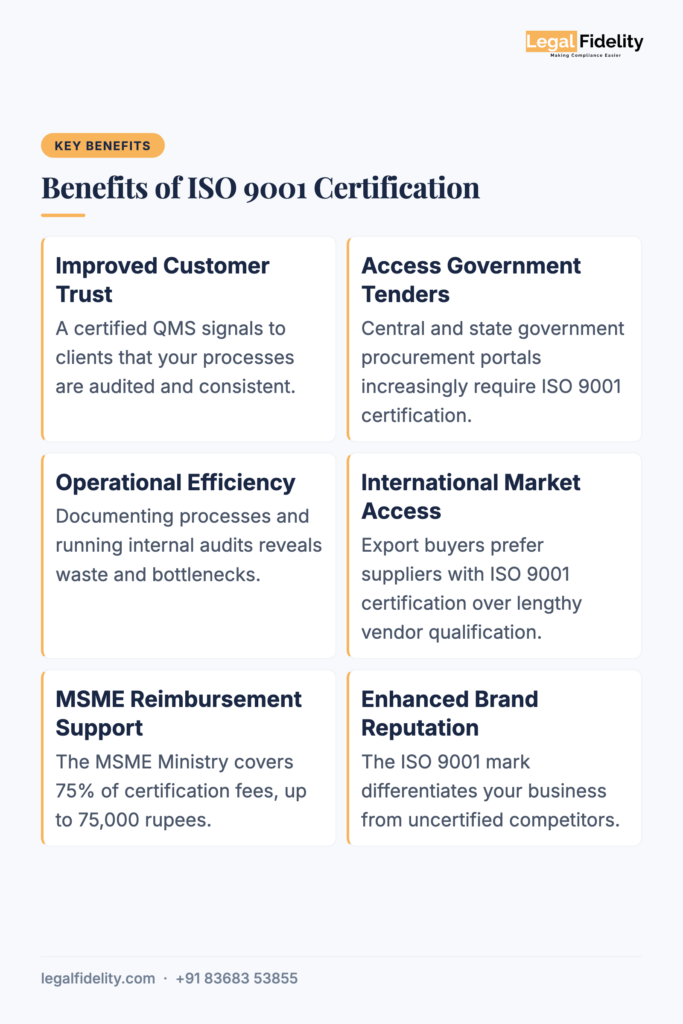
Improved customer trust
A certified QMS signals to clients that your processes are audited and consistent. This trust directly influences repeat business and referrals.
Access to government tenders and contracts
Central and state government procurement portals increasingly require ISO 9001 certification. Without it, your business is excluded from a significant portion of public-sector contracts.
Operational efficiency
Documenting processes and running internal audits forces you to identify waste, redundancy, and bottlenecks. Most businesses reduce operational costs within the first year.
International market access
Export buyers, especially in Europe and the Middle East, prefer suppliers with ISO 9001 certification. It replaces the need for lengthy vendor qualification processes.
Brand reputation
Displaying the ISO 9001 mark on your website, packaging, and marketing materials differentiates your business from uncertified competitors in the same market.
Who Should Get ISO 9001 Certified?
ISO 9001 is often assumed to be for large manufacturers, but the standard explicitly covers “organizations of all sizes and types.” In India, we see sole proprietors, MSMEs, IT firms, hospitals, educational institutions, and construction companies all benefit from this certification.
Industries and Business Types That Benefit
Almost every industry gains from ISO 9001 certification. Common sectors in India include manufacturing, IT services, healthcare, construction, logistics, food processing, and consulting. Government departments and NGOs also pursue this certification to demonstrate accountability.
In our work with clients, we’ve found that small businesses often see the biggest proportional gains from ISO 9001. The discipline of documenting processes and running internal audits reveals inefficiencies that owners didn’t realize existed.
Is ISO 9001 Certification Mandatory?
ISO 9001 is not legally mandatory for most Indian businesses. It’s a voluntary certification. That said, it becomes practically required in several situations: government tenders often list it as an eligibility criterion, large private buyers may demand it from vendors, and export contracts sometimes require proof of quality management.
ISO 9001 Certification Process in India
The certification process has two phases: internal preparation and external audit. Here’s how each step works.
Step 1 – Understand the ISO 9001:2015 Standard
Begin by reading the ISO 9001:2015 standard document. This helps you understand what the certification body will audit against. Identify which clauses apply to your organization and which can be excluded based on your scope of work.
Step 2 – Choose an Accredited Certification Body
Select a certification body accredited by a recognized authority. In India, the Quality Council of India (QCI) and the National Accreditation Board for Certification Bodies (NABCB) accredit legitimate certification bodies. Always verify accreditation before signing any agreement.
Step 3 – Conduct a Gap Analysis
A gap analysis compares your current processes against ISO 9001 requirements. It identifies what’s already in place and what needs to be created or improved. This step saves time and cost by focusing your preparation effort precisely where it’s needed.
Step 4 – Build and Document Your QMS
Create a Quality Management System that covers all ISO 9001 requirements. This includes writing a Quality Manual, defining quality policies and objectives, mapping core business processes, and creating Standard Operating Procedures (SOPs) for key activities.
Step 5 – Train Your Team
Your employees must understand the QMS and their specific roles within it. Training doesn’t need to be formal classroom sessions — it can include on-the-job coaching, procedure walkthroughs, and competency assessments. Training records must be maintained.
Step 6 – Run Internal Audits
Conduct at least one round of internal audits before the external certification audit. Internal auditors check whether the QMS is implemented as documented and working effectively. Non-conformities found here must be addressed with corrective actions before the external audit.
Step 7 – Management Review
Top management must formally review the QMS. This review assesses audit findings, customer feedback, process performance, and risks. The outcome of the review — decisions and actions taken — must be documented.
Step 8 – Stage 1 Audit (Documentation Review)
The certification body conducts a Stage 1 audit, which is primarily a desktop review of your QMS documentation. Auditors check whether your quality manual and key procedures align with ISO 9001:2015 requirements. They also confirm your organization’s readiness for the Stage 2 audit.
Step 9 – Stage 2 Audit (Certification Audit)
The Stage 2 audit is the main certification audit. Auditors visit your site, interview employees, observe processes, and examine records. They’re verifying that your QMS is actually implemented, not just documented. Any major non-conformities must be resolved before certification is issued.
Step 10 – Receive Your Certificate
Once the certification body confirms that all requirements are met and any non-conformities resolved, they issue your ISO 9001 certificate. The certificate is typically valid for three years.
Documents Required for ISO 9001 Certification
Mandatory QMS documents:
- Quality Manual (scope of QMS, quality policy, organizational goals)
- Quality Policy and Objectives
- Organizational Chart (roles, responsibilities, authorities)
- Procedures and Work Instructions for core processes
- Risk Assessment Plan
- Document Control Procedures
- Internal Audit Reports
- Corrective and Preventive Action Records
- Management Review Meeting Minutes
Optional but recommended documents
- Training and competence records
- Supplier evaluation records
- Customer feedback and complaint logs
- Calibration and equipment maintenance records
Supporting business documents
- Company registration certificate
- Business PAN card
- GST registration certificate
- Company letterhead with registered address
- Sales and purchase invoices (as process evidence)
ISO 9001 Certification Cost in India
Certification cost varies significantly based on organization size, location, and operational complexity.
How Long Does ISO 9001 Certification Take?
Most organizations complete the ISO 9001 certification process in 1 to 6 months. The actual time depends on how mature your existing processes are and how quickly your team can implement the required changes.
| Scenario | Typical Timeline |
|---|---|
| Well-organized business with existing SOPs | 1–2 months |
| Growing business starting from scratch | 3–4 months |
| Complex multi-location or multi-shift operations | 4–6 months |
Organizations that engage an experienced consultant from the start tend to move through the process faster. The most common delay is internal: teams struggle to find time for documentation and training alongside daily operations.
Surveillance Audits and Certificate Renewal
ISO 9001 certification doesn’t end at the certificate. You must maintain compliance throughout the three-year validity period.
Annual surveillance audits
Annual Audits conducted each year during the certificate’s validity. Auditors check a subset of your QMS, not a full re-audit but to confirm ongoing compliance. Failing a surveillance audit can lead to suspension of your certificate.
Recertification
Recertificaiton happens at the end of the three-year cycle. This involves a more thorough audit, similar to the original Stage 2 audit, to confirm your QMS is still effective and continuously improving. Organizations that run a healthy QMS throughout the three years typically pass recertification without issues.
ISO 9001 vs Other ISO Standards
Many businesses ask how ISO 9001 compares with other popular ISO standards. Here’s a quick reference.
| Standard | Focus Area | Who Typically Pursues It |
|---|---|---|
| ISO 9001:2015 | Quality Management System | All industries, all sizes |
| ISO 14001:2015 | Environmental Management System | Manufacturing, construction, chemicals |
| ISO 45001:2018 | Occupational Health and Safety | High-risk industries, construction, mining |
| ISO 27001:2022 | Information Security Management | IT, fintech, healthcare, BPOs |
| ISO 22000:2018 | Food Safety Management | Food processing, hospitality, catering |
| ISO 50001:2018 | Energy Management System | Manufacturing plants, large energy-consuming organisations |
| CE Marking | Product safety, health, and environmental compliance for European markets | Manufacturers exporting products to the European Economic Area (EEA) |
Many Indian businesses pursue ISO 9001 first and then layer additional standards on top. Because ISO 9001:2015 uses the Annex SL framework shared by ISO 14001, ISO 45001, and ISO 27001 integrating a second standard later is far less work than starting fresh.
Why Choose LegalFidelity for ISO 9001 Certification?
Getting ISO 9001 certified involves documentation, auditor coordination, and ongoing compliance, all while running your business. LegalFidelity makes this manageable.
We’ve guided hundreds of Indian businesses through ISO 9001 certification, from single-location startups to multi-site manufacturers. Our team of experienced ISO Consultants and Auditors manages the entire process: gap analysis, documentation support, audit preparation, and certification body liaison.
- Expert-led gap analysis to understand exactly where you stand
- Complete QMS documentation prepared by compliance professionals
- Dedicated manager who coordinates with the certification body on your behalf
- Transparent pricing with no hidden charges
- Post-certification support for annual surveillance audits
Conclusion
ISO 9001 Certification gives your business a recognized quality standard that opens doors: government tenders, international contracts, and customer trust that competitors without certification simply cannot match. The process is structured but manageable with the right preparation and support.