








FSSAI Registration in India
Table of Contents
What is FSSAI Registration?
If you are running a small food business like selling snacks from home, offering a tiffin service, or running a food cart then FSSAI Basic Registration is the very first step to becoming legally compliant.
A basic food safety registration is granted by the Food Safety and Standards Authority of India (FSSAI). It is required for any small scale business with an annual turnover of less than 12 lakhs.
After you register, you would get a 14 digit FSSAI number, which is the evidence that your business adheres to fundamental regulations on hygiene, as well as food safety in the Food Safety and Standards Act, 2006. This number must be printed on your food label, packaging boxes, or be posted in your store.
Why Do Food Operators Need FSSAI?
Getting FSSAI registration is not just about completing the government formality. It actually plays a very significant role in ensuring that the food system is safe and a reliable one. It assists in:
- Ensuring public health and safety: It has been used to guarantee the safety of food you prepare, sell, or deliver, which does not contain any harmful ingredients or unhygienic practices.
- Promoting accountability among food vendors: It encourages food vendors whether big or small to follow basic cleanliness and food safety norms.
- Uniformity of quality control measures: It puts in the industry minimum standards on food preparation, packaging and food storage so that all are on the same page in the industry.
- Assisting government to control and oversee food enterprises in the country: By registering under the FSSAI, the government is in a better position to monitor and assist food businesses at least in times of emergency or where there is a food related complaint.
Advantages of Obtaining FSSAI Registration
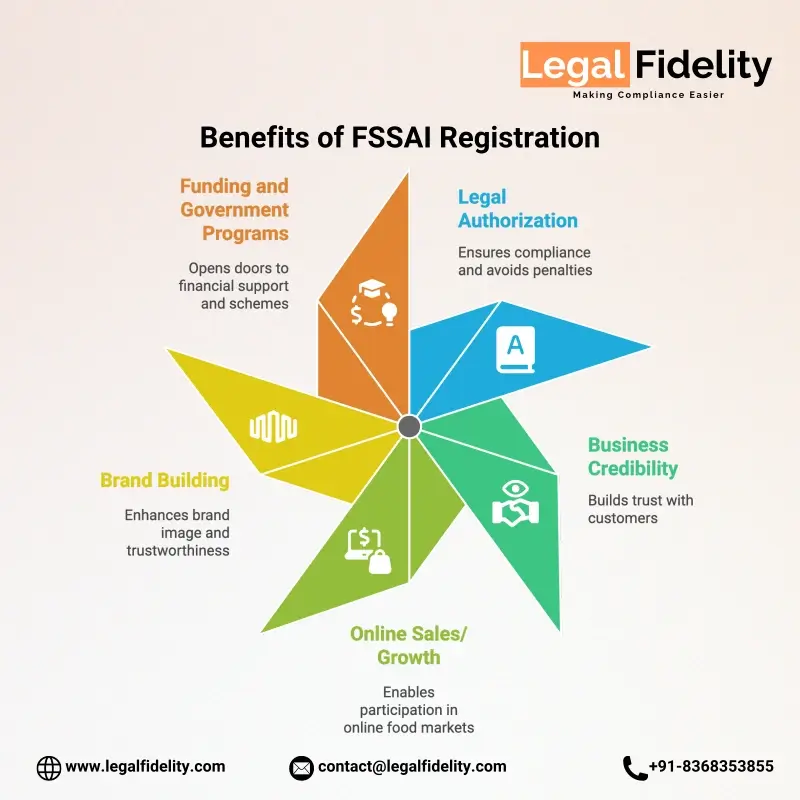
If you are running any kind of food business whether from home, a stall, or a small kitchen. FSSAI Basic Registration is not just about following rules. It actually comes with a bunch of benefits that can help you grow and succeed in the long run. Here’s how:
- Legal Authorization: You are given legal authorization to conduct business. Therefore, there is no more fear of surprise inspections, penalties, or being asked to shut down. Your FSSAI registration proves that you are operating according to food safety laws.
- Business Credibility: Showing your FSSAI number on your food packet or food stall, it will assure them that the food is clean, safe and handled with sufficient care. This creates trust which is a major influence in promoting repeat customers.
- Online Sales/Growth: You want to start selling your food on platforms such as Swiggy, you would require FSSAI license to start with and to grow in online presence. These platforms also need an FSSAI number. Therefore, this license opens the door to the online food market which is growing fast.
- Brand Building: Having an FSSAI number will make your brand appear more serious and trustworthy, even when you are just getting started.
- Funding and Government programs: In case you are willing to expand your venture business or avail a food startup loan. FSSAI registration can also make you eligible to get MSME schemes, subsidies, and even low interest business loans through banks/government schemes.
What is FoSCoS?
Before FoSCoS, the FSSAI used an older system called FLRS (Food Licensing and Registration System). However, it was outdated and not so user-friendly. In 2020, FoSCoS replaced it with a smarter, easier-to-use platform.
How FoSCoS Makes FSSAI Basic Registration Easy
- Completely paperless process
- Online tracking of the application status
- Automatic license number generation after approval
- Built in helpdesk and FAQs
- Fast renewal and easy upgrades
Who Needs to Get FSSAI Registration?
These are Businesses which require Basic FSSAI Registration:
- Home tiffin services: Food delivery of home cooked meals to offices or students
- Mom and pop grocery stores: Which offer packaged or loose food products
- Ice cream pushcart: Sellers of ice cream or kuli or desserts in local streets and market.
- Homemade Pickle or Jam sellers: Making and selling home preparations on traditional flavours
- Small bakery units: Producing bread, cakes or cookies in small amounts
- Mobile food vans: Food vans selling snacks, fast food or drinks on the streets
- Local caterers: Providing food to small scale gatherings or events with less than 50 people per day
FSSAI Basic Registration for Different Types of Food Businesses
| Business Type | Is Basic FSSAI Enough? |
|---|---|
| Cloud Kitchens | Yes, you may do it with Basic License when Annual turnover is Rs. 12 lakh. |
| Home Bakers | Yes, whether you are baking cakes, cookies, or bread from your home kitchen, you can start with a Basic License. |
| Amazon/Food App Sellers | Yes, like Amazon, Swiggy, Zomato sellers need a Basic License and you must display your FSSAI number. |
| Packaged Snacks | Yes, where low volume snack makers are selling chips, namkeen or energy bars in small lots. |
| Food Bloggers Selling Items | Yes, assuming you sometimes sell food items to complement the content creation, and you are on the small scale, then a Basic License is what you need. |
| Street Vendors | Food carts, hawkers, and juice stalls recognized as “petty food business operators”. Under the Eat Right India initiative, even if you run a small food cart, juice stall, or chaat counter, you need FSSAI registration. |
Eligibility Criteria for Petty Food Businesses
Food carts, hawkers, and juice stalls recognized as “petty food business operators”. Under the Eat Right India initiative, even if you run a small food cart, juice stall, or chaat counter, you need FSSAI registration.
- You have less than 12 lakh in sales per year
- You run a small food processing unit making under 100 kg or litres per day
- You sell food out of a cart, stall or the roadside
- You are a home based cook or baker who sells in your kitchen
- You have food stalls or kiosks which are temporarily set up at events, fairs or markets.
Examples of petty food business operators:
- Individual entrepreneurs running small food outlets
- Street food vendors selling eatables, drinking or food
- Tiffin service providers delivering home cooked food
- Bakers or Chef running from home making Cakes, Sweets, and Savouries
- Sellers on food delivery apps like Swiggy, Zomato etc.
- Shopkeepers or retailers who sell packaged food products whether they are store made or pre packaged by another brand.
FSSAI Registration Types
There are three types of licenses based on the annual turnover and the size of your business:
FSSAI Basic Registration: Up to 12 lakh turnover business
This applies to small-scale food companies or startups who are at its first steps. Examples include:
- Home kitchens selling homemade food
- Local tea stalls and snack counters
- Street food vendors
- Small dairy units (producing up to 500 litres of milk per day)
Issued by: Local Municipal Authority
Application Form: Form A
State FSSAI License: Brands that earn between 12 lakhs and 20 crores
This is applicable to medium sized food enterprises, like:
- Medium or large restaurants
- Food manufacturing units
- Large catering companies
- Food transporters operating within a state
Issued by: State Government
Application Form: Form B
Central FSSAI License: In case of businesses having turnover more than 20 crores
This applies to large-scale food businesses or such businesses as:
- Import and export of food items
- Operating e-commerce food delivery services
- Largely scaled food production plants
Issued by: Central Licensing Authority
Application Form: Form B
Quick Comparison Table – Basic vs State vs Central License
| Criteria | Basic Registration | State License | Central License |
|---|---|---|---|
| Turnover Limit | Up to Rs. 12 lakh | Rs. 12 lakh – Rs. 20 crores | Above Rs. 20 crores |
| Form Used | Form A | Form B | Form B |
| Issuing Authority | Local Municipal Authority | State FSSAI Office | Central FSSAI Office |
| Govt. Fee (Yearly) | Rs. 100 | Rs. 2,000 – Rs. 5,000, depends on business type | Rs. 7,500 |
| Validity | 1 to 5 years | 1 to 5 years | 1 to 5 years |
Documents Required for FSSAI Basic Registration
For Individual Proprietors
If you are applying as a single owner of your food business, you will need:
- A recent, clear Passport sized photograph
- Any government issued photo ID, it could be Aadhaar card, PAN card, or Voter ID for identity verification.
- Proof of business address: Electricity bill in your or your landlord’s name and Rent agreement if you are renting the space. If your kitchen is at home, the proof of home address works too
- Self-Declaration on Food Safety Practices is a simple document where you promise to follow safe food handling and hygiene practices as per FSSAI rules.
For Partnerships and Companies
- Company PAN card required to confirm your business identity for government records.
- Partnership deed or Certificate of Incorporation required for Business Formation Proof.
- Address proof of premises could be an electricity bill, rent agreement, or property tax receipt.
- Photo ID of authorized signatory required for person who will sign and take responsibility for the FSSAI application.
- Board resolution needed if the company’s board formally decides who will apply for FSSAI on its behalf.
Optional Documents That Help Avoid Rejections
- NOC from local authority, if your business place is rented or need municipal clearance.
- Kitchen layout, cloud kitchens or larger setups, demonstrating how your kitchen is organized.
- A simple Product list with categories of all the food products you will be making or selling.
- GST or MSME registration certificate is not mandatory, but makes your application stronger and more reliable.
Step by Step FSSAI Basic Registration
Getting a Basic License of FSSAI on your own can be quite difficult and time consuming. Since you are required to submit documents, fill out forms, track your status, and handle rejections, even just a small mistake can cost you weeks of processing or result in your application being canceled.
And this is where LegalFidelity simplifies the task in your FSSAI registration:
We do it end to end:
- The FoSCoS portal is an official licensing portal of FSSAI
- File a Form A with the attached necessary documents.
- UARN tracking number to monitor the Real time status.
- Follow ups with FSSAI authorities to prevent any unwanted delays.
- Digital certificate sends to your email as it is ready to print or share.
FSSAI Basic Registration Fees Explained
Due to the complexity of the registration process, food business owners choose professional help:
- Proper document verification to ensure papers are correct so they do not get rejected.
- Everything in the applications is entered correctly with applicable laws on the official FoSCoS portal
- We follow up with FSSAI so your file does not just stick there.
Common Mistakes to avoid during FSSAI Registration
- Uploading unclear documents or incomplete documents.
- Aadhar details not matching with the application form
- Wrong selection of food business category example choosing “restaurant” instead of “home-based seller”.
- Filing the application under the wrong state or zone.
These errors can cause rejections or delays in your license. With LegalFidelity, our team checks every detail in advance, so your application is error free and accepted quickly.
Renewal Process & Validity of FSSAI Basic Registration
Validity between 1-5 Years
When you apply for your FSSAI Basic Registration for the first time, you get to choose how long you want it to be valid:
- Minimum: 1 year
- Maximum: 5 years
When & How to Renew
- Renew at least 30 days before expiry do not wait till the last moment otherwise FSSAI’s system will automatically add late fees if you miss the deadline.
- Fill Form A again which was filled for your initial registration and pay fee based on number of years you choose
- In case there is a change in your business address, ownership or products list, you should include the new information together with the application
Late Renewal Fine
When you make a renewal beyond your license expiry date:
- Rs.100 per day after expiry until you make the application as a late fee.
- It makes your license invalid at this time, and it might cause Legal actions, or the rejection of Products on platforms or suppliers.
Post-Registration Guidelines
How to Display Your FSSAI License Number
- Put up the 14-digit FSSAI number somewhere visible like on the wall or counter at your shop/restaurant. This creates transparency and makes your business look more professional.
- If you sell packed food items like snacks, bakery goods, bottled drinks, or homemade products, you must print the FSSAI number clearly on the label.
- Required to mention basic details like ingredients used, expiry date, and net weight. Customers prefer packaged food more when they see the FSSAI number.
- Include you sell offline or online, always mention your license number on invoices, bills, and delivery slips. This is not only mandatory but also reassures customers that the food is registered and safe to.
Conditions to Avoid Suspension or Cancellation
Renew your license on time:
- FSSAI licenses come with a validity period of 1–5 years.
- Apply for renewal at least 30 days before expiry. Missing the deadline results in paying a fine or applying all over again.
Inform FSSAI About Any Business Changes
If you shift to a new shop or office, expand to a bigger kitchen, or change the type of food business such as from a home tiffin service to a restaurant, you must update FSSAI immediately to avoid license cancellation
Maintain Hygiene and Safety Standards safety strictly
- Always keep your premises clean, proper waste disposal arranged, time to time pest control, clean utensils, and safe storage are musts.
- Follow labeling rules honestly, no misbranding or fake claims. Ensure food handlers maintain personal hygiene and clean clothes, gloves, trimmed nails, etc.
- Cooperate during surprise inspections
- Be cooperative, show your license, records, and kitchen or work area without hiding anything. If they suggest improvements, follow them sincerely.
Steps to Respond to Improvement Notices
Sometimes, FSSAI officers may issue an improvement notice if they find something not up to the required food safety standards.
- Acknowledge the notice immediately, this shows FSSAI that you are cooperative and serious about resolving the matter.
- Go through the notice carefully and note down the exact points of non-compliance.
- Take required actions and work on each issue highlighted.
- If hygiene is poor: deep clean kitchen, pest control, proper storage.
- If labeling is wrong : redesign labels with FSSAI number, expiry date, ingredients.
- If records are missing : start maintaining proper books of purchases, stock, and cleaning schedules.
- Once corrections are made, submit photos, receipts, or updated documents to FSSAI as evidence. Do this within the deadline mentioned in the notice, usually 15–30 days.
- If you believe the notice was unfair or incorrect, you have the right to file an appeal within 15 days of receiving it. Providing strong evidence such as inspection reports, hygiene certificates, etc is provided to support your case.
Risks of Non-Compliance and FSSAI Penalties
Selling without License
A lack of an FSSAI license may result in attracting:
- Fines up to Rs. 5 lakh
- Imprisonment term of up to 6 months in terms of Section 63 of FSS Act, 2006
Mislabeling or Misbranding Food
Giving false information on labels or hiding important details from customer can lead to
- Penalty: Up to Rs. 3 lakh
- Possibility of Product recalls and license cancellation.
Using Unsafe Ingredients
The sale of food containing ingredients that are expired, substandard, or hazardous may lead to:
- It can attract you a penalty of Rs. 1 to 5 lakh, your goods can be detained and you can even face legal action under Section 59
Unsanitary Conditions & Adulteration
If your kitchen or storage area is unhygienic or your food is spoiled:
- Penalty of Rs. 1 lakh to Rs. 10 lakh, it may also lead to cancellation of FSSAI license
Legal Fines & Jail Time (Based on FSSAI Act)
| Offense | Fine/Action |
|---|---|
| Running a food business without an FSSAI license | Fine up to 5 lakh with imprisonment of 6 months |
| Misbranding giving false or misleading information on labels | Fine up to 3 lakh |
| Selling unsafe or harmful food | Fine betweenRs.1 lakh andRs.5 lakh |
| Storing or handling food in unhygienic conditions | Fine betweenRs.1 lakh andRs.2 lakh |
| Repeat violations | Repeating the same mistakes again License can be suspended or cancelled |
Why Choose LegalFidelity for FSSAI Basic Registration
Obtaining your FSSAI license does not involve the process of filling out a form but rather ensuring that any information is correct to enable you to launch your business without any stress.
LegalFidelity ensures that complicated applications become stress free, offering you speed, accuracy and comfort that the professionals are dealing with the procedure.
- Quick turnaround time – A lot of our customers can drive within 2-5 working days with their license.
- Expert consultation – We have handled applications for everything from home bakers to large food manufacturers, so we know exactly the right license type for you.
- Zero document errors – We pre check every document and detail before submission to avoid delay or rejection.
- WhatsApp or phone support – Get instant assistance by our team, who will reply back promptly.
Getting a FSSAI Basic License may look simple online, but in reality, even a small mistake in your application can cause weeks of delay or rejection. That’s why so many small food businesses, home chefs, and startups trust LegalFidelity to get it done right the very first time.
Conclusion
As a small food business owner, FSSAI Basic Registration is not a choice, it is a legal requirement. It saves your business from fines and enables you to sell on online platforms, and gain trust among customers.
In short, FSSAI Basic Registration is the base of your food business for making safe, trusted and scalable food business.