







+918368353855contact@legalfidelity.comITR season is open · File before 31 JulyFile Now →
4.8 · Average Google Rating

Trademark Objection Reply - an objection is not a refusal

An objection means the Trade Marks Registry has raised a query on your application in its Examination Report — not that your mark has been rejected. You have 30 days to reply. Our trademark experts read the report, draft a point-by-point reply with the right evidence, and file it for you before the clock runs out.

  • Examination Report and every cited mark reviewed by an expert
  • Point-by-point reply answering each ground under Section 9 and Section 11
  • User affidavit and proof-of-use compiled where prior use is claimed
  • Reply filed on the IP India portal well inside the 30-day window
  • Show-cause hearing representation before the Registrar, if one is fixed
10,000+
Happy Customers
70,000+
Services Completed
4.8
Average Google Rating
Free Consultation
Free expert call
Get started with Trademark Objection

Our expert will connect with you for a detailed consultation.

Your info is safe. No spam, ever.
Free Consultation
100% Online Process
No Hidden Costs
Satisfaction Guaranteed
ISO 9001 Certified
Trusted by 10,000+ founders & businesses across India
AWSCarDekhoHDFCOYORapidoSwiggyTata PlayTestbookAWSCarDekhoHDFCOYORapidoSwiggyTata PlayTestbook
Overview

What is a Trademark Objection?

After you file a trademark application, an examiner at the Trade Marks Registry checks it and issues an Examination Report. If the examiner has a query — the mark looks descriptive, or it resembles a mark already on the register — that query is called an objection. It is raised by the Registry itself, under Section 9 (absolute grounds, such as a mark that merely describes the goods) or Section 11 (relative grounds, such as a deceptively similar earlier mark) of the Trade Marks Act, 1999.

An objection is not a rejection. It is the Registry asking you to explain why your mark should still be registered, and you get 30 days from the Examination Report to answer. A well-drafted reply distinguishes your mark from the cited ones, cites the right sections and case law, and attaches evidence that you have actually been using the mark. If the examiner is not satisfied by the reply, a show-cause hearing is fixed and you argue the point in person or on video.

This is different from a trademark opposition, and the two are constantly confused. An objection comes from the Registry before your mark is advertised. An opposition comes from a third party after it is advertised in the Trade Marks Journal. If your notice is headed Examination Report and came from the Registry, you are in the right place. We, at LegalFidelity, draft and file the reply, and stay with the application through the hearing.

Raised by
The Trade Marks Registry, in the Examination Report
Legal grounds
Sections 9 and 11, Trade Marks Act, 1999
Deadline to reply
30 days from the Examination Report
If you miss it
Application is treated as abandoned
Why it matters

Why a professional objection reply matters

Keeps your application alive

A reply filed within 30 days stops the Registry from treating your application as abandoned. Miss the window and you lose the mark, the fee and your filing date.

Answers the actual grounds

Section 9 and Section 11 objections need completely different arguments. A reply that addresses the wrong ground reads as no reply at all to the examiner.

Evidence that carries weight

Invoices, packaging, advertising and a notarised user affidavit are what convince an examiner that your mark has acquired distinctiveness through real use.

Representation at the hearing

If the examiner is not satisfied on paper, a show-cause hearing is fixed. A trademark expert appears for you and argues the mark, so you do not have to.

Protects your filing date

Clearing the objection keeps the priority of your original filing date, which is what defeats anyone who applied for a similar mark after you.

Gets you to advertisement

Once the objection is cleared, the mark is advertised in the Trade Marks Journal — the last stage before your registration certificate is issued.

Eligibility

Who needs a trademark objection reply?

Anyone whose application status on the IP India portal reads Objected or Awaiting Reply to Examination Report
Applicants who have received an Examination Report citing Section 9, Section 11, or both
Applicants whose mark has been cited against an identical or deceptively similar earlier mark
Applicants told their mark is descriptive, generic or lacks distinctive character
Applicants with a formality objection — a wrong class, a defective Form TM-48 or an incomplete goods and services list
Applicants who have been given a show-cause hearing date by the Registrar
Checklist

Documents required

The Registry's notice

  • Copy of the Examination Report issued by the Trade Marks Registry
  • Your trademark application number and filing receipt
  • Copy of the application as filed — the mark, the class and the goods or services list

Evidence of use, where prior use is claimed

  • Invoices, bills and purchase orders showing the mark in the market
  • Product labels, packaging, signage and product photographs
  • Advertisements, brochures, website pages and social media campaigns
  • Domain registration records or web archive pages showing the date of first use

Affidavits and authorisation

  • Notarised user affidavit supporting your claim of prior and continuous use
  • Signed Form TM-48 authorising us to reply and appear before the Registrar
  • Authorisation letter, if an employee or representative signs for the applicant

If a consent route is available

  • No-Objection Certificate from the proprietor of the cited mark, where you can obtain one
  • Consent or coexistence agreement with the proprietor of the cited mark
How it works

How a trademark objection reply works

01

Free consultation

Fill the form and a trademark expert calls you the same day to read the Examination Report and tell you honestly where you stand.

02

Share the report and your proof of use

Upload the Examination Report and whatever evidence you have of the mark in use — invoices, packaging, advertising. We tell you exactly what is missing.

03

We draft and file the reply

Your expert drafts a point-by-point reply to every ground raised, attaches the affidavit and evidence, and files it on the IP India portal inside the 30-day window.

04

Hearing and advertisement

If a show-cause hearing is fixed, we appear for you and argue the mark. Once the objection is cleared, the mark moves to advertisement in the Trade Marks Journal.

Ready to get your Trademark Objection?

Talk to a Intellectual Property expert for free. Fixed quote upfront, no hidden costs.

Compare your options

Trademark Objection vs Trademark Opposition

These two are not the same thing, and the deadlines are different. Check which notice you have actually received before you do anything else.

Trademark ObjectionTrademark Opposition
Who raises itThe Trade Marks Registry itself, through its examinerA third party — usually another brand owner
When it happensBefore advertisement, in the Examination ReportAfter the mark is advertised in the Trade Marks Journal
Legal basisSections 9 and 11 of the Trade Marks Act, 1999Section 21 of the Trade Marks Act, 1999
What you fileA written reply to the Examination ReportA counter-statement in Form TM-O, then evidence by affidavit
Your deadline30 days from the Examination Report2 months from receiving the notice of opposition
Nature of itAn administrative clarification with the RegistryAn adversarial proceeding between two parties
Ends withThe mark is advertised, or refused after a hearingThe Registrar sustains or dismisses the opposition after a hearing
If you miss the deadlineThe application is treated as abandonedThe application is treated as abandoned
Why act now

What happens if you miss the 30-day deadline

There is no fine for a late objection reply. The consequence is worse than a fine — the Registry stops processing your application altogether, and everything you have already spent on it is gone.

Treated as abandoned

If no reply is filed within 30 days of the Examination Report, the Registrar can treat your application as abandoned. The mark simply stops moving through the system.

Your filing fee is gone

The government fee already paid on the application — ₹4,500 or ₹9,000 per class — is not refunded when an application is abandoned.

You lose your priority date

India is first-to-file. Start again and you file with today's date, which means anyone who applied for a similar mark after you now ranks ahead of you.

Refusal after a hearing

If the reply does not satisfy the examiner, a show-cause hearing is fixed. Skipping the hearing, or arguing it badly, ends in a refusal order.

The cost of a rebrand

Losing the mark means new packaging, signage, domains and marketing — and a brand your customers no longer recognise.

Questions answered

Frequently asked questions

An objection is a query raised by the Trade Marks Registry itself in its Examination Report, before your mark is advertised. It usually means the examiner thinks your mark is too similar to an existing mark (Section 11) or is descriptive and not distinctive enough (Section 9). It is not a refusal — it is the Registry asking you to justify the mark.

You must file your reply within 30 days of the date of the Examination Report. If you do not, the Registrar can treat the application as abandoned, and the government fee you paid is not refunded.

An objection is raised by the Trade Marks Registry in the Examination Report, before the mark is advertised, and you reply to the Registrar within 30 days. An opposition is filed by a third party after the mark is advertised in the Trade Marks Journal, and you defend it with a counter-statement within 2 months. Different notice, different deadline, different process — check the letterhead on what you received.

The usual grounds are: the mark is identical or deceptively similar to an earlier mark on the register (Section 11); the mark is descriptive, generic or lacks distinctive character (Section 9); the mark is likely to deceive or cause confusion; or there is a formality defect such as a wrong class, an incomplete goods and services list or a defective Form TM-48.

You file a written reply that answers every ground in the Examination Report point by point, distinguishes your mark from any cited marks, and attaches evidence of use — invoices, packaging, advertising — supported by a notarised user affidavit. The reply is filed online on the IP India portal before the 30-day deadline. We, at LegalFidelity, draft and file it for you.

Search your application number on the IP India public search portal. A status of Objected or Awaiting Reply to Examination Report means an objection has been raised and your 30-day clock is already running. We track the status for you and flag every deadline, so nothing is missed.

Yes. Your application is still live, so you can continue using the ™ symbol with the mark. You cannot use ® until the mark is actually registered. If the objection is based on a similar existing mark, take advice before you spend more on packaging or advertising for that mark.
If the examiner is not satisfied with your written reply, the Registrar fixes a show-cause hearing where your arguments are heard, in person or by video. Our Standard and Premium plans include representation at that hearing, along with the written submissions filed after it.

You can appeal the refusal order. Appeals no longer go to the IPAB, which was abolished in 2021 — they are now filed before the relevant High Court, within the prescribed limitation period. Our Premium plan covers the review of the refusal order and the appeal.

Our professional fees start at ₹4,499 for drafting and filing the reply. The Standard plan at ₹7,999 adds the evidence affidavit and representation at the show-cause hearing, and Premium at ₹12,999 adds appeal support. There is no government fee for filing the reply itself. You get a fixed quote on your free consultation call.
No. The whole process is online. You send us the Examination Report and your evidence from your phone, we file the reply on the IP India portal, and the hearing, if one is fixed, is attended by our expert on your behalf.
Sometimes. If the cited mark belongs to a business that has no real conflict with yours, a No-Objection Certificate or a consent agreement from that proprietor can be filed along with your reply and makes it much stronger. It is not always achievable, and it is never a substitute for filing the reply on time.
Still have questions? Talk to an expert
In depth

Trademark Objection in India

What is a Trademark Objection?

An objection to the trademark is an official notice issued by the Trademark Registrar in case where an application fails to satisfy the legal or procedural criteria.

A Trademark objection is filed during the first examination stage, unlike a trademark opposition, which is filed by a third party after your application is published.

The intention of an objection is to bring into focus matters that require explanation, correction or justification before your trademark can proceed further to publication and final registration.

Types of Trademark Objections in India

Under Section 9 (Objection on Absolute Grounds) and Section 11 (Objection on Relative Grounds) of the Trade Marks Act, 1999, the Registrar has the power to object to a trademark. The most common reasons are:

Incorrect or Incomplete Details (Procedural Objections)

  • Mistakes in the name, address, or business information of the applicant.
  • The inability to choose the appropriate trademark class of goods or services. This renders the application legally weak.

Descriptive or Generic Marks

  • Trademarks describing merely the product or service like Tasty Biscuits in reference to biscuits are not unique.
  • Exclusive rights cannot be granted on generic names which must be used by everyone in the industry.

Similarity with Existing Marks

  • A proposed mark that is too similar visually, phonetically, sound alike, or conceptually, meaning wise to another registered or pending trademark can create confusion in the public.
  • An application of the name Starbucks is likely to be refused due to the similarity with the existing mark Starbucks.

Prohibited or Offensive Words

  • The restricted words such as “Government, National, or names and symbols,” related to religion, state, or social institutions should be used.
  • Offensive, misleading, or immoral words or pictures are prohibited.

Improper or Missing Documents (Procedural Objections)

  • Failure to file a Power of Attorney (Form TM-48) when filing the application with the help of an agent or attorney.
  • The inability to submit an user affidavit along with evidence indicating previous use of the trademark prior to submitting the application.
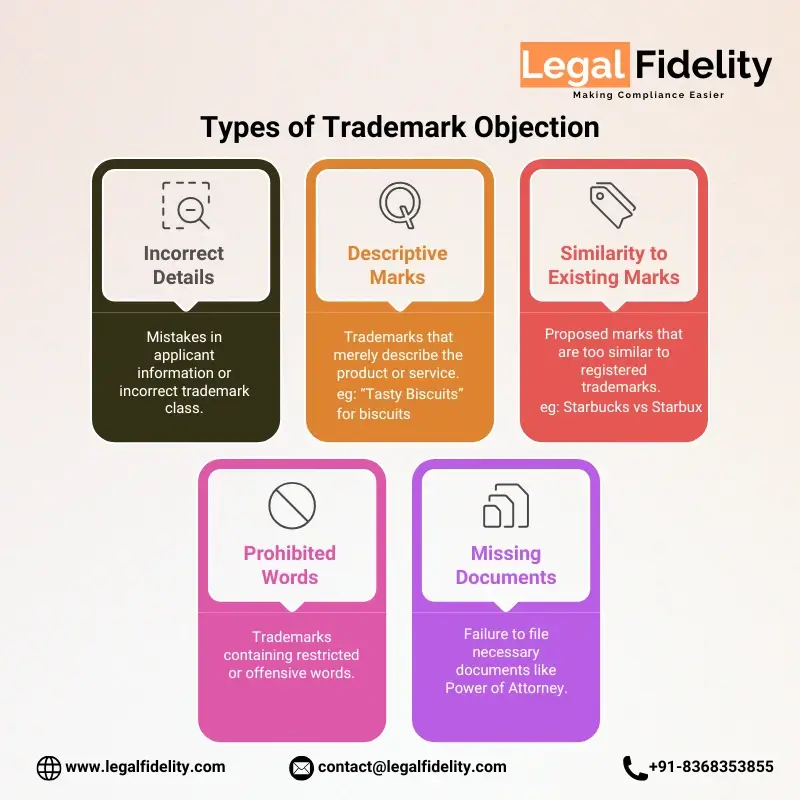
Types of Trademark Objection Reply | LegalFidelity

Trademark Objection Process in India

Examination of Application

The Registrar examines the application and investigates the errors, discrepancies with other existing marks or legal matters.

Examination Report Issued

  • In the event of any issue being detected, an Examination Report is issued by the Registrar.
  • The report is either submitted to the applicant or agent or posted on the official Trademark Registry site.

Reply to Trademark Objection

  • A written reply must be duly filed by the applicant within 30 days of the date of the report.
  • This response must be a clear explanation as to why the trademark should be registered, based on legal grounds, documents, and proof of use, in case of prior usage.

Show-Cause Hearing (if required)

  • A personal hearing is scheduled in case the Registrar considers the reply inadequate.
  • The applicant or their trademark attorney or agent should be present and present effective arguments with supporting documents.

Decision by Registrar

  • When the Registrar is satisfied, the trademark is accepted and published in the Trademark Journal.
  • Otherwise, the application is refused or rejected. Nevertheless, the applicant has the option to challenge the ruling to superior authorities.

Step 1: Consultation & Review

LegalFidelity reviews your notice to prepare an initial report on objections raised by the registrar and how to handle them.

Step 2: Collecting Supporting Documents

We will help to gather all the necessary documents: POA Form TM-48, user affidavit in case of previous use, and the evidence invoices, advertisements, Internet or social media evidence.

Step 3: Drafting a Strong Reply

LegalFidelity trademark specialists draft a legally valid and persuasive answer to each point made by the Registrar. Response is tailored to improve your application and improve the possibility of being approved.

Step 4: Filing the Reply Online

After preparing the response we submit it to the Trademark Department along with supporting documents and make sure all the requirements related to the process are met.

Step 5: Follow-up & Representation

After the reply is filed, LegalFidelity will follow up the application process, update you, and should there be a hearing scheduled, our professionals will argue on your behalf to the Registrar until the case is determined.

Documents Required to File a Trademark Objection Reply

Power of Attorney (Form TM-48)

Authorizes your trademark agent or attorney such as LegalFidelity to represent you before the Registrar.

User Affidavit

You should also submit a notarized affidavit with evidence to prove your claim when asserting that you have used the mark earlier and the evidence that can be provided to prove the claim can be sales record, advertisement or even promotional material.

Proof of Trademark Usage

Documents of a use of the mark on the market, such as Bills and invoices, labels and packaging of the products, Newspaper or Web pages and certificates of domain name and Social media campaigns or advertisements.

Examination Report Copy

An objection formally made by the Registrar of Trademarks.

Trademark Application Copy

Application copy including information like class, description of goods/services and details of the applicant.

Authorization Letter (if applicable)

This is mandatory when an employee or representative of a firm is submitting on behalf of the applicant.

Timeline to Respond to Trademark Objection

You should submit your response to the Examination Report within 30 days of receiving the same. Under the Trade Marks Act, 1999, this is a strict deadline.

Any failure to act within the time allocated will lead to the abandonment of your trademark application.

When the Registrar is not entirely convinced with the response, a trademark hearing might be scheduled. It typically occurs within 2 to 6 months depending on the workload of the Trademark Registry.

In case the Registrar is satisfied with the response and/or submissions presented during the hearing the application is approved and posted on the Trademark Journal to allow opposition by the other parties. Otherwise, there is rejection of the application.

Cost of Trademark Objection Reply in India

The fees to respond to a trademark objection in India are not standardized, they can vary depending on the details of the objection, the volume of evidence needed, and the involvement of a professional trademark expert.

By using LegalFidelity experts, you would have a reply that is legally sound, properly written, and supported with the necessary evidence that would greatly reduce the chances of prevailing against the objection and allow you to obtain the trademark.

Trademark Objection vs. Opposition Vs Infringement

AspectTrademark ObjectionTrademark OppositionTrademark Infringement
When it occursAt the time of examination by the RegistrarAt the time the trademark is published in the Trademark JournalAt the time the trademark was registered.
Who raises itTrademark ExaminerThird party (any person)Trademark owner
PurposeTo disclose or rectify problems in the applicationTo oppose a pending registration of a trademark.To prevent unauthorized or illegal use of a registered mark.
OutcomeApplicant must answer to continue with the processThe registrar will either grant registration or repudiate the mark.by means of legal action in court.

Consequences of Not Responding to a Trademark Objection

Failure to respond within 30 days of receiving the Trademark Objection leads to:

  • Application Abandonment : According to Trade Marks Act, 1999, the Registrar records the application as abandoned when no response is made within the legal time period.
  • Loss of Priority Rights : The loss of your original filing date, thereby weakening your rights against the later applicants of a similar mark.
  • Risk of Brand Misuse : In absence of registration, other businesses or competitors could use a similar name or logo which would cause confusion of the market and potential disputes.
  • Extra Costs & Delays : You will have to repeat the whole procedure by submitting a new application, paying new government fees and it will take you even more time to get your brand registered again.
  • Limited Legal Protection : The rights of your brand are not strongly established until the registration of the mark and it is more difficult to protect your brand by the trademark law in case of infringement.

Conclusion

A Trademark Objection is not a rejection. It can be sorted out smoothly with proper documents, good reasoning, and a timely response. Our experts at LegalFidelity make sure your response is adequately prepared, legally effective and more likely to get the objection removed.

Who does the work

A verified network of CAs, CS and lawyers

Every filing is prepared and reviewed by a qualified professional — never a bot, never an intern.

CA

Chartered Accountants

GST, ITR, audits, bookkeeping and tax planning — handled by practising CAs with startup experience.

GST & returnsTax planningAudit support
CS

Company Secretaries

Incorporations, ROC filings, board resolutions and secretarial compliance, done right the first time.

IncorporationROC filingsGovernance
ADV

Lawyers & IP Attorneys

Trademarks, agreements, licences and legal notices — drafted and filed by experienced advocates.

Trademark & IPContractsLicences
Every professional on our panel is verified — membership numbers checked with ICAI, ICSI and Bar Council records.
Trusted by founders across India

What Our Clients Say

LegalFidelity made starting my business incredibly simple. Their step-by-step guidance and expert support were invaluable — from name approval to my first GST return, one team handled everything.

The most reliable legal service platform. They handled all our compliance needs efficiently and professionally.

Their expertise in business registration and compliance saved us countless hours. Highly recommended!

Free consultation · No obligation

Talk to a Startup Expert. Free. Today.

Tell us what you're building. We'll tell you exactly what you need, what it costs, and how long it takes — before you pay a rupee.

Fixed, all-inclusive quote upfront
Callback within 30 minutes, 9am–9pm
Advice from a qualified CA / CS — not a sales rep
Free Consultation

Get your free expert call

Our Startup Expert will connect with you for a detailed consultation.

Your info is safe. No spam, ever.