








+918368353855contact@legalfidelity.comITR season is open · File before 31 JulyFile Now →
4.8 · Average Google Rating

Trade Licence Registration - from your local municipal body

A trade licence is the permission your municipal corporation gives you to run a particular trade at a particular address. Every city writes its own rules — the name, the fee, the documents and the renewal cycle all differ. We find out what yours requires and file it.

  • Right licence category chosen — general, health or industrial
  • Filed with the municipal corporation or council for your address
  • NOC, premises and owner-consent documents prepared for you
  • Inspection and departmental queries handled until the licence issues
  • Renewal tracked and filed on your municipality's cycle
10,000+
Happy Customers
70,000+
Services Completed
4.8
Average Google Rating
Free Consultation
Free expert call
Get started with Trade License

Our expert will connect with you for a detailed consultation.

Your info is safe. No spam, ever.
Free Consultation
100% Online Process
No Hidden Costs
Satisfaction Guaranteed
ISO 9001 Certified
Trusted by 10,000+ founders & businesses across India
AWSCarDekhoHDFCOYORapidoSwiggyTata PlayTestbookAWSCarDekhoHDFCOYORapidoSwiggyTata PlayTestbook
Overview

What is a Trade Licence?

A trade licence is a permission issued by the local municipal body — a municipal corporation, municipality, nagar panchayat or the relevant state authority — allowing you to carry on a specified trade or business at a specified premises within its limits. It is not a registration of your company and it says nothing about who owns the business. What it certifies is that the activity you propose to run is permitted at that address, and that the premises meet the local rules on safety, health, sanitation and zoning.

This is an entirely local licence, and that is the most important thing to understand about it. There is no national trade licence Act. The name of the licence, the fee, the documents demanded, whether an inspection is required and how often you must renew are all decided by the municipality your premises fall under — the rules in Mumbai are not the rules in Bengaluru or Kolkata. Anyone who quotes you a single all-India rule for trade licences is guessing. Broadly, licences fall into three families: a general trade licence for ordinary commercial activity, a health trade licence for food, restaurants and health-related trades, and an industrial licence for factories and manufacturing units.

We, at LegalFidelity, work out which municipal body your premises fall under and which category your trade sits in, prepare the documents in the form that body accepts, pay the municipal fee, and follow the application through inspection to issue. On the Premium plan we also file the renewal when it falls due, because the renewal cycle is one of the easiest things for a busy owner to miss.

Issued by
Local municipal body (corporation / municipality)
Governed by
State municipal Acts — no national law
Common types
General · Health · Industrial
Renewal
Periodic — cycle set by your municipality
Why it matters

Benefits of holding a trade licence

Trade legally at your premises

The licence is the municipality's formal permission to run your trade at that address. Without it, the business is operating outside the local law.

Protection from municipal action

A valid licence keeps you clear of fines, notices and sealing orders that municipal bodies issue against unlicensed premises.

Unblocks other approvals

FSSAI, pollution control consent, fire NOC and several state registrations are far easier to obtain once you can show a valid trade licence.

Easier banking and credit

Banks and NBFCs treat a municipal trade licence as proof of a genuine, permitted business when assessing a current account or a loan.

Credibility with customers and landlords

A licensed shop or restaurant signals to customers, landlords and suppliers that the premises have been cleared by the local authority.

Eligibility for tenders and contracts

Government bodies and large corporate buyers routinely ask for the trade licence as part of vendor onboarding and tender documentation.

Eligibility

Who needs a Trade Licence?

Retail shops, showrooms, supermarkets and trading counters inside municipal limits
Restaurants, cafés, bakeries, cloud kitchens and any food business — usually a health trade licence
Salons, spas, gyms, clinics, coaching classes and other service establishments
Factories, workshops, manufacturing and processing units — usually an industrial licence
Warehouses, godowns and storage premises within a municipal area
Any trade that a municipal body has notified as requiring its permission at that address — check locally, because the notified list differs by city
Checklist

Documents required

Identity of the applicant

  • Aadhaar card, Voter ID or Passport of the applicant
  • PAN card of the business or the proprietor
  • Passport-size photographs of the applicant

Proof of premises

  • Rent agreement, or ownership documents if the premises are owned
  • Latest electricity or water bill for the premises
  • NOC from the property owner where the premises are rented
  • Property tax receipt for the premises

Business & trade-specific papers

  • Certificate of incorporation, partnership deed or proprietorship declaration
  • Layout plan or site plan of the premises
  • Fire safety NOC — where the trade or the size of premises requires it
  • Pollution control NOC and health certificates — for industrial and food trades
How it works

How trade licence registration works

01

Free consultation

Fill the form and our expert calls you to identify which municipal body covers your premises and which licence category your trade falls into.

02

Share documents

Send your ID, premises proof, owner NOC and business papers from your phone. We tell you exactly what your city asks for.

03

We file with the municipality

We prepare the application in your municipality's format, pay the municipal fee and file it, then handle queries and support the inspection if one is scheduled.

04

Get your licence

Your trade licence is issued by the municipal body and delivered to your dashboard, usually in 7–20 working days depending on the city and whether an inspection is required.

Ready to get your Trade License?

Talk to a Licenses & Certifications expert for free. Fixed quote upfront, no hidden costs.

Why act now

What happens if you trade without a licence

Running a trade inside municipal limits without the licence that municipality requires is an offence under the relevant state municipal Act. The amounts are fixed locally, but the consequences take the same shape in every city.

Municipal fines

The municipal body can impose a monetary penalty for unlicensed trading, and many allow a further fine for each day the default continues.

Sealing or closure

Municipal corporations have the power to seal premises or order the business shut until the licence is obtained — the most expensive outcome by far.

Prosecution

State municipal Acts allow the local body to prosecute persistent unlicensed traders, not merely fine them.

Downstream approvals stall

FSSAI, fire and pollution clearances, bank credit and vendor onboarding all ask for the trade licence, so operating without one blocks far more than the licence itself.

Questions answered

Frequently asked questions

A trade licence is a permission granted by your local municipal body allowing you to carry on a specified trade at a specified premises within its limits. It confirms that the activity is permitted at that address and that the premises comply with local safety, health and zoning rules. It is not a company registration and it does not certify ownership of the business.

It is mandatory wherever the municipal body has notified your trade as requiring one — which in practice covers most shops, restaurants, factories and service establishments operating inside municipal limits. But the notified list, the exemptions and the thresholds are set city by city, so the honest answer is that it depends on your municipality and your trade. We check that for you before filing anything.

Typically 7–20 working days. The range is wide because it depends on your municipality and on whether a physical inspection of the premises is required before the licence is granted.

Because they are. There is no national trade licence law. Each state's municipal Act empowers the local body to license trades, and each corporation or municipality sets its own categories, fees, documents, inspection practice and renewal cycle. Treat any "all-India trade licence rule" you read online with suspicion.

  • General trade licence — ordinary commercial and trading activity.
  • Health trade licence — food, restaurants, bakeries and health-related trades.
  • Industrial licence — factories, workshops and manufacturing units.

The exact names vary by municipality, but nearly every city follows this three-way split.

No. The licence is the permission to trade, so you should not begin operations until it is formally issued. Trading in the meantime exposes you to municipal fines and can prejudice the application itself.

Yes, in most municipalities. The renewal cycle and the renewal window are set locally — annual renewal is common, but it is not universal. We confirm your city's cycle before filing, and the Premium plan covers the renewal when it falls due.

Our professional fees start at ₹2,999, with the municipal fee charged at actuals on top — that fee is set by your local body and depends on the trade and the size of the premises. The process is handled online: you share documents from your phone and we deal with the municipality. If your city insists on a physical inspection of the premises, someone will need to be at the shop or office when the inspector visits.

No. A trade licence is municipal permission to run a trade at a premises. Udyam is central MSME recognition, and GST is a tax registration. They serve different purposes and most businesses end up needing more than one of them.

Yes. Food businesses normally need a health trade licence rather than a general one, plus an FSSAI licence, and depending on the size of the premises a fire safety NOC as well. We will map out the full list for your specific setup on the consultation call.

Still have questions? Talk to an expert
In depth

What is a Trade License in India?

Who Needs a Trade License?

  • Retail stores and wholesalers: clothing store, supermarket, electronics store or wholesale.
  • Food related enterprises: restaurants, cafes, bakeries, hotels, catering, food stalls.
  • Personal care and wellness services: beauty shops, spas, gym and barbers.
  • The industrial and manufacturing facilities: production plants, warehouses.
  • Healthcare: medical stores, clinics, hospitals, pathology laboratories and diagnostic centres.
  • Professional and service related business: this includes consultancy firms, advertising agencies, IT service providers or any other commercial service.

Businesses in urban and semi urban areas are primarily controlled by:

Types of Trade Licenses in India

General Trade License

It is the general type of a license. It is given to those shops, offices and service based enterprises that trade in non hazardous goods or services. Examples are clothing stores, stationery, salons or consultancy firms. This is a license that permits businesses to operate lawfully in their locality.

Health Trade License

This license is mandatory for businesses that affect public health directly, such as:

  • Food processing units, cafes, bakery, and restaurants.
  • Hotels, spas, salons, and wellness centres.
  • Hospitals, clinics, etc, and similar establishments

It makes sure that the business practices health, hygiene, and sanitation standards that are required by local authorities to ensure the safety of the people.

Industrial Trade License

This license is a requirement to the factories, warehouses and manufacturing units which make use of machinery, labour or industrial processes. It makes sure that such businesses are in accordance with industrial safety regulations, labour laws and environmental conservation standards in order to avoid hazards and pollution.

Other State-Specific Categories.

Besides the major categories, there are also specialized licenses that might be required by some states depending on the nature of business. Examples include:

  • Fire Safety License: where the fuel station, warehouse or a place where there are combustible materials are concerned.
  • Lodging House License: in case of hotels, hostels and guest houses.
  • Pollution Control License: industries that emit waste or pollution.

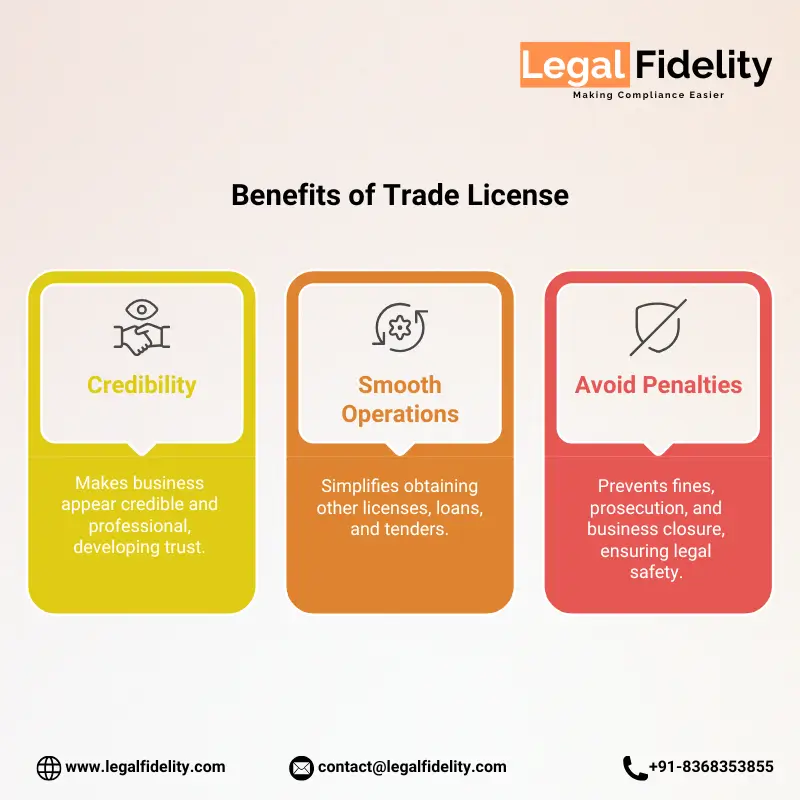
Benefits of Having a Trade License

Credibility and Protection by Law.

It makes your business appear credible and professional. It develops trust and confidence among customers, banks and partners.

Smooth Operations

Having a trade license makes it simpler to obtain other licenses such as GST, FSSAI, or Pollution Control, take loans and even tenders.

Avoid Penalties and Closure

Without a trade license, you may face fines, prosecution, or even the shutdown of your business. A license makes you worry-free and legally safe.
Benefits of Trade License Registration | LegalFidelity

Step by Step Process for Trade License Registration

LegalFidelity simplifies trade license registration, ensures the registration is correct and hassle-free and assists your business to commence legal and safe.

Check Local Eligibility

Ensure your business operation and location are within the local rules.

Submit the Application

Filling up the application form with the following information: name of business, owner details, type of business and type of license.

Upload Documents

Provide any required paper work such as ID documentation, business documentation, and property documentation. LegalFidelity makes sure that there is nothing missing or incorrect.

Inspection by Authorities

Your premises can be visited by the municipal officers to ensure that safety and zoning rules are observed.

Approval and Issuance

After being checked, the license is issued within 7-21 days.

Documents Required for Trade License

Identity and Address Proof

You must submit a copy of identity and address including, Aadhaar card, Voter ID or Passport of an applicant and PAN card of business or owner.

Business Address Proof

Documents that prove your business address like Rent agreement or property ownership documents and recent electricity or water bill.

NOC from Property Owner

When renting a property in order to carry out your business, you require a No Objection Certificate (NOC) of the owner.

Other Health or Industrial License Document

Other documents might be needed, depending on the type of business:

  • Certificate of health: salon, spa, bakery, food processing plant.
  • Pollution control NOC: factory or industrial unit.
  • Fire safety NOC: this applies to the companies that handle dangerous or flammable materials.
  • Premises layout or plan: Show layout of your shop, office or factory.
  • Certificate of incorporation: where companies or LLP are concerned.

Trade License Fees and Charges

In India, the cost of a trade license depends on various factors including the nature of business, place and volume of trade. Every locality or municipal government possesses its own guidelines of fees to be charged by state or local regulations.

The key factors to consider when determining the fee are:

  • Business Location: The cost tends to be higher in big urban cities than in small towns or rural regions.
  • Type of Business: Industrial or hazardous businesses tend to pay higher fees than general shops or service-based businesses.
  • Size of Premises: Larger establishments have higher fees compared with smaller ones.
  • Business Turnover: The license fee can also be based on the annual revenue of the business in certain states.

Validity, Renewal and Modification of Trade License

License Validity

A trade license usually lasts for one year, between April 1 and March 31. Multi-year validity like 3-5 years is permitted in some states to minimize repeated administrative effort.

Renewal Timeline and Process

You are normally allowed to renew your license 30-90 days before the expiry date, by municipalities. Failure to renew in time can lead to either late fees or temporary suspension of your license.

Modification in the case of business changes

You need to apply to obtain a modified license in case of any modifications in your business. This includes changes like:

  • Transfer of ownership or partners.
  • Change of business address.
  • Modification in nature of trade like transformation of retail into food services.
  • Expansion or addition of premises space.

Penalties for Not Having a Trade License

Conducting business without a registered trade license can lead to severe repercussions as per the local municipal laws like Fines, Closure of Business and Legal Action

How to Check a Trade License Status

In almost all states and cities, Municipal portals have quick and simple to use portals to check the status of your Trade License application.

Trade License for Different Business Categories

Shops and Commercial Establishments.

Small retail stores, boutiques and service centers require a general trade license issued by the municipal authority. Ensure that your business site is within the local zoning laws and shop establishment requirements.

Restaurants, Food Businesses, Cafes.

Food related businesses should possess a Trade license, a Health Trade license, and FSSAI registration.

They are also expected to practice good hygiene, waste management and fire safety to ensure that the people are safe.

Factories and Manufacturing Units

With the assistance of the appropriate authorities, factories and other industrial units must take an Industrial Trade License and other approvals, including:

  • Pollution Control Board (PCB)
  • Fire Department
  • Labor and Safety Departments.

Hazardous Goods and High-Risk Businesses

Special permissions are required in businesses dealing with chemicals, fuel, explosives, or other dangerous substances, such as:

  • Hazardous trade approval
  • Environmental clearance
  • Fire NOC and pollution control certificate

Trade License vs Shop and Establishment License

AspectTrade LicenseShop & Establishment License
PurposeThe business activity must operate legally and safely and must not contribute to a negative effect on human health and safety.Maintains fair working conditions, employee rights, and rules of business operation.
Governing AuthorityAuthority of the local civic body or the Municipal CorporationIssued by the Labour Department under the State Shop and Establishment
Who it Applies ToAll types of trades such as restaurants, factories, manufacturing units and service based businesses.Stores, offices, IT companies and other organizations that have employees.
Focus AreaAdherence to safety, health, and zoning regulations.Providing employee welfare, good working hours and labor laws.
When to ApplyBefore starting your business.After determining the place of work or hiring employees.

Businesses requiring both Trade License and Shop Act Registration

There are businesses which require Trade License along with Shop and Establishment License before operation.

Examples:

  • A restaurant should possess a Health Trade license to ensure its hygiene and food security and a Shop and Establishment license to comply with employee regulations and labor laws.
  • A retail store or salon or service centre also needs both licenses, one that will ensure that the business activity is legal and the second license is to ensure that the workers rights and regulations of the working place.

  • End to End Support: LegalFidelity will take care of the entire process of filing the application till the granting of the license.
  • Error Free Documentation: Error Free Documentation: Our staff ensures that all forms and documentation they use are in line with the local municipal requirements to reduce the possibility of rejection.
  • Quickly Approved: LegalFidelity has been working with the civic procedures and ensures your application is approved with ease.
  • State Wise Compliance: Each state and municipality has its regulations. We assure you that your application is within the particular legal requirement within your location and line of business.

Who does the work

A verified network of CAs, CS and lawyers

Every filing is prepared and reviewed by a qualified professional — never a bot, never an intern.

CA

Chartered Accountants

GST, ITR, audits, bookkeeping and tax planning — handled by practising CAs with startup experience.

GST & returnsTax planningAudit support
CS

Company Secretaries

Incorporations, ROC filings, board resolutions and secretarial compliance, done right the first time.

IncorporationROC filingsGovernance
ADV

Lawyers & IP Attorneys

Trademarks, agreements, licences and legal notices — drafted and filed by experienced advocates.

Trademark & IPContractsLicences
Every professional on our panel is verified — membership numbers checked with ICAI, ICSI and Bar Council records.
Trusted by founders across India

What Our Clients Say

LegalFidelity made starting my business incredibly simple. Their step-by-step guidance and expert support were invaluable — from name approval to my first GST return, one team handled everything.

The most reliable legal service platform. They handled all our compliance needs efficiently and professionally.

Their expertise in business registration and compliance saved us countless hours. Highly recommended!

Free consultation · No obligation

Talk to a Startup Expert. Free. Today.

Tell us what you're building. We'll tell you exactly what you need, what it costs, and how long it takes — before you pay a rupee.

Fixed, all-inclusive quote upfront
Callback within 30 minutes, 9am–9pm
Advice from a qualified CA / CS — not a sales rep
Free Consultation

Get your free expert call

Our Startup Expert will connect with you for a detailed consultation.

Your info is safe. No spam, ever.