







What is Trademark Opposition in India?
Table of Contents
Trademark Opposition refers to a legal procedure that assists in safeguarding the brand owners of an existing brand against others registering a similar or conflicting trademark.
Upon scrutiny and approval of a trademark application by the Trademark Office, it is published in the Trademark Journal. The mark is publicly available within the period of four months after the date of publication.
Any individual who feels that registration of the published mark might affect his or her rights, or create confusion with its existing brand, can initiate a Trademark Opposition during this time.
Importance of Trademark Opposition in Brand Protection
Trademark Opposition is significant to protect your brand name and reputation. It enables business owners to take action early and avoid any possible conflict before it turns into a serious legal problem.
- Prevents Brand Dilution: Prevents the registration of the same or similar mark that may cause confusion to the customers or dilute your brand individuality.
- Maintains Market Exclusivity: This gives you the right to ensure that your brand name, logo, or symbol is not used improperly by your competitors.
- Avoids Future Lawsuits: Assists in settling conflict situations early on, saving time and money on the expensive litigation process in the future.
- Supports Unique and Real Registration: The trademark system is just in a way that only unique and real trademarks are registered.
Legal Foundation under the Trade Marks Act, 1999
The Trademark Opposition in India that is administered under the control of the Trade Marks Act, 1999 and the Trade Marks Rules, 2017 under the jurisdiction of the Registrar of Trademarks.
Section 21 of the Act, any person, firm or partnership can present an objection, in case a person feels that the published trademark is going to infringe his or her rights, or that it will be confusing, or that it will have a negative effect on his or her businesses.
This will be to maintain fairness and avoid misleading or conflicting with trademark registering to the actual owners of the brand.
Trademark Objection vs Opposition vs Infringement
It is important to know the distinction between objection, opposition, and infringement in order to defend your trademark rights during various registration and use.
| Aspect | Trademark Objection | Trademark Opposition | Trademark Infringement |
|---|---|---|---|
| When it occurs | At the time of examination by the Registrar | At the time the trademark is published in the Trademark Journal | At the time the trademark is registered |
| Who raises it | Trademark Examiner | Third party (any person) | Trademark owner |
| Purpose | To disclose or rectify problems in the application | To oppose a pending registration of a trademark | To prevent unauthorized or illegal use of a registered mark |
| Outcome | Applicant must answer to continue with the process | Registrar will either grant registration or repudiate the mark | by means of legal action in court |
When and How to File a Trademark Opposition
The Trade Mark Act, 1999, Section 21(1), provides that a Trademark Opposition must be made within a duration of four months after the date of registration of the mark in the Trademark Journal.
It is objected to the Registrar of Trademarks at the Trademark Registry Office to which the application is submitted.
The Trademark Registry Offices are located in India:
- Mumbai
- Delhi
- Chennai
- Kolkata
- Ahmedabad
This early application helps to avoid the registration of marks that could conflict with existing registered rights.
Who Can File a Trademark Opposition
According to the Indian trademark law, any individual who feels that a published mark may somehow adversely affect their rights or reputations, or will create confusion, has the right to file a Trademark Opposition. This includes:
- Registered Trademark Owners: in order to protect their already registered marks against such similar or common applications
- Prior Users: This prior use is useful to prevent registration of marks that might be conflicting with current registered rights
- Licensees or Assignees: legal persons authorised to have rights in the trademark
- Consumer or Trade Associations: Associations that represent the interests of the public or consumers
- Any Other Interested Person: any person who might be infringed by the registration of the mark
In short any party which is a real sufferer has a right to initiate an action against a mark in the law to make rights in the law fair and safe and to avoid confusion to the people.
Grounds & Reasons for Trademark Opposition
Trademark Opposition according to Trade Marks Act, 1999 was offered on a variety of grounds. Common reasons include:
Identical or Deceptively Similar Trademark
In case, where the mark applied is identical or has a close relation to an already registered or likely to be registered mark, it creates a risk of confusion between the consumer.
Bad Faith or Dishonest Filing
Where the application is submitted based on the intention to abuse, duplicate or unfair use of another brand goodwill or reputation.
Descriptive or Non-Distinctive Mark
Directly descriptive marks indicating the nature or quality of goods or services, Fresh Milk of dairy products or too generic are ineligible to registration.
Consumer Confusion Likelihood
The misleading of the source or origin of quality of goods or services to the people by the mark.
Infringement of Well Known or Registered Marks
Section 11(2) gives that in lieu of the imitation or violation of a mark, a notice of opposition can be applied towards the well known trademark.
Contrary to Law or Morality
Offensive, deceptive and unethical marks are not registrable.
How to File a Trademark Opposition
Formal is the filing of a Trademark opposition that must be done carefully within the given time. The key steps are:
- Identify the Conflicting Trademark: Find the mark that you would like to contest in Trademark Journal.
- Prepare a Notice of Opposition (Form TM–O): The details that must be stated include your name, address, the information about your trademark, and reasons of opposition.
- Attach Supporting Documents: Provide evidence, certificates and Power of Attorney Form TM-48 in case of filing by an agent or attorney.
- File Online or Offline: The objection can be done online, through IP India portal or through the physical submission at the respective Trademark Registry office.
- Pay the Prescribed Fee: The cost per opposition is Rs. 2,700 through online or Rs. 3,000 offline per opposition.
On receiving the same, the Registrar of Trademarks sends a copy of the opposition to the applicant, which is the formal beginning of the opposition process.
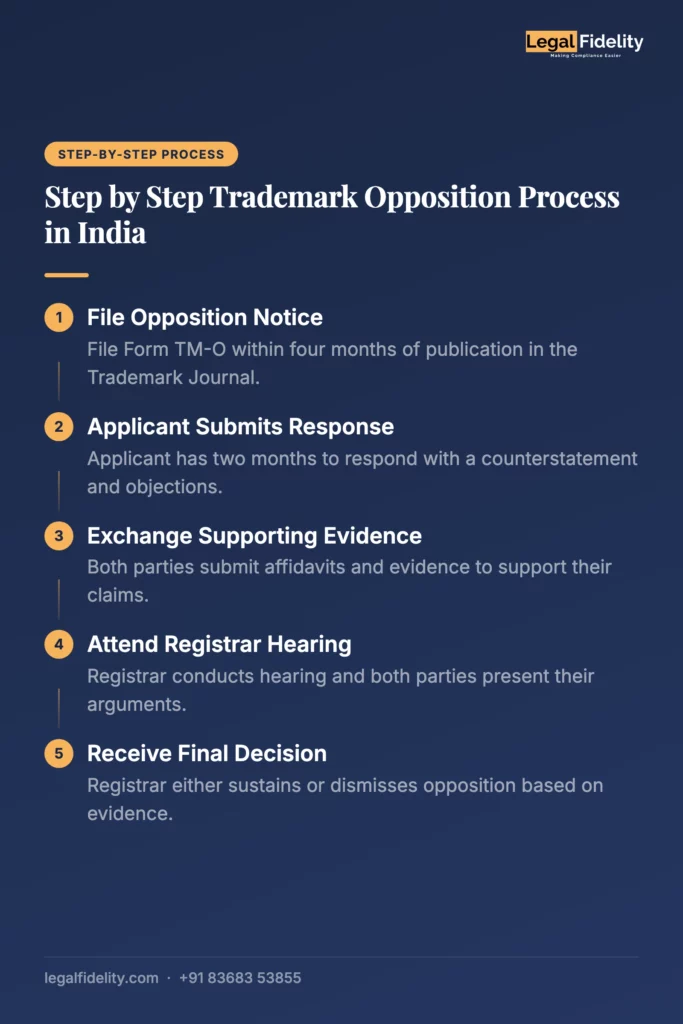
Step by Step Trademark Opposition Process in India
The Trademark Opposition procedure is overseen by the Rules 42 to 51 of the Trade Marks Rules, 2017, and it consists of a series of steps prior to the Registrar of Trademarks. The simple way it works is as follows:
Filing the Opposition
The individual or entity that is against the mark files a formal notice Form TM-O within four months of the mark being published in the Trademark Journal, as to why the mark should not be registered.
Applicant’s Response
The applicant is given 2 months period to respond in defense of his or her mark and respond to any objection as well.
Submission of Evidence
Both parties must provide evidence in favor of the evidence in the form of affidavits, provide use evidence, or any other evidence to support the claims.
Hearing Before the Registrar
The Registrar conducts a hearing after examining all documents and gives both parties an opportunity to argue their case.
Final Decision
Depending upon the facts and evidence the Registrar will either sustain the opposition means the mark is refused registration or dismiss the opposition means the mark proceeds to registration.
The Order of registration is finally registered and published by Trademark Office.
Documents & Evidence Required for Trademark Opposition
In order to back a Trademark Opposition, the opponent is supposed to provide good documents and evidence to make his claims stronger. The major requirements are:
- Notice of Opposition (Form TM–O): The principal document containing information about the opponent, grounds, and reasons of objection.
- Power of Attorney (Form TM–48): Required when the opposition is filed by way of a trademark agent or attorney.
- Proof of Prior Use: Evidence such as Invoices, packaging, advertisement, or domain records of the mark being used continuously.
- Certificate of Registration: A copy of your current trademark registration or proposed registration, where necessary.
- Evidence of Reputation or Goodwill: Such documents such as sales information, advertisement papers, prizes, or reviews of the mark proving its recognition.
- Affidavit with Supporting Documents: A written statement of assurance that all the evidence presented is accurate and valid.
Forms, Fees & Deadlines for Trademark Opposition
Form TM–O
The TM-O form is the major document in the process of opposition of trademarks. It has two major uses, it may be used to file a Notice of Opposition or a Counterstatement when responding to an opposition.
The form should include:
- Specification of the opposed trademark: application number, class, name of the applicant and mark.
- Opponent information: name of opponent, address of opponent and capacity opponent is being filed under.
- Legal reasons under sections 9 and 11 of the Trade Marks Act, 1999.
- Signing of the opponent or his or her representative or attorney.
Government Fees
As per the official IP India fee schedule:
- Rs. 2,700: for online filing through the IP India portal.
- Rs. 3,000: when submitted offline at the respective Trademark Registry office.
Timelines for Each Stage
The opposition to trademarks is conducted in compliance with strict statutory deadlines. Failure to provide them may lead to the abandonment of the opposition or application.
| Stage | Action | Time Limit | Provision |
|---|---|---|---|
| Filing of Opposition | after publicity of mark | Within 4 months | Section 21(1) |
| Counterstatement | applicant may reply | Within 2 months of receiving notice | Rule 44 |
| Evidence by Opponent | Supporting documents and proof | Within 2 months after counterstatement | Rule 45 |
| Evidence by Applicant | Evidence in reply | Within 2 months after opponent’s evidence | Rule 46 |
| Hearing | Conducted by Registrar | As scheduled | Rule 50 |
Responding to a Trademark Opposition
How to File a Counterstatement
As long as opposition has been made against your trademark, it would be well to send a Counterstatement in Form TM-O.
Deadline: 2 months of the date of notification of the opposition.
Your counterstatement should:
- Answer all the points in the opposition in a factual and simple way.
- Give a justification as to why you decided to use the mark, either through its meaning, uniqueness or appropriateness to your business.
- Give documents to indicate actual use of the mark or you intend to use it.
Failure to submit the counterstatement within the 2 month period automatically abandons the trademark application according to the Trade Marks Rules.
Preparing Evidence to Defend Your Trademark
To protect your trademark, you must demonstrate that you are in actual use of the marks and that you are in goodwill. Evidence may include:
- Evidence of first use: invoices, product labels, packages, product listing on the Internet, etc.
- Advertisements and promotional material: posters, social media advert, brochures.
- Sales data and market coverage: sales data, coverage, market, distribution.
- Web page snapshots and domain name records with your brand online.
- Any goodwill and reputation awards, certifications or recognition.
All the evidence should be relevant, genuine and dated according to the Trade Marks Act and Rules.
Common Defenses Used by Applicants
In opposition of a trademark, the applicants usually use the following legal defences:
- Good faith and fair competition: You have been using the mark in good faith and independently.
- Prior use: It was your mark that was adopted and used before the opponent commenced using his mark.
- Acquired distinctiveness: This mark has acquired distinctiveness due to long and continuous use.
- No similarity: The mark that you have is visually, phonetically, and conceptually dissimilar to the opponent mark.
- Other business areas: The goods/services do not relate, they do not belong to the same categories, or they do not imply the same trade channels, and there is no chance to be confused.
Attending Hearings Before the Registrar
Once the evidence of both sides is received:
- A hearing is scheduled by the Registrar of Trade Marks.
- Both parties should have oral arguments or they can have their own attorneys.
- All the documents, evidence and legal precedents are reviewed by the Registrar.
- Merits of the case and Trade Marks Act are the basis on which final decision is made.
Settlement or Withdrawal Options
The trademark opposition questions can be solved without the hearing:
- There is the settlement or co-existence agreement of parties.
- The opponent may withdraw the opposition by clarifications or through understanding.
- A trademark modification is something you can do to remove the confusing elements.
The settlement process often is faster, easier, and less expensive than proceeding to the entire opposition hearing process.
Post-Opposition Outcomes & Appeals
The Registrar of Trade Marks may make any of the following orders following the review of the opposition evidence and hearing arguments:
- Opposition Accepted: The opposition is successful and your trademark application is rejected.
- Opposition Rejected: The opposition has been rejected and your trademark proceeds to registration.
- Partial Acceptance: Acceptance is made of some only of the goods/services; the mark can be limited or altered to eliminate conflict.
Appeal Process Before the High Court (IP Division)
In the past, appeals involving trademarks were done to the Intellectual Property Appellate Board (IPAB).
Since the abolition of the IPAB, all the appeals have been transferred to the Intellectual Property Division (IPD) of the respective High Court according to Section 91 of the Trade Marks Act.
The appeal should be within a period of 3 months after the order made by the Registrar.
How to Avoid Trademark Oppositions
Perform Detailed Trademark Search
You must always search before placing your application in the IP India database and other internet sources in an attempt to ensure that your proposed mark is not similar or deceptively identical with the existing trademarks.
Select a Unique Brand Name
Avoid use of repetitive, descriptive or generic words.
An original or coined word (e.g., Zyntra, Belvyn) is more original and will not be so easily opposed by objections as a trade mark under Sections 9 and 11 of the Trade Marks Act.
File in the Correct Class
India uses 45 classes (1-34 and 35-45) of Nice Classification system for goods and services.
Making the right selection prevents the objections of the incorrect or missing classification.
Present Correct Application Information
Make sure that:
- The information about applicants is accurate.
- Goods and services are well defined.
- In case required, Form TM-48 Power of Attorney is duly signed and uploaded.
Accuracy minimizes the procedural objections of the Registry.
Use a Clear Logo or Wordmark
Make sure that the logo or wordmark is readable, original and not close to any existing registered mark.
Designing clarity enhances your application and the possibility of opposition based on confusion is minimized.
Maintain Usage Proof
Keep records such as:
- Invoices and packaging
- Advertisements and promotional material.
- Social media and websites screenshots.
These documents will be demanded in case somebody has an objection or opposition to your mark.
Early File and Keep Track of your Mark
India has a first to file system, which implies that the first to apply is given first consideration.
Early filing and frequent use of Trademark Journal prevents any conflict with subsequent application.
LegalFidelity simplifies, expedites, and has an expert to overcome the trademark objections, and makes sure that your brand is not impacted.
Why Choose LegalFidelity for Trademark Objection Reply
LegalFidelity makes it easy, fast and with the help of an expert to manage the trademark objections, and ensure that your brand is not affected.
- Detailed Check of Your Objection: We read each of the points in our objection very carefully to get ourselves clear on the problem and determine how best to respond.
- Replies and Counterstatements that are Professionally Written: We take time to examine each point being presented in the objection so that we understand what is wrong and how to respond in the most appropriate way.
- Full Paperwork and Submission on Time: We make the necessary preparations, make sure all the documents are in and submit them prior to the deadline so that your application is not rejected or postponed.
- Legal Support & Ongoing Tracking: When hearing you out before the Registrar, we represent you until the time when your trademark gets to be registered.
Conclusion
Trademark opposition is a significant legal procedure, which assists in safeguarding brand identity. It allows any interested party the option to prevent registration of a mark that is identical, similar or likely to create confusion.
When you have to protect your mark against an opposition or you want to challenge another mark which interferes with your rights, you should take action within the legal timeframes and use the procedures provided in the Trade Marks Act and Rules.