








Trademark Infringement in India: Types, Penalties and Defences
Table of Contents
What is Trademark Infringement?
Under Section 29 of the Trade Marks Act, 1999, a registered trademark is infringed when a person:
- Uses a mark identical or deceptively similar to the registered trademark
- Uses it in relation to goods or services for which the trademark is registered
- Uses it in a manner likely to cause confusion in the mind of the public
- Uses it in advertising in a way that takes unfair advantage of the trademark’s reputation
The Controller General of Patents, Designs and Trade Marks (CGPDTM) under the Indian Patent Office maintains the register of trademarks and is the nodal authority for trademark administration in India.
| Key Legal Note |
| Only a REGISTERED trademark owner can sue for trademark infringement under the Trade Marks Act, 1999. |
| If your trademark is unregistered, you may still have rights under the common law action of ‘passing off’ . |
| Registration is valid for 10 years and can be renewed indefinitely. |
Types of Trademark Infringement in India
Direct Trademark Infringement (Section 29)
The four main scenarios that constitute direct infringement under Section 29 are:
| Scenario | What Happens | Legal Trigger |
| Identical Mark, Same Goods | A competitor uses the exact same name or logo for the same product category | Automatic infringement – confusion presumed |
| Similar Mark, Same Goods | A similar-looking or similar-sounding mark is used for the same goods/services | Court applies ‘deceptive similarity’ test |
| Identical/Similar Mark, Related Goods | Mark used for goods closely related to those in the registration | Likelihood of confusion assessed by court |
| Well-Known Trademark Misuse | A mark dilutes or takes advantage of a well-known brand’s reputation, even in unrelated goods | Section 29(4) – applies to famous brands |
Indirect Trademark Infringement
| Vicarious Infringement | Contributory Infringement |
| A party benefits financially from the infringement AND has the ability to supervise the infringing party | A party knowingly assists, enables, or induces another to infringe a trademark |
| Example: A marketplace platform that allows counterfeit sellers to operate and profits from their sales | Example: A supplier who knowingly manufactures packaging with an infringing mark for a seller |
| Both financial benefit and control over the infringer must be established | Knowledge of the infringement or ‘wilful blindness’ is sufficient to establish liability |
What Constitutes Trademark Infringement
Section 29 of the Trade Marks Act, 1999 lists specific acts that constitute infringement.
- Applying the trademark to goods or their packaging without authorisation
- Using the mark on labels, invoices, business letters, advertisements, or promotional materials
- Importing or exporting goods bearing the infringing mark
- Using the mark in digital advertising, search engine keywords, or sponsored listings in a way that takes unfair advantage of its reputation
- Using the mark in a comparative advertisement that damages or unfairly exploits the registered trademark
- Applying the mark in a manner that suggests a false association with the trademark owner
A practical test courts use is the ‘triple identity test’: (1) the marks are similar or identical, (2) the goods or services are the same or similar, and (3) there is a likelihood of confusion among consumers. If all three are met, infringement is generally established.
| Practical Examples for Business Owners |
| Using the name ‘PUMA’ for sports shoes without a licence from PUMA = Direct infringement |
| A garment manufacturer printing a logo nearly identical to a registered brand’s logo = Direct infringement (Section 29) |
| An e-commerce seller listing fake branded goods on a platform that profits from the transaction = Vicarious infringement |
| Using ‘Baidyanath’ for health products that sound similar to the registered mark ‘Baidyanath’ = Deceptive similarity |
Trademark Infringement vs. Passing Off: Key Differences
| Trademark Infringement | Passing Off |
| Statutory remedy under Trade Marks Act, 1999 | Common law remedy (no statute required) |
| Only registered trademarks are protected | Even unregistered marks can be protected |
| No need to prove actual damage – infringement itself is actionable | Must prove actual or likely damage to goodwill |
| Governed by Sections 29-30 of the Trade Marks Act | Governed by Section 27(2) and common law principles |
| Proof of confusion is part of the legal test | Must prove three elements: goodwill, misrepresentation, and damage |
| Available to any registered trademark owner in India | Available where business has acquired goodwill and reputation, even abroad (trans-border reputation doctrine) |
The three-pronged test for passing off (established in Perry v Truefitt and applied by Indian courts) requires the plaintiff to prove:
- Goodwill: The plaintiff’s mark has an established reputation and goodwill among consumers
- Misrepresentation: The defendant’s use of a similar mark creates a false impression of connection with the plaintiff
- Damage: The misrepresentation has caused or is likely to cause actual damage to the plaintiff’s business or goodwill
The doctrine of trans-border reputation (Whirlpool v N.R. Dongre, 1996) allows even foreign brands to claim protection in India if they have acquired goodwill among Indian consumers, even without formal registration in India.
Penalties for Trademark Infringement in India
Indian law provides two parallel streams of remedies for trademark infringement: civil remedies and criminal penalties. In serious cases, brand owners can pursue both simultaneously.
Civil Remedies (Section 135, Trade Marks Act 1999)
A civil suit for trademark infringement can be filed before the District Court or the High Court having jurisdiction. Civil courts can award all or any of the following:
- Permanent or interim injunction (to stop the infringing activity immediately)
- Damages or account of profits (compensation for the loss suffered or profits made by the infringer)
- Delivery up and destruction of infringing goods, labels, packaging, and materials
- Ex-parte injunction in urgent cases, even without hearing the defendant first
- Anton Piller Order (court-sanctioned search and seizure of evidence from the infringer’s premises)
| Landmark Damages Award: Amazon Seller Services v BHPC (2024-25) |
| The Delhi High Court awarded damages of approximately Rs. 340 crore in this case. |
| The case involved counterfeit goods being sold through an online marketplace. |
| It signals that Indian courts are willing to impose significant financial penalties to deter large-scale infringement. |
| This is one of the largest trademark damages awards in Indian legal history. |
Criminal Penalties (Section 103, Trade Marks Act 1999)
Trademark infringement in India is not just a civil matter. It is also a criminal offence under Section 103 of the Trade Marks Act, 1999.
| Criminal Penalty | Details Under Section 103 |
| Imprisonment (First Offence) | Minimum 6 months, extendable up to 3 years |
| Fine (First Offence) | Minimum Rs. 50,000, extendable up to Rs. 2,00,000 |
| Imprisonment (Repeat Offence) | Minimum 1 year, extendable up to 3 years |
| Fine (Repeat Offence) | Minimum Rs. 1,00,000, extendable up to Rs. 2,00,000 |
| Who can file? | Any person, not just the trademark owner (cognisable offence) |
| Investigating authority | Police can investigate; complaint filed before a Magistrate |
Unlike civil remedies where you hire a lawyer and file a suit, a criminal complaint can be filed by any person aggrieved before a Judicial Magistrate of First Class. Police can also arrest and investigate in cases of cognisable offences.
Civil Route vs. Criminal Route: Which Should You Choose?
| Factor | Civil Route | Criminal Route |
| Primary Goal | Compensation and injunction | Punishment and deterrence |
| Who Files | Trademark owner / licensee | Any aggrieved person |
| Forum | District Court / High Court | Judicial Magistrate First Class |
| Outcome | Damages, account of profits, injunction | Imprisonment and/or fine |
| Timeline | Can take 2-4 years for final judgment; interim relief faster | Criminal trials can be slower; but arrest acts as deterrent |
| Interim Relief | Strong – ex-parte injunctions available | Arrest and search are possible in serious cases |
| Best Used When | Seeking compensation; stopping ongoing infringement | Large-scale counterfeiting; deterrence needed |
| Can Both Be Filed? | Yes | Yes – simultaneously allowed |
Defences Against Trademark Infringement in India
Being served a trademark infringement notice does not automatically mean you are liable. Indian law recognises several valid legal defences under Sections 30 to 35 of the Trade Marks Act, 1999.
| Defence | When It Applies |
| Fair Use (Descriptive Use) | Using the mark descriptively (not as a trademark) to describe your own product’s qualities, characteristics, or geographic origin |
| Nominative Fair Use | Referring to the trademark owner’s product by name for comparison, review, or commentary purposes |
| Prior Use (Section 34) | If you have been using the mark continuously and bona fide since before the registered owner’s application date in India, you may have a prior use defence |
| Non-Use by Registered Owner | If the registered trademark has not been genuinely used for 5 or more years, it can be challenged for cancellation (Section 47) |
| Invalid Registration | If the registered trademark was itself registered in violation of the Act (e.g., it is generic, descriptive, or deceptive), its registration can be challenged |
| Honest Concurrent Use | If two parties have independently used the same or similar mark honestly and for long periods, courts may allow both to continue using it |
| Licence/Authorisation | If you hold a valid licence or consent from the registered trademark owner, there is no infringement |
Landmark Trademark Infringement Cases in India
Indian courts have shaped trademark law through a body of landmark judgments. These cases are essential references in any infringement dispute.
| Case | Court / Year | Key Principle Established |
| Amritdhara Pharmacy v Satyadeo Gupta | Supreme Court, 1963 | Introduced the ‘average consumer with imperfect recollection’ test for deceptive similarity in marks |
| Parle Products v J.P. and Co. | Supreme Court, 1972 | Established that overall impression of marks matters more than point-by-point comparison |
| Kaviraj Pandit Durga Dutt Sharma v N.P. Laboratories | Supreme Court, 1965 | Distinguished infringement from passing off; set out the rule of comparing marks as a whole |
| Whirlpool Corporation v N.R. Dongre | Supreme Court, 1996 | Recognised trans-border reputation – a foreign brand with Indian consumer awareness can claim passing off protection without Indian registration |
| Yahoo! Inc. v Akash Arora | Delhi High Court, 1999 | First Indian case on cybersquatting – domain name registration of ‘Yahoo India’ held to be trademark infringement |
| Coca-Cola Company v Bisleri International | Delhi High Court, 2009 | Even an assignor cannot use a trademark after assignment; using ‘MAAZA’ after transferring it to Coca-Cola was infringement |
| Amazon Seller Services v BHPC | Delhi High Court, 2024-25 | One of India’s largest trademark damages awards (approx. Rs. 340 crore) for large-scale counterfeiting through e-commerce |
How to File a Trademark Infringement Complaint in India
If someone is infringing your registered trademark, here is the step-by-step process to enforce your rights in India.
Document the infringement
Gather clear evidence such as photographs, product samples, screenshots, invoices, advertisements, and any online listings that show the infringing mark being used.
Send a Cease and Desist Notice
Through your trademark lawyer, send a formal legal notice demanding that the infringer immediately stop using your mark. Many disputes are resolved at this stage.
Consult a Trademark Attorney
Work with a registered IP advocate to evaluate the strength of your case, identify the correct forum, and decide whether to proceed with civil or criminal action.
File a Civil Suit
File the suit before the District Court or High Court in the district where you carry on business or where the infringement occurred. Apply for an interim injunction immediately to stop ongoing harm.
Apply for Border Measures (Optional)
Record your trademark with the Indian Customs authorities. This enables Customs to seize infringing imported goods at the port of entry.
File a Criminal Complaint (If Needed)
In cases of large-scale counterfeiting, file a criminal complaint before a Judicial Magistrate of First Class under Section 103. The police may arrest the accused and conduct searches.
Pursue Final Judgment
A civil suit in India typically takes 2 to 4 years to reach final judgment. However, interim injunctions can provide immediate relief. Where appropriate, consider negotiating a settlement.
How to Respond to a Trademark Infringement Notice
Receiving a trademark infringement notice or cease and desist letter can feel alarming. Do not panic, and do not ignore it. Here is what to do:
| Step-by-Step Response Checklist |
| Step 1: Do NOT ignore the notice. A non-response can be treated as admission or lead to an ex-parte court order against you. |
| Step 2: Do NOT admit liability or make any payment without legal advice. Your response can be used against you in court. |
| Step 3: Consult a trademark lawyer immediately. Engage an IP advocate to review the notice and assess its legal merit. |
| Step 4: Check the trademark registration. Verify the claimant’s trademark registration status on the Indian Patent Office (IP India) portal. Is the trademark actually registered? Is it in force? Does it cover your goods or services? |
| Step 5: Assess your defences. Do you have prior use? Is the mark generic or descriptive? Did you have a licence? Build your defence with your lawyer. |
| Step 6: Respond formally within the deadline. Your lawyer should send a formal reply disputing the claims, stating your defences, and preserving your legal position. |
| Step 7: Consider negotiation. Many trademark disputes are resolved through licensing, coexistence agreements, or settlement, avoiding costly litigation. |
If the notice is from a well-known brand with a valid registration, and your use is genuinely similar, a negotiated licensing arrangement may be cheaper and faster than court proceedings.
Trademark Infringement in the Digital Age and E-Commerce
Online trademark infringement is growing rapidly in India. E-commerce platforms, social media, and domain names have created new battlegrounds for brand protection.
E-Commerce Platform Infringement
Large e-commerce marketplaces like Amazon and Flipkart have faced legal scrutiny over counterfeit goods sold by third-party sellers. Indian courts have increasingly held that platforms cannot claim complete immunity if they have been notified of infringement and failed to act.
The Delhi High Court’s judgment in the Amazon-BHPC case is a landmark here: the court held that platforms can bear liability when they profit from or enable infringing activity at scale.
Domain Name (Cybersquatting)
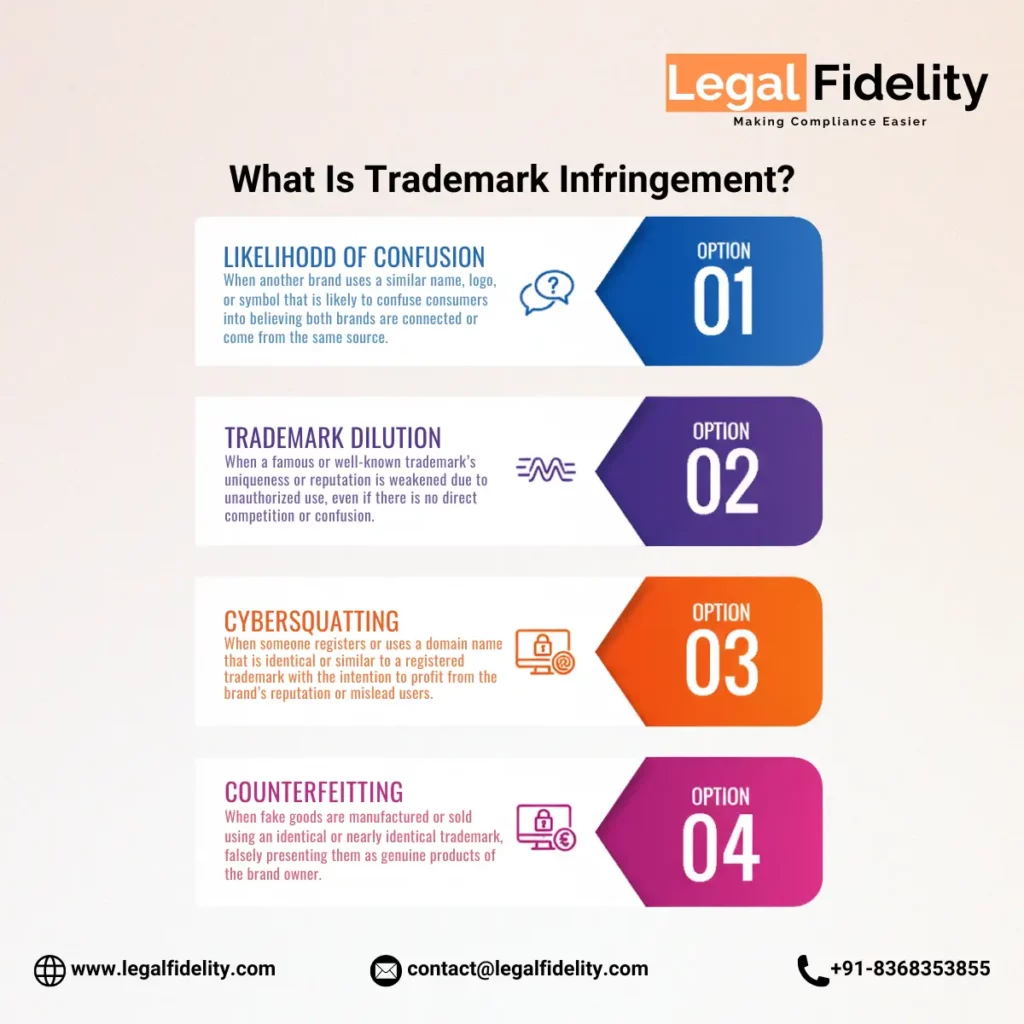
Registering a domain name that is identical or confusingly similar to a registered trademark is considered trademark infringement in India. The Delhi High Court established this principle in Yahoo! Inc. v Akash Arora (1999), which involved the domain name ‘yahooindia.com’.
If someone has registered a domain using your trademark, you can pursue civil remedies under the Trade Marks Act or file a complaint under ICANN’s Uniform Domain Name Dispute Resolution Policy (UDRP) or the INDRP for .in domains.
Social Media and Digital Advertising
Using a competitor’s registered trademark in social media handles, hashtags, or paid search advertising keywords can also constitute infringement if it causes consumer confusion or takes unfair advantage of the mark’s reputation. This is an emerging area of Indian trademark law.
| Digital Infringement Type | Legal Remedy Available |
| Counterfeit goods on e-commerce platforms | Civil suit + Takedown notice to platform + Criminal complaint |
| Domain name squatting (cybersquatting) | Civil suit in District/High Court + UDRP/INDRP complaint |
| Unauthorised use in social media handles | Civil suit + Platform complaint (Meta, LinkedIn, X) |
| Keyword advertising using competitor’s trademark | Civil suit under Section 29; ex-parte injunction possible |
| Fake app using registered trademark name | Civil suit + complaint to app store (Google Play, Apple) |
International Trademark Protection and the Madrid Protocol
If your business operates internationally, India is a signatory to the Madrid Protocol, administered by the World Intellectual Property Organization (WIPO). Through a single application, you can seek trademark registration in over 130 countries, including India.
For well-known international brands, the trans-border reputation doctrine (Whirlpool case, 1996) allows enforcement even before formal Indian registration, provided the mark has acquired goodwill among Indian consumers.
| International Protection Tips for Indian Businesses |
| File your trademark in India first through IP India (CGPDTM) before expanding internationally. |
| Use the Madrid Protocol to extend protection globally through a single WIPO application. |
| Record your trademark with Indian Customs to prevent import of infringing foreign goods. |
| Monitor international markets regularly using trademark watch services. |
How to Protect Your Trademark from Infringement
Prevention is always more cost-effective than enforcement. Here are practical steps every Indian business should take:
Register your trademark early
File your trademark application with IP India (CGPDTM) as early as possible. Registration gives you the exclusive statutory right to sue for infringement.
Conduct a prior art search
Before launching a brand name or logo, search the Trade Marks Registry to ensure you are not infringing on someone else’s mark.
Use the registered trademark symbol (®)
Once registered, always use the ® symbol to put the public on notice and strengthen your enforcement position.
Monitor the market regularly
Use trademark monitoring services or conduct periodic searches to detect unauthorised use at an early stage.
Record your trademark with Indian Customs
This enables customs officials to intercept infringing imported goods at ports of entry.
Include strong IP clauses in contracts
Ensure all manufacturing, licensing, distribution, and vendor agreements include clear clauses on trademark usage and protection.
Renew your trademark on time
Trademark registrations in India are valid for 10 years and must be renewed on time. A lapsed registration loses statutory protection.
Act quickly when infringement is detected
Take early action, usually starting with a cease and desist notice. This is far less expensive and more effective than pursuing a full trial later.
Conclusion: Protect Your Brand Before It Is Too Late
Trademark infringement in India is a serious legal and commercial risk. With Indian courts increasingly awarding significant damages, even a single instance of infringement can cost your business millions of rupees and years of litigation.
Its most important is to register your trademark early, monitor its use actively, and act decisively when you see it being misused. If you receive a notice, take it seriously, get legal advice, and respond strategically.
Indian intellectual property law has matured considerably. Courts are sending a clear signal through landmark judgments: brands will be protected, and infringers will face real consequences.