







+918368353855contact@legalfidelity.comITR season is open · File before 31 JulyFile Now →
4.8 · Average Google Rating

Section 8 Company Registration — the most credible NGO structure in West Bengal

A Section 8 Company is the most credible way to run an NGO in West Bengal — a company licensed by the ROC to pursue charitable objects, with no dividend to its members. We handle the licence and incorporation end-to-end, and take you through 12A and 80G so your NGO is tax-exempt and your donors get their deduction.

  • 2 Digital Signature Certificates (DSC) & 2 DIN for directors
  • Name approval and MOA/AOA with charitable objects
  • Section 8 licence from the ROC (Form INC-12)
  • Certificate of Incorporation with company PAN & TAN
  • 12A & 80G registration available with the Standard plan
10,000+
Happy Customers
70,000+
Services Completed
4.8
Average Google Rating
Free Consultation
Free expert call
Get started with Section 8 Company Registration in West Bengal

Our expert will connect with you for a detailed consultation.

Your info is safe. No spam, ever.
Free Consultation
100% Online Process
No Hidden Costs
Satisfaction Guaranteed
ISO 9001 Certified
Trusted by 10,000+ founders & businesses across India
AWSCarDekhoHDFCOYORapidoSwiggyTata PlayTestbookAWSCarDekhoHDFCOYORapidoSwiggyTata PlayTestbook
Overview

What is a Section 8 Company in West Bengal?

A Section 8 Company is a non-profit organisation registered under Section 8 of the Companies Act, 2013. It is formed to promote charitable objects such as education, science, art, commerce, sports, research, social welfare, religion and environmental protection, and it operates under a licence granted by the Registrar of Companies.

Unlike a Private Limited Company or an LLP, a Section 8 Company does not exist to make profits for its owners. It may earn a surplus, but that surplus must be reinvested in its charitable objects — no dividend can ever be paid to its members. Directors may draw a reasonable salary for services rendered, but they cannot share in the profits. There is no minimum capital requirement, and most states exempt or reduce stamp duty on the MOA and AOA for Section 8 companies.

A Section 8 licence pairs naturally with tax registrations: 12A exempts the NGO's own income from tax, and 80G lets donors claim a deduction on what they give. At LegalFidelity, a dedicated expert handles the whole process online — DSC and DIN, name approval, charitable-object MOA and AOA, the Section 8 licence, PAN and TAN — and files your 12A and 80G applications.

Governed by
Section 8, Companies Act, 2013
Min. directors
2 (private) · 3 (public)
Setup time
15–30 working days
Profit to members
None — no dividend allowed
Why it matters

Benefits of a Section 8 Company in West Bengal

Legal recognition

A licence from the ROC makes your NGO far more credible to donors and corporates than an unregistered group.

Tax exemptions (12A & 80G)

12A exempts the NGO's income from tax, and 80G lets your donors claim a deduction on what they donate.

CSR & government grants

Registered Section 8 companies can receive corporate CSR funding and apply for government grants and schemes.

Easier bank operations

Banks deal far more readily with a registered company — opening accounts and receiving large donations gets simpler.

No minimum capital, low stamp duty

Start with any amount of capital. Most states exempt or reduce stamp duty on the Memorandum and Articles of Association for Section 8 companies.

Limited liability

The company is a separate legal entity — the personal assets of its directors and members stay protected.

Eligibility

Who should register a Section 8 Company?

NGOs and non-profits working in education, health, environment or social welfare
Founders who want the most credible NGO structure for attracting institutional donors
Organisations planning to receive corporate CSR funding (which needs CSR-1 registration)
Charitable bodies that want 12A income-tax exemption and 80G benefits for their donors
Groups expecting foreign donations, who will additionally need FCRA registration
Foundations, associations and research bodies that must reinvest every rupee of surplus
Checklist

Documents required

Directors & members (KYC)

  • PAN card of every director and member
  • Aadhaar card of every director and member
  • Identity proof (Passport / Voter ID / Driving License)
  • Address proof (bank statement / utility bill, not older than 2 months)
  • Passport-size photograph of each director
  • Passport (mandatory for NRI / foreign national directors)

Registered office proof

  • Latest utility bill (electricity / water / gas)
  • Rent agreement (if the premises are rented)
  • NOC from the property owner

Section 8 licence documents

  • Two or three proposed company names
  • Statement of the charitable objects of the proposed company
  • Draft MOA (Form INC-13) and AOA
  • Estimated income and expenditure for the first three years
  • Declarations in Form INC-14 and INC-15
How it works

How Section 8 registration works

01

Fill the form

Fill the form above to get started and share your basic details.

02

Talk to an expert

Our registration expert calls you for a detailed consultation, collects your documents and drafts your charitable objects.

03

Get your licence

We obtain the Section 8 licence from the ROC and deliver your Certificate of Incorporation, PAN and TAN.

Ready to get your Section 8 Company Registration in West Bengal?

Talk to a Business Registration expert for free. Fixed quote upfront, no hidden costs.

Compare your options

Section 8 Company vs Trust vs Society

These are the three ways to structure an NGO in West Bengal. Here's how they compare.

Section 8 CompanyTrustSociety
Governed byCompanies Act, 2013Indian Trusts Act, 1882Societies Registration Act, 1860
Registered withROC (MCA)State sub-registrarState Registrar of Societies
Minimum members2 directors, 2 members2 trustees7 members
Governing documentMOA & AOATrust deedMOA & rules
Credibility with donorsHighestModerateModerate
12A & 80G eligibleYesYesYes
CSR funding eligibleYes, with CSR-1Yes, with CSR-1Yes, with CSR-1
Compliance burdenHigh — annual ROC filingsLowModerate
Best forNGOs seeking institutional & CSR fundingFamily or private charitiesMembership-driven local bodies
Why act now

Compliance you can't skip

A Section 8 Company is still a company, so annual ROC filings apply in full — and the licence itself is at stake if the charitable objects are misused.

₹100 per day

Late filing of the annual financial statements (AOC-4) or annual return (MGT-7) attracts ₹100 per day, per form, with no upper limit.

Licence revoked

The Central Government can revoke the Section 8 licence if the company's affairs are conducted fraudulently or against its charitable objects.

Exemption withdrawn

Failing to file the annual income tax return or the donation statement can cost you your 12A and 80G registrations.

Foreign funds blocked

Accepting foreign donations without FCRA registration is an offence and can freeze the NGO's funding entirely.

Questions answered

Frequently asked questions

The process normally takes 15 to 30 working days. The timeline depends on how quickly and accurately the documents are submitted and how fast the ROC processes the licence application.
You need at least 2 directors for a private Section 8 Company and 3 directors for a public Section 8 Company. At least one director must be a resident of India.
The company can earn a surplus, but it must be reinvested in the company's charitable objects. No profit or dividend can be distributed to its members or directors.
Yes. Directors can be paid a reasonable salary for services actually rendered, but they cannot receive any share of the profits as dividend. The remuneration must be consistent with the company's charitable objects.
12A exempts your NGO from paying income tax on its donations and grants. 80G lets your donors claim a tax deduction on the money they donate to your NGO. Both are filed with the Income Tax Department and are included in our Standard plan.
Yes. A Section 8 Company can accept donations from individuals and companies, and from foreign sources once it has FCRA approval. With 80G certification, your donors can claim a tax deduction on what they donate.
Yes. Even after registering under Section 8, you must apply under the Foreign Contribution (Regulation) Act (FCRA) to legally accept money from outside India.
Unlike other companies, a Section 8 Company has no minimum share capital requirement. You can start with any amount of capital.
Once granted, the Section 8 licence is valid for the lifetime of the company. It is only revoked if the company is misused or run contrary to its stated charitable objects.
No. The whole process is completed online through the MCA portal — you only need to send scanned copies of the documents. You do, however, need a genuine registered office address in West Bengal with valid proof such as a rent agreement and utility bill.

GST is not mandatory unless turnover crosses ₹20 lakh (₹10 lakh in special category states). You may still choose to obtain GST registration if a funder or client requires it, or if the NGO supplies services for a consideration.

Any individual, including an NRI or foreign national, can become a director in a Section 8 Company, provided they:

  • are a natural person
  • are over 18 years of age
  • hold a Director Identification Number (DIN)

At least one director must be a resident of India.

It is possible, but the process is long and requires special approval from the Central Government. Conversion is only permitted under specific conditions laid down in the Companies Act.
Yes. A Section 8 Company is a separate legal entity and can buy and hold property — land, buildings, equipment — in its own name.
Yes, where the thresholds are crossed. EPFO registration is required once the company employs 20 or more people, and ESIC registration once it employs 10 or more employees earning within the prescribed wage limits.
Our Section 8 plans start at ₹1,999 for the incorporation and licence, with 12A and 80G bundled into the Standard plan. Government fees are low, and most states exempt or reduce stamp duty on the MOA and AOA for Section 8 companies. Stamp duty is set by each state, so the final cost depends on where you incorporate and which registrations you add.
Still have questions? Talk to an expert
In depth

Section 8 Company Registration in West Bengal

What is a Section 8 Company?

A Section 8 Company is a special type of organization that you can register under the Companies Act of 2013 in India. It is set up with the objective to promote commerce, arts, science, education, research, social welfare, religion, charity, or any other useful objective.

The key features of Section 8 company is that profits made by the organization cannot be distributed among its members or shareholders. Instead, all profits are applied toward promoting the objectives of the company and are not distributed as dividends.

Why Register a Section 8 Company in West Bengal?

  • West Bengal is known as financial capital of India and home to thousands of NGOs and non-profits. Thus, it ensures continuous inflow of support such as funding, donations, and grants to the non profits.
  • The ROC in West Bengal is quite efficient and very responsive and therefore you will easily be able to get your non-profit registered and have all the paper work run very smoothly.
  • Maharashtra’s stamp duty policies are straightforward, making it hassle free to complete registration and legal formalities.
  • West Bengal is hub of a diverse set of professionals such as lawyers, accountants, and social workers, who can help you build and run your Section 8 Company efficiently.

Eligibility Criteria

  • You will need a minimum of 2 directors for private company or 3 directors for a public company.
  • At least One of these directors must be a resident of India, someone living in India for at least 182 days during the last year.
  • The company must have objectives that are clearly charitable or related to social welfare such as education, healthcare, poverty alleviation, etc.
  • Section 8 Company cannot distribute profits among its members. All profits should be reinvested toward promoting the objectives.

Required Documents for Section 8 Company Registration in West Bengal

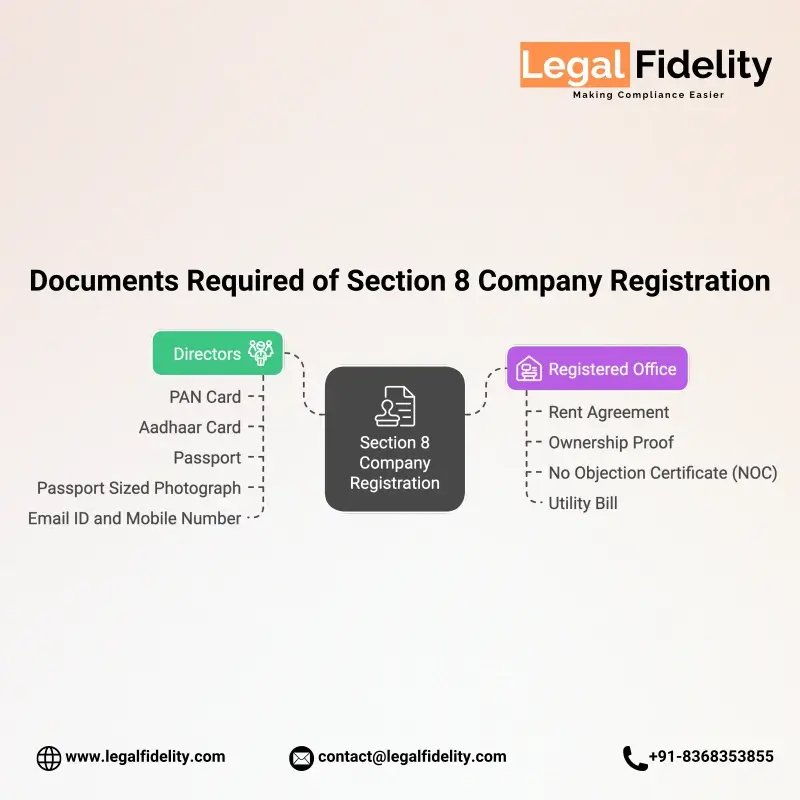
When you are planning to register a Section 8 Company in West Bengal, it is important to have all the necessary documents in place. Following are the list of mandatory documents required to apply Section 8 Company registration in West Bengal:

For Directors:

DocumentDescription
PAN CardMandatory for all directors and is required as ID Proof and tax purposes.
Aadhaar CardActs as proof of identity and residence.
PassportRequired if any of your directors are from outside India.
Passport Sized PhotographRequired for the application of each director.
Email ID and Mobile NumberValid and active for each director.

For Registered Office:

DocumentDescription
Rent AgreementIf the registered office is in a rented space, provide a copy of the rent agreement.
Ownership ProofIf owned, provide Sale Deed, Property Tax Receipt, or Title Deed as proof.
No Objection Certificate (NOC)Required if the property is owned by someone else. Must state permission to use as company’s registered office.
Utility BillElectricity, water, or gas bill not older than 2 months as proof of office address.

Documents Required for Section 8 Company Registration in West Bengal

Step-by-Step Registration Process for Section 8 Company Registration in West Bengal

  1. Obtain Digital Signature Certificate (DSC)
    All directors must get in hand their Digital Signature Certificate (DSC), which is required to sign electronic documents during the registration process.
  2. Apply for Director Identification Number (DIN)
    DIN is a unique identification number issued by the Ministry of Corporate Affairs (MCA) to every director. It is mandatory for all directors to have DIN and is applied through Form DIR-3. Generally, approval will take 2–3 days.
  3. Name Approval via SPICe+ Form
    Submit unique name for your section 8 company and submit approval request with MCA using the SPICe+ Part A form. Make sure the name clearly shows it is a non-profit organization.
  4. Draft MOA and AOA
    MOA and AOA are documents that support your organization and define the aims, policies and the way the organization is going to be managed.
  5. File Incorporation Forms
    Now submit all the forms on the MCA portal, including:
    • SPICe+ (INC-32), main application form
    • INC-12 form to get the license to operate as a non-profit
    • Declaration by directors in INC-9
    • For GST, PF, ESI, bank account, etc. use AGILE-PRO-S.
  6. Get License & Certificate of Incorporation
    Once everything is in place and application is approved, you will receive:
    • Section 8 License in form INC-16
    • Certificate of Incorporation (COI)
    • Tax and legal PAN and TAN of the company

Fees for Section 8 Company Registration in West Bengal

Government Fees:

  • These are the formal fees which are paid directly to the Ministry of Corporate Affairs and other departments.
  • Stamp Duty: These are state government charges depending on the authorized capital and state of your company.
  • License Fee for INC-12: The government does not charge any license fee for issuing a Section 8 license.
  • MCA Form charges: Standard filing fees for forms like SPICe+ (INC-32), INC-9, AGILE-PRO-S, etc based on the capital structure.

Professional Charges:

If you hire Professionals like Legalfidelity’s CA, CS, or legal expert to help with the process, charges may range between Rs. 4,999 to Rs. 25,000 or more. Varies by experience of the service provider for:

  • Drafting MOA & AOA
  • Filing forms
  • DSC/DIN, PAN/TAN, and GST
  • End to end support

Time Required for Section 8 Company Registration in West Bengal

StepEstimated Time
Name Approval2–3 working days
License Issuance7 to 10 working days
Company Registration (COI)2–3 working days after issuance of license
Total Duration15–20 days (approx.)

Post-Incorporation Compliance for Section 8 Company Registration in West Bengal

Once your Section 8 Company is officially registered with MCA, there are a some crucial steps you must follow to stay compliant with the applicable law:

  • File annual returns with ROC
    Every year, Section 8 company need to intimate the government in AOC-4 and MGT-7, about how your company is doing.
    • Form AOC-4 – Shows your financials. Due 30 days after AGM
    • Form MGT-7 – Yearly report. Due 60 days after AGM
  • Conduct statutory audits
    Every year, your financial records like income, donations, expenses, etc. must be checked and certified by a Chartered Accountant (CA).
    This is called statutory audits. It avoids fraud and keeps your accounts legal.
  • Maintain proper books of accounts
    You must keep proper records of everything related to money like donations received, expenses made, Bank transactions, and any purchases or payments made in a software or manual ledger.
    It makes filing returns, audits, and government checks easier and more transparent.
  • Apply for 80G and 12A registration for tax exemption
    If you want your company to save on taxes, and your donors to get tax benefits. You must apply for:
    • 12A – To claim exemptions for your company from paying income tax
    • 80G – Allows donors to claim tax deductions on their donation while paying income tax
  • Hold Annual General Meetings (AGMs)
    Each year, you must conduct a formal meeting with your company’s members, directors, founders, etc. to discuss the progress of the company, review financials and approve important decisions.
    This meeting must be held by 30th September every year after the financial year ends on 31st March.

Advantages of Section 8 Company Registration in West Bengal

These are the reasons why many people choose to register a Section 8 Company for social or charitable purposes:

  • Tax Benefits under 80G and 12A
    If your company is registered under Section 12A, it does not have to pay income tax on donations received. If you have 80G approval, your donors can also claim tax deductions while paying income tax on the donations they give to you.
  • No minimum capital requirement
    You do not require to have any fixed amount of money as capital contribution to start a Section 8 Company.
  • Increased credibility among donors
    Since a Section 8 Company is closely controlled by the government, it is considered more transparent and reliable. Donors, grant agencies, and even international funders trust these companies more than other groups or unregistered NGOs.
  • Separate legal entity
    It is able to purchase property, open bank accounts and enter into contracts not in the name of directors or the founders, but in its own name.
  • Limited liability for members
    If anything goes wrong financially, the personal money or property of members and directors is not at risk. You are only responsible up to the amount you contributed or guaranteed to the company.

Disadvantages of Section 8 Company Registration in West Bengal

  • Cannot distribute profits
    Section 8 company are not allowed to take out profits or earnings for personal use. All income must be reinvested to promote your charitable purpose like education, health, or environment.
  • Requires regular compliance
    You have to submit annual returns within AOC-4 and MGT-7, conduct AGMs, keep adequate records yearly. Failing to meet deadlines may result in penalty, or even, directors can be disqualified.
  • Strict scrutiny from ROC
    Because it is a regulated structure, your activities may be closely watched by the Registrar of Companies and Income Tax Department.
  • More paperwork than Trust/Society
    A Section 8 Company has greater legal formalities, and greater form filings and rules to complied with compared to a Trust or Society.

Seeking professional help like LegalFidelity, helps you to focus on your motive to contribute to society and we will manage everything smoothly.

Conclusion

Starting a Section 8 Company in West Bengal is a great way to make a long term impact in society.

Due to its formal legal structure and various tax benefits for company and donors such as 80G & 12A, it gains more trust from individuals, corporates, and government bodies to stay financially healthy.

All the paperwork and compliances may be quite stressful, yet with the correct guidance and planning, it can be made quite manageable.

Hiring professionals like LegalFidelity helps you achieve smooth and stress-free registration.

Who does the work

A verified network of CAs, CS and lawyers

Every filing is prepared and reviewed by a qualified professional — never a bot, never an intern.

CA

Chartered Accountants

GST, ITR, audits, bookkeeping and tax planning — handled by practising CAs with startup experience.

GST & returnsTax planningAudit support
CS

Company Secretaries

Incorporations, ROC filings, board resolutions and secretarial compliance, done right the first time.

IncorporationROC filingsGovernance
ADV

Lawyers & IP Attorneys

Trademarks, agreements, licences and legal notices — drafted and filed by experienced advocates.

Trademark & IPContractsLicences
Every professional on our panel is verified — membership numbers checked with ICAI, ICSI and Bar Council records.
Trusted by founders across India

What Our Clients Say

LegalFidelity made starting my business incredibly simple. Their step-by-step guidance and expert support were invaluable — from name approval to my first GST return, one team handled everything.

The most reliable legal service platform. They handled all our compliance needs efficiently and professionally.

Their expertise in business registration and compliance saved us countless hours. Highly recommended!

Free consultation · No obligation

Talk to a Startup Expert. Free. Today.

Tell us what you're building. We'll tell you exactly what you need, what it costs, and how long it takes — before you pay a rupee.

Fixed, all-inclusive quote upfront
Callback within 30 minutes, 9am–9pm
Advice from a qualified CA / CS — not a sales rep
Free Consultation

Get your free expert call

Our Startup Expert will connect with you for a detailed consultation.

Your info is safe. No spam, ever.