








+918368353855contact@legalfidelity.comITR season is open · File before 31 JulyFile Now →
4.8 · Average Google Rating

LLP Registration — partnership flexibility, limited liability in Pune

A Limited Liability Partnership gives you the flexibility of a partnership with the limited liability protection of a company — and far lighter compliance than a Private Limited. We handle your incorporation end-to-end, from DSC and name approval to the Certificate of Incorporation and LLP Agreement.

  • 2 Digital Signature Certificates (DSC) for designated partners
  • 2 Designated Partner Identification Numbers (DPIN)
  • LLP name approval & FiLLiP filing with MCA
  • LLP Agreement drafting and filing
  • Certificate of Incorporation with LLP PAN & TAN
10,000+
Happy Customers
70,000+
Services Completed
4.8
Average Google Rating
Free Consultation
Free expert call
Get started with Limited Liability Partnership (LLP) in Pune

Our expert will connect with you for a detailed consultation.

Your info is safe. No spam, ever.
Free Consultation
100% Online Process
No Hidden Costs
Satisfaction Guaranteed
ISO 9001 Certified
Trusted by 10,000+ founders & businesses across India
AWSCarDekhoHDFCOYORapidoSwiggyTata PlayTestbookAWSCarDekhoHDFCOYORapidoSwiggyTata PlayTestbook
Overview

What is a Limited Liability Partnership (LLP) in Pune?

A Limited Liability Partnership (LLP) is a popular business structure in Pune that combines features of both a Partnership Firm and a Private Limited Company. The Limited Liability Partnership Act, 2008 introduced it to protect partners from unlimited liability while preserving the flexibility of a partnership and giving the business its own legal identity.

An LLP is a separate legal entity from its partners — it can own property, sign contracts and sue in its own name, and it enjoys perpetual succession. Partners' personal assets stay protected: the LLP is responsible for its own debts. It needs a minimum of 2 designated partners (at least one resident in Pune), has no maximum limit on partners, and no minimum capital requirement.

Because of its simple formation process, lighter compliance burden and tax benefits — including no Dividend Distribution Tax — an LLP is an attractive structure for professionals, service-based startups and small businesses. At LegalFidelity, a dedicated expert handles the entire process online: DSC and DPIN for the partners, name approval, FiLLiP filing and the LLP Agreement.

Governed by
LLP Act, 2008
Min. partners
2 designated partners
Setup time
7–15 working days
Best for
Professionals & service-based businesses
Why it matters

Benefits of an LLP in Pune

Limited liability protection

Partners' personal assets are protected — the LLP is liable for its own debts, unlike a traditional partnership firm.

Separate legal entity

The LLP can own assets, sign contracts and sue or be sued in its own name, independent of its partners.

Lower compliance burden

Far fewer filings and formalities than a Private Limited Company — no mandatory board meetings or AGMs.

Tax benefits

No Dividend Distribution Tax when profits are distributed to partners, giving a lower tax burden than a company.

Perpetual succession

The LLP continues to exist even if partners die, retire, leave or are declared insolvent.

No minimum capital

Start with any amount of contribution — there is no minimum capital requirement under the LLP Act.

Eligibility

Who should register an LLP?

Professionals such as CAs, lawyers, architects and consultants setting up a firm
Service-based startups and small businesses that want limited liability without heavy compliance
Two or more partners who want a separate legal identity for the business
Existing partnership firms looking to convert and protect partners' personal assets
NRIs and foreign nationals partnering with at least one India-resident designated partner
Checklist

Documents required

Designated partners (KYC)

  • PAN card of every partner
  • Aadhaar card of every partner
  • Identity proof (Passport / Voter ID / Driving License)
  • Address proof (bank statement / utility bill, not older than 2 months)
  • Passport-size photograph of each partner
  • Passport (mandatory for NRI / foreign national partners)

Registered office proof

  • Latest utility bill (electricity / water / gas)
  • Rent agreement (if the premises are rented)
  • NOC from the property owner

LLP details

  • Two or three proposed LLP names
  • Nature of the proposed business activity
  • Capital contribution of each partner and profit-sharing ratio
How it works

How LLP registration works

01

Fill the form

Fill the form above to get started and share your basic details.

02

Talk to an expert

Our startup expert calls you for a detailed consultation and collects your documents.

03

Get incorporated

We file FiLLiP with the MCA and deliver your Certificate of Incorporation and LLP Agreement.

Ready to get your Limited Liability Partnership (LLP) in Pune?

Talk to a Business Registration expert for free. Fixed quote upfront, no hidden costs.

Compare your options

LLP vs Private Limited vs Partnership Firm

Not sure which structure fits? Here's how an LLP compares to the popular alternatives.

LLPPrivate LimitedPartnership Firm
Members required2 or more2 to 2002 or more
Separate legal entityYesYesNo
Limited liabilityYesYesNo — unlimited
Minimum capitalNoneNoneNone
Raise equity fundingNoYesNo
Compliance burdenModerateHighLow
Governed byLLP Act, 2008Companies Act, 2013Partnership Act, 1932
Best forProfessional & service firmsStartups raising fundsSmall local businesses
Why act now

Compliance you can't skip

An LLP is lighter on compliance than a company, but the penalties for missing a filing are steep and have no upper limit — they keep accruing until you file.

₹100 per day

Late filing of the annual return (Form 11) or Statement of Account & Solvency (Form 8) attracts ₹100 per day, per form, with no maximum cap.

No upper limit

The daily penalty continues to accrue until the filing is actually completed — a long-forgotten form can cost lakhs.

Filing due even at zero turnover

Form 8 and Form 11 must be filed every year even if the LLP had no business activity at all during the year.

Legal action or dissolution

Continued non-compliance with MCA guidelines can invite legal action against the partners or dissolution of the LLP.

Questions answered

Frequently asked questions

LLP registration is the legal process of incorporating a Limited Liability Partnership under the Limited Liability Partnership Act, 2008 in Pune.
To get registered as an LLP takes 7 to 15 working days, depending on how fast the documents are completed, verified and approved by the MCA.
A minimum of 2 partners are required to form an LLP as per the LLP Act, 2008. There is no maximum limit on the number of partners in an LLP.

No, an LLP must have a minimum of two designated partners to be registered, and there is no maximum limit on how many partners an LLP can have. If you are a single entrepreneur, consider a One Person Company (OPC) or a Sole Proprietorship instead.

Any startup or entrepreneur can register an LLP, as there is no minimum capital requirement in the rules. A business can be registered as an LLP with any amount of contribution.

Any individual, company, foreign entity or NRI can become a partner in an LLP. The designated partner must be a natural person above 18 years of age and of sound mind. The law mandates that an LLP must have at least one designated partner who is an Indian resident.
Yes, an NRI or Foreign National can be a partner in an LLP. The only requirement is that at least one Designated Partner should be a resident of India.
No, at LegalFidelity.com the LLP registration process is completely online. You just need to send scanned copies of all the documents required for the incorporation.
Yes, you can register an LLP at your residence. You only need to submit any utility bill along with a No Objection Certificate (NOC) from the owner.

There are 5 important steps in the LLP registration process:

  1. Getting the DSC & DPIN for the designated partners of the LLP.
  2. Reservation and approval of the name of the LLP from the MCA.
  3. Preparation of the necessary documents and drafting of the LLP Agreement to submit with the MCA.
  4. Submission of the FiLLiP form for incorporation.
  5. Receiving the Certificate of Incorporation and filing the LLP Agreement in Form 3.
The MCA grants a DPIN (Designated Partner Identification Number) to individuals who want to take a position as designated partners in an LLP. This unique identification number consists of 8 digits and has lifetime validity unless deactivated.

Unlike a traditional partnership firm, an LLP provides limited liability protection to its partners and has a separate legal identity from its partners.

The choice of business structure depends on your business model and future expansion plans.

  • An LLP is suitable for small businesses and professional firms due to lower compliance costs.
  • A Private Limited Company is better for startups looking for funding and offers better scalability.

LLPs are not required to pay Dividend Distribution Tax (DDT) when the LLP distributes profits to its partners. An LLP therefore has a lower tax burden compared to private companies.

No, an LLP is not allowed to raise equity funding from investors as it does not issue shares, unlike a Private Limited Company.
Yes. As an LLP is a legal entity separate from its partners, it can buy or sell assets, land and property in its own name.
The LLP, being a separate legal entity before the law, is responsible for its own debts. The personal assets of the partners remain secure unless they have given personal guarantees.

Yes. Every LLP must file its annual return (Form 11) and Statement of Account & Solvency (Form 8) with the MCA, as well as its income tax return — even if there was no business activity during the year.

If an LLP fails to comply with the MCA guidelines, a penalty starting from ₹100 per day can be levied with no upper limit. Legal action or dissolution of the LLP can be ordered by the MCA.

  • LLPs cannot raise equity capital from investors, as they do not have share capital like a Private Limited Company.
  • Higher penalties for non-compliance (₹100 per day) which continue until the filing is completed.
  • LLPs are not suitable for businesses or startups focused on large-scale fundraising or an eventual IPO.

Yes, an LLP is a go-to option for service-based startups and small businesses due to their fewer compliance requirements, lower cost and limited liability protection. Startups planning to raise equity funding should consider a Private Limited Company instead.

Yes, FDI (Foreign Direct Investment) is allowed in an LLP, subject to the applicable sectoral conditions.

Yes, one can be a partner in an LLP, a Director of a Private Limited Company or an OPC even if already employed. There are no such restrictions. However, you must ensure that your employment agreement does not contain any restriction on becoming a Director of a company or a Partner in an LLP.

Yes, the conversion of a Partnership Firm to an LLP is possible.

Yes, the conversion of an LLP into a Private Limited Company can be done by following the rules and regulations provided by the MCA. Approval for the conversion is provided by the MCA and ROC.

GST is required once the LLP exceeds the threshold limit. LLPs engaged in the supply of goods whose yearly turnover exceeds ₹40 lakhs (₹20 lakh for special category states), and in services whose turnover exceeds ₹20 lakhs (₹10 lakh for special category states) in a financial year, must obtain GST registration.

The cost of LLP registration depends on various factors: professional fees, government charges, the number of partners and the state of incorporation. Government fees are calculated on a contribution of ₹1,00,000, and stamp duty on the LLP Agreement is borne by the applicant.

Once an LLP is successfully registered, it has perpetual succession. It continues to exist even if one or more partners die, retire, leave or are declared insolvent, so the continuity of the LLP is not affected by a change in its partners.

Still have questions? Talk to an expert
In depth

LLP Registration in Pune

A Limited Liability Partnership (LLP) in Pune is a business structure that combines the benefits of both Private Limited and partnership. It offers benefits like limited liability to its Partners which means personal assets are not at risk in event of business incur losses. Its also provide flexibility in managing the business operations. Therefore, This makes it popular choice among the new Startups, freelancers, and small businesses.

Key Features of an LLP in Pune

  1. Separate Legal Entity : An LLP is considered as seperate legal entity in the eyes of the law. It can take its own decisions, own property in name of LLP, and be responsible for its own decisions.
  2. Limited Liability: Partners are only liable for the business’s debts up to the amount they have invested. This means their personal savings or assets of partners are safe.
  3. Fewer Compliance Requirements: In comparison to Private limited, an LLP has to follow fewer rules and regulations, making it easier and less expensive to keep LLP compliant. as per the requirements
  4. No Minimum Capital Requirement: There is no mandatory capital requirement to start the business as LLP. You can start your business with any amount of capital you may think.
  5. Tax Benefits: LLP specifically exempt from tax on distribution of profits to its partners. Therefore, there is no dividend distribution tax, when the LLP distributes profits to its partners. This feature makes it more tax-friendly than other business types.
  6. Flexibility in Management: Unlike Private Limited companies, there is no mandatory requirement to conduct board meetings. LLPs are managed by the Partners themselves.
  7. Easy to Scale: As your business of LLP grows, you can easily add more partners and expand your operations without a lot of hassle.

Benefits of Registering an LLP in Pune

  1. Limited Liability Protection – In case LLP incurs losses, Partners are not personally liable for the debts of business, therefore Partner are only liable for their contribution, it means personal assets of partners are safe from business risks and debts.
  2. Separate Legal Identity – In the eye of law, LLP and its partners are considered as separate form each other. The Feature of Separate legal entity enhances business trustworthiness and market standing to enter contracts in the LLP’s name.
  3. Lower Compliance Costs – LLPs has less rules and regulation to comply with as compared to private limited. Fewer filings and statutory obligations make it more attractive to choose as business structure by new startup and small business.
  4. Easy Transfer of Ownership – Unlike Private limited where ownership can be transferred by selling shares to investors. In LLP, ownership can only be transferred through hassle-free process by making changes to the LLP agreement, such as Adding or removing partners.
  5. Flexible Management – LLP provides liberty to Partners through LLP Agreement by deciding mutually their terms of operation, profit sharing and responsibilities. There is no need to conduct Board meeting compared to Private limited.
  6. Attractive for Professionals – LLP is an ideal choice for consultants, accountants, and legal practitioners. Numerous benefits like limited liability by protecting personal assets and ease of doing business, making it easier to operate the business
  7. Perpetual Succession – LLP continues to exists indefinitely regardless of whether one or more partner dies, retires, leave or declared insolvent. The continuity of LLP does not get affect by change in its Partners.
  8. Ideal for Small & Medium Businesses – Choosing LLP over other business types are a cost-effective solution for small and medium-sized businesses. It provides a simple structure with lesser compliances and lower costs compared to other business types.
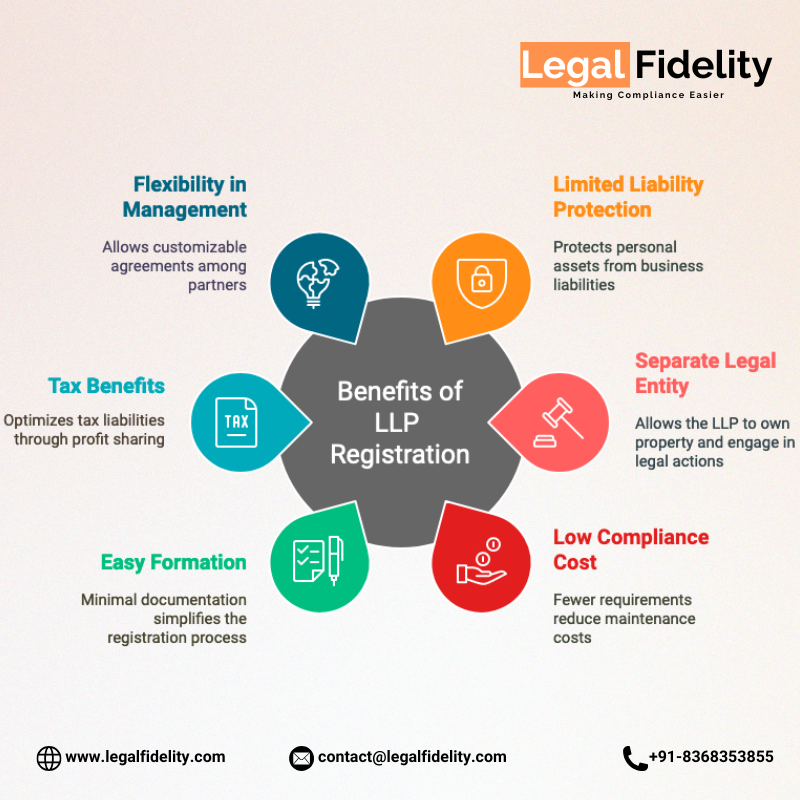
Benefits of LLP Registration in Pune

Step-by-Step Process for LLP Registration in Pune

1. Obtain Digital Signature Certificate (DSC)

All Partners must obtain (DSC) Digital Signature Certificate. It is an electronic signature from issued by certified authorities to file applications online. It is a mandatory to have DSC to validate the documents submmited and digital filing process.

2. Apply for Designated Partner Identification Number (DPIN)

It is mandatory for each partner to obtain a DPIN from Ministry of Corporate Affairs (MCA). Every partner must apply for DPIN by filling out the DIR-3 form and unique identification number will be issued by the Ministry of Corporate Affairs (MCA).

3. Name Reservation with RUN-LLP

Choose a unique LLP name which must be must be unique and not identical or similar to any existing business. Application for reservation filled through the RUN-LLP portal on the MCA website. The LLP name must comply with naming guidelines issued by MCA and name should end with “LLP” or “Limited Liability Partnership

4. File Incorporation Documents

Once the name approved by MCA, you need to file the FiLLiP Form for LLP incorporation to the Registrar of Companies (RoC) for incorporation through MCA Portal. The Documents must attached with the form are Partners’ and Designated Partners’ details, ID proof and address proof of all partners, Proof of the registered office address, DSC of the designated partners.

5. Draft and File LLP Agreement

Once the Incorporation Certificate is issued, An LLP Agreement must be filed with the Registrar of Companies (RoC) within 30 days of incorporation. The LLP Agreement is a key document that includes the Roles and responsibility of the partnership, including profit-sharing ratios, and their roles in managing the business.

6. Obtain LLP Incorporation Certificate

Once you will the Certificate of Incorporation, the LLP recognized as a registered business entity. The certificate includes details like Registration number, Registered office address and other essential details.

7. PAN & TAN Application

After incorporation must apply for a Permanent Account Number (PAN) and Tax Deduction and Collection Account Number (TAN) for tax filing purposes.

8. Bank Account Opening

Once you have all the documents like incorporation documents and PAN Card. You must apply to open a business bank account in the Name of LLP for financial transactions.

9. GST Registration ( If applicable)

GST registration is mandatory for businesses that whose annual turnover is exceeding ₹40 lakhs (₹20 lakhs for special category states).

10. Compliance Setup & Business Operations

After registration, ensure that you must comply with Regular filing of tax returns, annual compliance forms, and keep proper records.

Documents Required for LLP Registration in Pune

  1. PAN Card and Aadhar Card of partners
  2. Address Proof can be water bill, electricity Bill, rent agreement, or passport
  3. Registered Office Address Proof can be Electricity bill, property deed, or lease agreement
  4. No Objection Certificate (NOC) from the property owner if registered office is rented
  5. Apply for Digital Signature Certificate (DSC) and Designated Partner Identification Number for all partners
  6. LLP Agreement outlying the Terms and Condition, Role and responsibility of partners and profit sharing ration etc.

LLP Registration in Pune Fees

The LLP registration cost in Pune varies depending on professional fees and government charges. On an average the cost is 5000-10000

Time Taken for LLP Registration in Pune

The time frame for LLP registration in Pune generally takes around 7 to 15 working days, but this can vary based on several factors like name approval, documentation requirements, ROC approval after submitting the Incorporation form etc.

Post-Registration Compliances for LLPs in Pune

After successfully registering an LLP in Pune, there are various legal and financial obligations that must be comply with to keep the business compliant with the law. here is the complete guide related to legal requirements:

  1. Annual Returns (Form 11) – Every LLP must file an Annual Return with the Registrar of Companies (RoC) by May 30th each year. Return includes information about LLP, such as the Details of partners, their capital contribution, and any changes in business structure.
  2. Statement of Accounts & Solvency (Form 8) – Every LLP is required to file the Statement of Accounts & Solvency by October 30th every year. This form includes detail like assets and Liability and profit & loss statements. It also shows whether the LLP is solvent.
  3. Income Tax Filing – It is mandatory for LPP to file Income tax, just like other businesses.
  4. GST Registration (if applicable) – GST registration is mandatory for businesses that whose annual turnover is exceeding ₹40 lakhs (₹20 lakhs for special category states).
  5. Auditing (if applicable) – Audit is mandatory for LLP whose turnover exceeds ₹40 lakhs or capital exceeds ₹25 lakhs in a financial year.
  6. Event-Based Filings – LLPs are required to notify MCA for Addition or removal of partners, change in capital contribution or registered office.
  7. Compliance with LLP Act – It is necessary for LLPs to comply with the regularly requirement of laws. This includes keeping proper records, LLP agreements, and any other.

LegalFidelity, offers complete professional guidance throughout the entire registration process from start to finish to ensure your business successes fully gets registered. We are here to make your journey seamless and hassle-free with our expert guidance.

Conclusion

LLP registration in Pune offers a good choice for Emerging entrepreneurs, new startups and freelancers with small businesses. LLP offers limited liability protection to its partners and fewer compliance regulations makes it great choice to choose as business structure. Keeping the LLP compliant with both registration rules and post-registration requirements enables LLPs to achieve success in the progressing Indian market.

Who does the work

A verified network of CAs, CS and lawyers

Every filing is prepared and reviewed by a qualified professional — never a bot, never an intern.

CA

Chartered Accountants

GST, ITR, audits, bookkeeping and tax planning — handled by practising CAs with startup experience.

GST & returnsTax planningAudit support
CS

Company Secretaries

Incorporations, ROC filings, board resolutions and secretarial compliance, done right the first time.

IncorporationROC filingsGovernance
ADV

Lawyers & IP Attorneys

Trademarks, agreements, licences and legal notices — drafted and filed by experienced advocates.

Trademark & IPContractsLicences
Every professional on our panel is verified — membership numbers checked with ICAI, ICSI and Bar Council records.
Trusted by founders across India

What Our Clients Say

LegalFidelity made starting my business incredibly simple. Their step-by-step guidance and expert support were invaluable — from name approval to my first GST return, one team handled everything.

The most reliable legal service platform. They handled all our compliance needs efficiently and professionally.

Their expertise in business registration and compliance saved us countless hours. Highly recommended!

Free consultation · No obligation

Talk to a Startup Expert. Free. Today.

Tell us what you're building. We'll tell you exactly what you need, what it costs, and how long it takes — before you pay a rupee.

Fixed, all-inclusive quote upfront
Callback within 30 minutes, 9am–9pm
Advice from a qualified CA / CS — not a sales rep
Free Consultation

Get your free expert call

Our Startup Expert will connect with you for a detailed consultation.

Your info is safe. No spam, ever.